

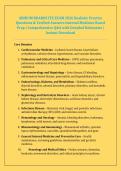
ABIM IM BOARDS ITE EXAM 2026 Realistic Practice
Questions & Verified Answers Internal Medicine Board
Prep | Comprehensive Q&A with Detailed Rationales |
Instant Download
Core Domains
1. Cardiovascular Medicine – Ischemic heart disease, heart failure,
arrhythmias, valvular disease, hypertension, and vascular disorders.
2. Pulmonary and Critical Care Medicine – COPD, asthma, pneumonia,
pulmonary embolism, interstitial lung disease, and mechanical
ventilation.
3. Gastroenterology and Hepatology – Liver disease, GI bleeding,
inflammatory bowel disease, pancreatitis, and hepatobiliary disorders.
4. Endocrinology, Diabetes, and Metabolism – Diabetes mellitus,
thyroid disorders, adrenal disorders, pituitary disorders, and metabolic
bone disease.
5. Nephrology and Electrolyte Disorders – Acute kidney injury, chronic
kidney disease, electrolyte disturbances, acid-base disorders, and
glomerular diseases.
6. Infectious Disease – Bacterial, viral, fungal, and parasitic infections;
antimicrobial therapy; HIV/AIDS; and infection control.
7. Hematology and Oncology – Anemia, bleeding disorders, leukemias,
lymphomas, solid tumors, and cancer screening.
8. Rheumatology and Immunology – Rheumatoid arthritis, systemic
lupus erythematosus, vasculitis, spondyloarthropathies, and gout.
9. General Internal Medicine and Preventive Care – Health
maintenance, screening guidelines, immunization, and geriatric
medicine.
10. Neurology and Medical Ethics – Stroke, seizures, dementia,
headache, movement disorders, and ethical principles in medicine.
,SECTION 1: CARDIOVASCULAR MEDICINE (Questions 1-15)
1. A 72-year-old man with a history of hypertension and hyperlipidemia
presents to the emergency department with sudden onset, severe
tearing chest pain radiating to the back. On examination, blood pressure
is 170/95 mmHg in the right arm and 110/70 mmHg in the left arm. A
diastolic murmur is heard at the left upper sternal border. Chest X-ray
shows a widened mediastinum. What is the appropriate next step in
diagnosis?
A. Transesophageal echocardiography
B. CT angiography of the chest with contrast
C. Transthoracic echocardiography
D. Aortic arch angiography
Rationale: The presentation of acute severe tearing chest pain, asymmetric
blood pressures, a diastolic murmur, and a widened mediastinum is
characteristic of acute aortic dissection. CT angiography of the chest with
contrast is the test of choice because it is rapid, widely available, and can
visualize the intimal flap, extent of dissection, and involvement of branch
vessels. TEE is highly sensitive but may not be immediately available.
Transthoracic echocardiography has lower sensitivity. Conventional
angiography is invasive and not first-line.
2. A 54-year-old woman with a 40-pack-year smoking history presents
with persistent cough and dyspnea. Spirometry reveals an FEV1/FVC
ratio of 0.65. Post-bronchodilator FEV1 improves by 15% and 300 mL.
Which of the following is the most likely diagnosis?
A. Asthma
B. Chronic obstructive pulmonary disease (COPD)
C. Pulmonary embolism
D. Pneumonia
Rationale: The patient has a significant smoking history and an FEV1/FVC
ratio <0.70, which is consistent with COPD. The 15% improvement (≥12% and
≥200 mL) suggests a bronchodilator response, which can occur in COPD
(especially with an asthma-COPD overlap). However, the presence of a
smoking history and fixed airflow obstruction points toward COPD as the
primary diagnosis.
,3. A 68-year-old male with a history of myocardial infarction 3 years ago
presents with progressive dyspnea on exertion, orthopnea, and bilateral
lower extremity edema. On examination, JVP is elevated, S3 gallop is
present, and crackles are heard at the lung bases. An echocardiogram
reveals an ejection fraction of 30%. Which medication is most likely to
reduce mortality in this patient?
A. Digoxin
B. Hydralazine
C. Carvedilol
D. Amlodipine
Rationale: The patient has heart failure with reduced ejection fraction
(HFrEF). Carvedilol (a beta-blocker) has been shown to reduce mortality in
patients with HFrEF. Digoxin reduces hospitalizations but not mortality.
Hydralazine and isosorbide dinitrate are beneficial in African American
patients with HFrEF. Amlodipine is not associated with mortality benefit in
HFrEF.
4. A 62-year-old woman with hypertension and diabetes is started on
lisinopril. One week later, she presents with a dry cough. What is the
most appropriate next step?
A. Continue lisinopril and add a cough suppressant
B. Switch to losartan
C. Add a beta-blocker
D. Switch to an angiotensin receptor blocker (ARB)
Rationale: The dry cough is a classic side effect of ACE inhibitors due to
increased bradykinin levels. Switching to an ARB (e.g., losartan) is the most
appropriate next step, as ARBs have a lower incidence of cough.
5. A 55-year-old male with a history of hyperlipidemia and hypertension
presents with substernal chest pain at rest associated with diaphoresis
and nausea. ECG shows ST-segment elevation in leads V1-V4. What is the
immediate management priority?
A. Sublingual nitroglycerin
B. Oral aspirin
C. Intravenous heparin
D. Emergency percutaneous coronary intervention (PCI)
Rationale: The patient is having an ST-elevation myocardial infarction
, (STEMI). The immediate priority is reperfusion, and PCI is the preferred
method if available within 90 minutes of first medical contact. Aspirin and
heparin are important adjuncts but do not reperfuse the artery.
6. A 75-year-old female with a history of hypertension and diabetes
presents with palpitations and lightheadedness. ECG reveals atrial
fibrillation with a ventricular rate of 150 bpm. She is hemodynamically
stable. What is the most appropriate initial management?
A. Immediate cardioversion
B. Rate control with beta-blocker or calcium channel blocker
C. Warfarin loading
D. Amiodarone infusion
Rationale: In hemodynamically stable patients with atrial fibrillation and
rapid ventricular response, rate control with beta-blockers or non-
dihydropyridine calcium channel blockers is the initial approach. Rhythm
control is generally reserved for symptomatic patients or those who fail rate
control.
7. A 65-year-old male with a history of coronary artery disease is started
on atorvastatin 80 mg daily. Which laboratory test should be monitored
at baseline and periodically?
A. Creatinine
B. Liver function tests (ALT, AST)
C. Complete blood count
D. Thyroid function tests
Rationale: Statins can cause hepatotoxicity; liver function tests should be
checked at baseline and as clinically indicated. Routine monitoring of CK is not
recommended unless the patient develops muscle symptoms.
8. A 58-year-old male with hypertension and diabetes has a blood
pressure of 148/92 mmHg on lisinopril 20 mg daily. His home blood
pressure readings are consistently elevated. What is the most
appropriate next step?
A. Increase lisinopril to 40 mg daily
B. Add a diuretic (HCTZ)
C. Add a calcium channel blocker (amlodipine)
D. All of the above
Rationale: For patients not at goal on an ACE inhibitor, adding a diuretic or
Questions & Verified Answers Internal Medicine Board
Prep | Comprehensive Q&A with Detailed Rationales |
Instant Download
Core Domains
1. Cardiovascular Medicine – Ischemic heart disease, heart failure,
arrhythmias, valvular disease, hypertension, and vascular disorders.
2. Pulmonary and Critical Care Medicine – COPD, asthma, pneumonia,
pulmonary embolism, interstitial lung disease, and mechanical
ventilation.
3. Gastroenterology and Hepatology – Liver disease, GI bleeding,
inflammatory bowel disease, pancreatitis, and hepatobiliary disorders.
4. Endocrinology, Diabetes, and Metabolism – Diabetes mellitus,
thyroid disorders, adrenal disorders, pituitary disorders, and metabolic
bone disease.
5. Nephrology and Electrolyte Disorders – Acute kidney injury, chronic
kidney disease, electrolyte disturbances, acid-base disorders, and
glomerular diseases.
6. Infectious Disease – Bacterial, viral, fungal, and parasitic infections;
antimicrobial therapy; HIV/AIDS; and infection control.
7. Hematology and Oncology – Anemia, bleeding disorders, leukemias,
lymphomas, solid tumors, and cancer screening.
8. Rheumatology and Immunology – Rheumatoid arthritis, systemic
lupus erythematosus, vasculitis, spondyloarthropathies, and gout.
9. General Internal Medicine and Preventive Care – Health
maintenance, screening guidelines, immunization, and geriatric
medicine.
10. Neurology and Medical Ethics – Stroke, seizures, dementia,
headache, movement disorders, and ethical principles in medicine.
,SECTION 1: CARDIOVASCULAR MEDICINE (Questions 1-15)
1. A 72-year-old man with a history of hypertension and hyperlipidemia
presents to the emergency department with sudden onset, severe
tearing chest pain radiating to the back. On examination, blood pressure
is 170/95 mmHg in the right arm and 110/70 mmHg in the left arm. A
diastolic murmur is heard at the left upper sternal border. Chest X-ray
shows a widened mediastinum. What is the appropriate next step in
diagnosis?
A. Transesophageal echocardiography
B. CT angiography of the chest with contrast
C. Transthoracic echocardiography
D. Aortic arch angiography
Rationale: The presentation of acute severe tearing chest pain, asymmetric
blood pressures, a diastolic murmur, and a widened mediastinum is
characteristic of acute aortic dissection. CT angiography of the chest with
contrast is the test of choice because it is rapid, widely available, and can
visualize the intimal flap, extent of dissection, and involvement of branch
vessels. TEE is highly sensitive but may not be immediately available.
Transthoracic echocardiography has lower sensitivity. Conventional
angiography is invasive and not first-line.
2. A 54-year-old woman with a 40-pack-year smoking history presents
with persistent cough and dyspnea. Spirometry reveals an FEV1/FVC
ratio of 0.65. Post-bronchodilator FEV1 improves by 15% and 300 mL.
Which of the following is the most likely diagnosis?
A. Asthma
B. Chronic obstructive pulmonary disease (COPD)
C. Pulmonary embolism
D. Pneumonia
Rationale: The patient has a significant smoking history and an FEV1/FVC
ratio <0.70, which is consistent with COPD. The 15% improvement (≥12% and
≥200 mL) suggests a bronchodilator response, which can occur in COPD
(especially with an asthma-COPD overlap). However, the presence of a
smoking history and fixed airflow obstruction points toward COPD as the
primary diagnosis.
,3. A 68-year-old male with a history of myocardial infarction 3 years ago
presents with progressive dyspnea on exertion, orthopnea, and bilateral
lower extremity edema. On examination, JVP is elevated, S3 gallop is
present, and crackles are heard at the lung bases. An echocardiogram
reveals an ejection fraction of 30%. Which medication is most likely to
reduce mortality in this patient?
A. Digoxin
B. Hydralazine
C. Carvedilol
D. Amlodipine
Rationale: The patient has heart failure with reduced ejection fraction
(HFrEF). Carvedilol (a beta-blocker) has been shown to reduce mortality in
patients with HFrEF. Digoxin reduces hospitalizations but not mortality.
Hydralazine and isosorbide dinitrate are beneficial in African American
patients with HFrEF. Amlodipine is not associated with mortality benefit in
HFrEF.
4. A 62-year-old woman with hypertension and diabetes is started on
lisinopril. One week later, she presents with a dry cough. What is the
most appropriate next step?
A. Continue lisinopril and add a cough suppressant
B. Switch to losartan
C. Add a beta-blocker
D. Switch to an angiotensin receptor blocker (ARB)
Rationale: The dry cough is a classic side effect of ACE inhibitors due to
increased bradykinin levels. Switching to an ARB (e.g., losartan) is the most
appropriate next step, as ARBs have a lower incidence of cough.
5. A 55-year-old male with a history of hyperlipidemia and hypertension
presents with substernal chest pain at rest associated with diaphoresis
and nausea. ECG shows ST-segment elevation in leads V1-V4. What is the
immediate management priority?
A. Sublingual nitroglycerin
B. Oral aspirin
C. Intravenous heparin
D. Emergency percutaneous coronary intervention (PCI)
Rationale: The patient is having an ST-elevation myocardial infarction
, (STEMI). The immediate priority is reperfusion, and PCI is the preferred
method if available within 90 minutes of first medical contact. Aspirin and
heparin are important adjuncts but do not reperfuse the artery.
6. A 75-year-old female with a history of hypertension and diabetes
presents with palpitations and lightheadedness. ECG reveals atrial
fibrillation with a ventricular rate of 150 bpm. She is hemodynamically
stable. What is the most appropriate initial management?
A. Immediate cardioversion
B. Rate control with beta-blocker or calcium channel blocker
C. Warfarin loading
D. Amiodarone infusion
Rationale: In hemodynamically stable patients with atrial fibrillation and
rapid ventricular response, rate control with beta-blockers or non-
dihydropyridine calcium channel blockers is the initial approach. Rhythm
control is generally reserved for symptomatic patients or those who fail rate
control.
7. A 65-year-old male with a history of coronary artery disease is started
on atorvastatin 80 mg daily. Which laboratory test should be monitored
at baseline and periodically?
A. Creatinine
B. Liver function tests (ALT, AST)
C. Complete blood count
D. Thyroid function tests
Rationale: Statins can cause hepatotoxicity; liver function tests should be
checked at baseline and as clinically indicated. Routine monitoring of CK is not
recommended unless the patient develops muscle symptoms.
8. A 58-year-old male with hypertension and diabetes has a blood
pressure of 148/92 mmHg on lisinopril 20 mg daily. His home blood
pressure readings are consistently elevated. What is the most
appropriate next step?
A. Increase lisinopril to 40 mg daily
B. Add a diuretic (HCTZ)
C. Add a calcium channel blocker (amlodipine)
D. All of the above
Rationale: For patients not at goal on an ACE inhibitor, adding a diuretic or


