

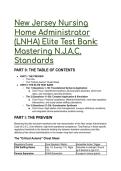
New Jersey Nursing
Home Administrator
(LNHA) Elite Test Bank:
Mastering N.J.A.C.
Standards
PART 0: THE TABLE OF CONTENTS
● PART I: THE PREVIEW
○ The Intro
○ The "Critical Axioms" Cheat Sheet
● PART II: THE ELITE TEST BANK
○ Tier 1 (Questions 1–10): Foundational Syntax & Application
■ Core Focus: Operational baselines, physical plant absolutes, direct-care
ratios, and mandatory reporting timelines.
○ Tier 2 (Questions 11–20): Complex Application & Simulation
■ Core Focus: Financial compliance, Medicaid thresholds, multi-step regulatory
intersections, and acuity-based staffing calculations.
○ Tier 3 (Questions 21–30): Grandmaster Synthesis
■ Core Focus: High-stakes crisis management, surveyor deficiency avoidance,
and integrated clinical-administrative problem-solving.
PART I: THE PREVIEW
Mastering this elite test bank transforms the rote memorization of the New Jersey Administrative
Code (N.J.A.C.) into reflexive, high-level operational competence. Total fluency in these specific
regulatory thresholds is the absolute dividing line between standard compliance and elite,
deficiency-free clinical administration in the modern long-term care environment.
The "Critical Axioms" Cheat Sheet
Regulatory Domain Core Standard / Metric Immediate Action Trigger
CNA Staffing Ratios Day 1:8, Evening 1:10, Night Calculate at midnight. Round
1:14 up if decimal is \ge 0.51.
Census Expansion 9-Shift Exemption A surge in census grants
,Regulatory Domain Core Standard / Metric Immediate Action Trigger
exactly 9 shifts of ratio
exemption.
Peggy's Law 2-Hour vs. 24-Hour Rule Serious bodily injury demands
external reporting within 2
hours of discovery.
Physical Plant Temps: 65°F–81°F (Air) / Any breach requires immediate
95°F–110°F (Water) mitigation; HVAC failures
require instant state notification.
Medicaid PNA $50 Threshold / $2,000 Cap Funds >$50 mandate an
interest-bearing account. Warn
at $1,800.
LNHA Renewal 60 CEUs Triennially 4 mandatory ethics hours.
Maximum 10-hour carryover
limit.
PART II: THE ELITE TEST BANK
Tier 1: Foundational Syntax & Application
Q1: A Medicaid-funded resident is transferred to a local acute care hospital following a sudden
cardiac event. The facility currently operates at a 92% occupancy rate. Based on N.J.A.C. 8:85
and federal regulations regarding bed hold policies, which action by the facility admissions
coordinator is the MOST ACCURATE? A) Rely exclusively on the bed hold policy signed by the
family during the initial admission process, as it provides umbrella coverage for all subsequent
hospitalizations. B) Provide a written bed hold notice to the resident and/or family representative
specifying the duration of the state bed-hold policy at the exact time of the transfer. C) Terminate
the bed hold immediately, as Medicaid only reimburses for empty beds if the facility's overall
occupancy rate is maintained above 95%. D) Inform the family that Medicaid strictly prohibits
hospital bed holds, and they must immediately transition to a private-pay contract to reserve the
bed for the 10-day period.
● Answer: B (Provide a written bed hold notice to the resident and/or family representative
specifying the duration of the state bed-hold policy at the exact time of the transfer.)
● Distractor Analysis:
○ A is incorrect: While providing the policy at admission is a regulatory baseline,
N.J.A.C. standards and federal rules mandate that the specific notice must be
re-issued explicitly at the time of transfer. Relying on admission paperwork results
in an F-Tag deficiency.
○ C is incorrect: The occupancy threshold for Medicaid bed hold reimbursement in
New Jersey is 90%, not 95%. The facility is at 92%, making them eligible for the
50% per diem reimbursement.
○ D is incorrect: New Jersey Medicaid expressly pays to hold a bed for up to 10 days
for a hospital transfer provided the facility meets the 90% occupancy threshold.
The Mentor's Analysis: Transparency during transitions of care is a heavily scrutinized survey
target. When facing a resident transfer, the immediate priority is contemporaneous written
notification of the bed hold policy. By utilizing real-time documentation, you bypass the common
trap of relying on stale admission paperwork to satisfy dynamic transfer rules.
Professional/Academic Intuition: Never assume baseline admission paperwork satisfies
, transfer-specific notice requirements; legal documentation must mirror the real-time
event.
Q2: A Licensed Nursing Home Administrator (LNHA) in New Jersey is preparing for their
triennial license renewal. Upon auditing their Continuing Education Units (CEUs) for the current
cycle, they realize they have accumulated 75 total hours. Which of the following conclusions
regarding their renewal is MOST ACCURATE according to N.J.A.C. 8:34-7.2? A) The
administrator may confidently carry over 15 excess credit hours into the subsequent triennial
licensure period. B) The administrator has satisfied all baseline requirements, provided the 75
accumulated hours includes a minimum of 4 CEU hours dedicated to professional ethics. C)
The administrator is fully exempt from the mandatory ethics requirement because their total
hours significantly exceed the 60-hour state baseline. D) The administrator must retake the NAB
examination because accumulating over 70 hours triggers an automatic administrative audit by
the state licensing board.
● Answer: B (The administrator has satisfied all baseline requirements, provided the 75
accumulated hours includes a minimum of 4 CEU hours dedicated to professional ethics.)
● Distractor Analysis:
○ A is incorrect: N.J.A.C. 8:34-7.2 explicitly dictates that a licensee is permitted to
carry over a maximum of only 10 excess credit hours to the next triennial period.
○ C is incorrect: The 4-hour professional ethics requirement is an absolute,
non-negotiable mandate for every renewal cycle, regardless of the total volume of
hours accumulated.
○ D is incorrect: There is no regulatory statute suggesting excess CEUs trigger an
examination retake or an automatic punitive audit.
The Mentor's Analysis: Licensure maintenance is the foundation of administrative authority
and continuous facility compliance. When facing triennial renewal, the immediate priority is
verifying the 60-hour minimum against specific category mandates. By utilizing proactive CEU
tracking, you bypass the common trap of missing the non-negotiable ethics sub-requirement.
Professional/Academic Intuition: Surplus hours do not erase specific category mandates;
always verify the 4-hour ethics requirement before submitting your attestation.
Q3: A Certified Nurse Aide (CNA) witnesses a resident being violently shoved by a dietary aide.
The resident falls, sustaining a fractured hip and a severe laceration. Under Peggy's Law
(N.J.S.A. 52:27G-7.1), what is the facility's IMMEDIATE reporting obligation regarding this
event? A) Notify the New Jersey Department of Health and local law enforcement within 24
hours of the incident. B) Notify the internal grievance committee and the Director of Nursing
before the end of the current operational shift. C) Notify local law enforcement and the
Long-Term Care Ombudsman immediately, but no later than 2 hours. D) Notify the resident's
family and the attending physician within 2 hours, and the Ombudsman within 24 hours.
● Answer: C (Notify local law enforcement and the Long-Term Care Ombudsman
immediately, but no later than 2 hours.)
● Distractor Analysis:
○ A is incorrect: The 24-hour reporting window applies strictly to suspected crimes
that do not result in serious bodily injury. A fractured hip unequivocally qualifies as
serious bodily injury.
○ B is incorrect: While internal reporting is required by facility policy, state and federal
statutory reporting supersedes internal chain-of-command delays.
○ D is incorrect: While the family and physician must be notified, Peggy's Law dictates
that local law enforcement and the Ombudsman must receive notification within 2
hours for serious injuries.
Home Administrator
(LNHA) Elite Test Bank:
Mastering N.J.A.C.
Standards
PART 0: THE TABLE OF CONTENTS
● PART I: THE PREVIEW
○ The Intro
○ The "Critical Axioms" Cheat Sheet
● PART II: THE ELITE TEST BANK
○ Tier 1 (Questions 1–10): Foundational Syntax & Application
■ Core Focus: Operational baselines, physical plant absolutes, direct-care
ratios, and mandatory reporting timelines.
○ Tier 2 (Questions 11–20): Complex Application & Simulation
■ Core Focus: Financial compliance, Medicaid thresholds, multi-step regulatory
intersections, and acuity-based staffing calculations.
○ Tier 3 (Questions 21–30): Grandmaster Synthesis
■ Core Focus: High-stakes crisis management, surveyor deficiency avoidance,
and integrated clinical-administrative problem-solving.
PART I: THE PREVIEW
Mastering this elite test bank transforms the rote memorization of the New Jersey Administrative
Code (N.J.A.C.) into reflexive, high-level operational competence. Total fluency in these specific
regulatory thresholds is the absolute dividing line between standard compliance and elite,
deficiency-free clinical administration in the modern long-term care environment.
The "Critical Axioms" Cheat Sheet
Regulatory Domain Core Standard / Metric Immediate Action Trigger
CNA Staffing Ratios Day 1:8, Evening 1:10, Night Calculate at midnight. Round
1:14 up if decimal is \ge 0.51.
Census Expansion 9-Shift Exemption A surge in census grants
,Regulatory Domain Core Standard / Metric Immediate Action Trigger
exactly 9 shifts of ratio
exemption.
Peggy's Law 2-Hour vs. 24-Hour Rule Serious bodily injury demands
external reporting within 2
hours of discovery.
Physical Plant Temps: 65°F–81°F (Air) / Any breach requires immediate
95°F–110°F (Water) mitigation; HVAC failures
require instant state notification.
Medicaid PNA $50 Threshold / $2,000 Cap Funds >$50 mandate an
interest-bearing account. Warn
at $1,800.
LNHA Renewal 60 CEUs Triennially 4 mandatory ethics hours.
Maximum 10-hour carryover
limit.
PART II: THE ELITE TEST BANK
Tier 1: Foundational Syntax & Application
Q1: A Medicaid-funded resident is transferred to a local acute care hospital following a sudden
cardiac event. The facility currently operates at a 92% occupancy rate. Based on N.J.A.C. 8:85
and federal regulations regarding bed hold policies, which action by the facility admissions
coordinator is the MOST ACCURATE? A) Rely exclusively on the bed hold policy signed by the
family during the initial admission process, as it provides umbrella coverage for all subsequent
hospitalizations. B) Provide a written bed hold notice to the resident and/or family representative
specifying the duration of the state bed-hold policy at the exact time of the transfer. C) Terminate
the bed hold immediately, as Medicaid only reimburses for empty beds if the facility's overall
occupancy rate is maintained above 95%. D) Inform the family that Medicaid strictly prohibits
hospital bed holds, and they must immediately transition to a private-pay contract to reserve the
bed for the 10-day period.
● Answer: B (Provide a written bed hold notice to the resident and/or family representative
specifying the duration of the state bed-hold policy at the exact time of the transfer.)
● Distractor Analysis:
○ A is incorrect: While providing the policy at admission is a regulatory baseline,
N.J.A.C. standards and federal rules mandate that the specific notice must be
re-issued explicitly at the time of transfer. Relying on admission paperwork results
in an F-Tag deficiency.
○ C is incorrect: The occupancy threshold for Medicaid bed hold reimbursement in
New Jersey is 90%, not 95%. The facility is at 92%, making them eligible for the
50% per diem reimbursement.
○ D is incorrect: New Jersey Medicaid expressly pays to hold a bed for up to 10 days
for a hospital transfer provided the facility meets the 90% occupancy threshold.
The Mentor's Analysis: Transparency during transitions of care is a heavily scrutinized survey
target. When facing a resident transfer, the immediate priority is contemporaneous written
notification of the bed hold policy. By utilizing real-time documentation, you bypass the common
trap of relying on stale admission paperwork to satisfy dynamic transfer rules.
Professional/Academic Intuition: Never assume baseline admission paperwork satisfies
, transfer-specific notice requirements; legal documentation must mirror the real-time
event.
Q2: A Licensed Nursing Home Administrator (LNHA) in New Jersey is preparing for their
triennial license renewal. Upon auditing their Continuing Education Units (CEUs) for the current
cycle, they realize they have accumulated 75 total hours. Which of the following conclusions
regarding their renewal is MOST ACCURATE according to N.J.A.C. 8:34-7.2? A) The
administrator may confidently carry over 15 excess credit hours into the subsequent triennial
licensure period. B) The administrator has satisfied all baseline requirements, provided the 75
accumulated hours includes a minimum of 4 CEU hours dedicated to professional ethics. C)
The administrator is fully exempt from the mandatory ethics requirement because their total
hours significantly exceed the 60-hour state baseline. D) The administrator must retake the NAB
examination because accumulating over 70 hours triggers an automatic administrative audit by
the state licensing board.
● Answer: B (The administrator has satisfied all baseline requirements, provided the 75
accumulated hours includes a minimum of 4 CEU hours dedicated to professional ethics.)
● Distractor Analysis:
○ A is incorrect: N.J.A.C. 8:34-7.2 explicitly dictates that a licensee is permitted to
carry over a maximum of only 10 excess credit hours to the next triennial period.
○ C is incorrect: The 4-hour professional ethics requirement is an absolute,
non-negotiable mandate for every renewal cycle, regardless of the total volume of
hours accumulated.
○ D is incorrect: There is no regulatory statute suggesting excess CEUs trigger an
examination retake or an automatic punitive audit.
The Mentor's Analysis: Licensure maintenance is the foundation of administrative authority
and continuous facility compliance. When facing triennial renewal, the immediate priority is
verifying the 60-hour minimum against specific category mandates. By utilizing proactive CEU
tracking, you bypass the common trap of missing the non-negotiable ethics sub-requirement.
Professional/Academic Intuition: Surplus hours do not erase specific category mandates;
always verify the 4-hour ethics requirement before submitting your attestation.
Q3: A Certified Nurse Aide (CNA) witnesses a resident being violently shoved by a dietary aide.
The resident falls, sustaining a fractured hip and a severe laceration. Under Peggy's Law
(N.J.S.A. 52:27G-7.1), what is the facility's IMMEDIATE reporting obligation regarding this
event? A) Notify the New Jersey Department of Health and local law enforcement within 24
hours of the incident. B) Notify the internal grievance committee and the Director of Nursing
before the end of the current operational shift. C) Notify local law enforcement and the
Long-Term Care Ombudsman immediately, but no later than 2 hours. D) Notify the resident's
family and the attending physician within 2 hours, and the Ombudsman within 24 hours.
● Answer: C (Notify local law enforcement and the Long-Term Care Ombudsman
immediately, but no later than 2 hours.)
● Distractor Analysis:
○ A is incorrect: The 24-hour reporting window applies strictly to suspected crimes
that do not result in serious bodily injury. A fractured hip unequivocally qualifies as
serious bodily injury.
○ B is incorrect: While internal reporting is required by facility policy, state and federal
statutory reporting supersedes internal chain-of-command delays.
○ D is incorrect: While the family and physician must be notified, Peggy's Law dictates
that local law enforcement and the Ombudsman must receive notification within 2
hours for serious injuries.


