

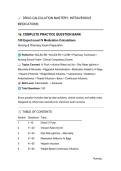
DRUG CALCULATION MASTERY: INTRAVENOUS
MEDICATIONS
COMPLETE PRACTICE QUESTION BANK
100 Expert-Level IV Medication Calculations
Nursing & Pharmacy Exam Preparation
Perfect for: NCLEX-RN • NCLEX-PN • CCRN • Pharmacy Technician •
Nursing School Finals • Clinical Competency Exams
Topics Covered: IV Push • Infusion Rates (mL/hr) • Drip Rates (gtt/min) •
Macrodrip & Microdrip • Piggyback Administration • Medication Added to IV Bags
• Heparin Protocols • Weight-Based Infusions • Vasopressors • Sedatives •
Antiarrhythmics • Titrated Infusions • Bolus + Continuous Infusions
Skill Level: Intermediate → Advanced
Total Questions: 100
Every question includes step-by-step solutions, clinical context, and safety notes.
Designed by critical care educators for maximum exam success.
TABLE OF CONTENTS
Section Questions Topic
1 1–10 Direct IV Push
2 11–20 Infusion Rate (mL/hr)
3 21–30 Drip Rate (gtt/min) – Macrodrip
4 31–40 Medication Added to IV Bags
5 41–50 Heparin Infusions
6 51–60 Weight-Based Continuous Infusions
Nursing
,Section Questions Topic
7 61–70 IV Piggyback Administration
8 71–80 Bolus + Continuous Infusion Protocols
9 81–90 Microdrip Rates (Pediatric)
10 91–100 Complex Titrated Infusions
HOW TO USE THIS DOCUMENT
1. Attempt each question independently before checking the answer.
2. Show all your work — examiners award partial credit for correct
methodology.
3. Review the safety notes — IV medication errors can be life-threatening.
4. Time yourself — aim for 3–4 minutes per question on exam day.
5. Flag difficult questions for later review.
CLINICAL SAFETY REMINDERS
• Always verify the order against the medication administration record
(MAR).
• Check the IV site before administering any medication — assess for
infiltration or phlebitis.
• Use an infusion pump for all IV medications whenever possible.
• Double-check heparin calculations — this is a high-alert medication.
• Monitor vital signs during vasopressor and sedative infusions.
• Never mix incompatible medications in the same IV line.
• Label all IV bags clearly with medication name, concentration, and rate.
• When in doubt, ask — patient safety is everyone’s responsibility.
Question 1: IV Medication – Infusion Rate (mL/hr)
Patient: Mrs. Robinson, 55 years old
Nursing
,Order: 0.9% Sodium Chloride 1000 mL IV over 8 hours
Question: At what rate (mL/hr) will you set the infusion pump?
Answer
Step 1: Identify total volume and total time. - Total volume: 1000 mL - Total time:
8 hours
Step 2: Apply the formula. - Rate (mL/hr) = Total Volume (mL) / Total Time (hr) -
Rate = 1000 mL / 8 hr
Step 3: Calculate. - Rate = 125.0 mL/hr
Answer: 125.0 mL/hr
Question 2: IV Medication – Medication Added to IV Bag
Patient: Mr. Garcia, 64 years old
Order: Cefotaxime 1 g IV q6h in 100 mL NS over 30 minutes
Available: Cefotaxime 1 g vial; reconstitute with 10 mL sterile water for injection
Question: a) How many mL of reconstituted Cefotaxime will you add to the bag?
b) At what rate (mL/hr) will you set the pump?
Answer
Part a – Volume of reconstituted medication:
Step 1: The vial contains 1 g of Cefotaxime. When reconstituted with 10 mL, the
entire 10 mL contains 1 g. - To give 1 g, you need the entire 10 mL of
reconstituted solution.
Part b – Infusion rate:
Step 1: Identify total volume and total time. - Total volume: 100 mL (bag) + 10
mL (medication) = 110 mL - Total time: 30 minutes = 0.5 hours
Step 2: Apply the formula. - Rate (mL/hr) = Total Volume (mL) / Total Time (hr) -
Rate = 110 mL / 0.5 hr
Step 3: Calculate. - Rate = 220.0 mL/hr
Answer: a) 10 mL | b) 220.0 mL/hr
Nursing
, Question 3: IV Medication – Titrated Infusion
Patient: Mr. Roberts, 57 years old, weight 60 kg
Order: Phenylephrine 0.5 mcg/kg/min IV infusion, titrate by 0.5 mcg/kg/min every
5 minutes as needed (max 2 mcg/kg/min)
Available: Phenylephrine 10 mg in 250 mL D5W
Question: a) What is the initial infusion rate (mL/hr)? b) What is the maximum
infusion rate (mL/hr)?
Answer
Step 1: Determine the concentration of the solution. - 10 mg = 10,000 mcg -
Concentration = 10,000 mcg / 250 mL = 40 mcg/mL
Part a – Initial rate at 0.5 mcg/kg/min:
Step 1: Calculate rate in mL/min. - Rate (mL/min) = 30.0 mcg/min / 40 mcg/mL =
0.7500 mL/min
Step 2: Convert to mL/hr. - Rate (mL/hr) = 0.7500 mL/min × 60 min/hr = 45.0
mL/hr
Part b – Maximum rate at 2 mcg/kg/min:
Step 1: Calculate rate in mL/min. - Rate (mL/min) = 120 mcg/min / 40 mcg/mL =
3.0000 mL/min
Step 2: Convert to mL/hr. - Rate (mL/hr) = 3.0000 mL/min × 60 min/hr = 180.0
mL/hr
Answer: a) 45.0 mL/hr | b) 180.0 mL/hr
Question 4: IV Medication – Medication Added to IV Bag
Patient: Mrs. Sanchez, 68 years old
Order: Imipenem 500 g IV q6h in 100 mL NS over 30 minutes
Available: Imipenem 500 g vial; reconstitute with 10 mL sterile water for injection
Question: a) How many mL of reconstituted Imipenem will you add to the bag?
b) At what rate (mL/hr) will you set the pump?
Nursing
MEDICATIONS
COMPLETE PRACTICE QUESTION BANK
100 Expert-Level IV Medication Calculations
Nursing & Pharmacy Exam Preparation
Perfect for: NCLEX-RN • NCLEX-PN • CCRN • Pharmacy Technician •
Nursing School Finals • Clinical Competency Exams
Topics Covered: IV Push • Infusion Rates (mL/hr) • Drip Rates (gtt/min) •
Macrodrip & Microdrip • Piggyback Administration • Medication Added to IV Bags
• Heparin Protocols • Weight-Based Infusions • Vasopressors • Sedatives •
Antiarrhythmics • Titrated Infusions • Bolus + Continuous Infusions
Skill Level: Intermediate → Advanced
Total Questions: 100
Every question includes step-by-step solutions, clinical context, and safety notes.
Designed by critical care educators for maximum exam success.
TABLE OF CONTENTS
Section Questions Topic
1 1–10 Direct IV Push
2 11–20 Infusion Rate (mL/hr)
3 21–30 Drip Rate (gtt/min) – Macrodrip
4 31–40 Medication Added to IV Bags
5 41–50 Heparin Infusions
6 51–60 Weight-Based Continuous Infusions
Nursing
,Section Questions Topic
7 61–70 IV Piggyback Administration
8 71–80 Bolus + Continuous Infusion Protocols
9 81–90 Microdrip Rates (Pediatric)
10 91–100 Complex Titrated Infusions
HOW TO USE THIS DOCUMENT
1. Attempt each question independently before checking the answer.
2. Show all your work — examiners award partial credit for correct
methodology.
3. Review the safety notes — IV medication errors can be life-threatening.
4. Time yourself — aim for 3–4 minutes per question on exam day.
5. Flag difficult questions for later review.
CLINICAL SAFETY REMINDERS
• Always verify the order against the medication administration record
(MAR).
• Check the IV site before administering any medication — assess for
infiltration or phlebitis.
• Use an infusion pump for all IV medications whenever possible.
• Double-check heparin calculations — this is a high-alert medication.
• Monitor vital signs during vasopressor and sedative infusions.
• Never mix incompatible medications in the same IV line.
• Label all IV bags clearly with medication name, concentration, and rate.
• When in doubt, ask — patient safety is everyone’s responsibility.
Question 1: IV Medication – Infusion Rate (mL/hr)
Patient: Mrs. Robinson, 55 years old
Nursing
,Order: 0.9% Sodium Chloride 1000 mL IV over 8 hours
Question: At what rate (mL/hr) will you set the infusion pump?
Answer
Step 1: Identify total volume and total time. - Total volume: 1000 mL - Total time:
8 hours
Step 2: Apply the formula. - Rate (mL/hr) = Total Volume (mL) / Total Time (hr) -
Rate = 1000 mL / 8 hr
Step 3: Calculate. - Rate = 125.0 mL/hr
Answer: 125.0 mL/hr
Question 2: IV Medication – Medication Added to IV Bag
Patient: Mr. Garcia, 64 years old
Order: Cefotaxime 1 g IV q6h in 100 mL NS over 30 minutes
Available: Cefotaxime 1 g vial; reconstitute with 10 mL sterile water for injection
Question: a) How many mL of reconstituted Cefotaxime will you add to the bag?
b) At what rate (mL/hr) will you set the pump?
Answer
Part a – Volume of reconstituted medication:
Step 1: The vial contains 1 g of Cefotaxime. When reconstituted with 10 mL, the
entire 10 mL contains 1 g. - To give 1 g, you need the entire 10 mL of
reconstituted solution.
Part b – Infusion rate:
Step 1: Identify total volume and total time. - Total volume: 100 mL (bag) + 10
mL (medication) = 110 mL - Total time: 30 minutes = 0.5 hours
Step 2: Apply the formula. - Rate (mL/hr) = Total Volume (mL) / Total Time (hr) -
Rate = 110 mL / 0.5 hr
Step 3: Calculate. - Rate = 220.0 mL/hr
Answer: a) 10 mL | b) 220.0 mL/hr
Nursing
, Question 3: IV Medication – Titrated Infusion
Patient: Mr. Roberts, 57 years old, weight 60 kg
Order: Phenylephrine 0.5 mcg/kg/min IV infusion, titrate by 0.5 mcg/kg/min every
5 minutes as needed (max 2 mcg/kg/min)
Available: Phenylephrine 10 mg in 250 mL D5W
Question: a) What is the initial infusion rate (mL/hr)? b) What is the maximum
infusion rate (mL/hr)?
Answer
Step 1: Determine the concentration of the solution. - 10 mg = 10,000 mcg -
Concentration = 10,000 mcg / 250 mL = 40 mcg/mL
Part a – Initial rate at 0.5 mcg/kg/min:
Step 1: Calculate rate in mL/min. - Rate (mL/min) = 30.0 mcg/min / 40 mcg/mL =
0.7500 mL/min
Step 2: Convert to mL/hr. - Rate (mL/hr) = 0.7500 mL/min × 60 min/hr = 45.0
mL/hr
Part b – Maximum rate at 2 mcg/kg/min:
Step 1: Calculate rate in mL/min. - Rate (mL/min) = 120 mcg/min / 40 mcg/mL =
3.0000 mL/min
Step 2: Convert to mL/hr. - Rate (mL/hr) = 3.0000 mL/min × 60 min/hr = 180.0
mL/hr
Answer: a) 45.0 mL/hr | b) 180.0 mL/hr
Question 4: IV Medication – Medication Added to IV Bag
Patient: Mrs. Sanchez, 68 years old
Order: Imipenem 500 g IV q6h in 100 mL NS over 30 minutes
Available: Imipenem 500 g vial; reconstitute with 10 mL sterile water for injection
Question: a) How many mL of reconstituted Imipenem will you add to the bag?
b) At what rate (mL/hr) will you set the pump?
Nursing


