

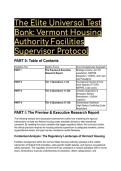
The Elite Universal Test
Bank: Vermont Housing
Authority Facilities
Supervisor Protocol
PART 0: Table of Contents
Cognitive Tier Section Focus Core Competencies Assessed
PART I The Preview & Executive Strategic Axioms, Act 181
Research Report Jurisdiction, NSPIRE
Integration, VOSHA, and Lead
Law Paradigms
PART II Tier 1 (Questions 1–10) Foundational Syntax & Hard
Deck Statutes (VT DFS,
NSPIRE, Lead Laws)
PART II Tier 2 (Questions 11–20) Complex Application &
Simulation (Defect
Remediation, VOSHA,
Logistics)
PART II Tier 3 (Questions 21–30) Grandmaster Synthesis
(High-Stakes Conflicting Code
Resolution)
PART I: The Preview & Executive Research Report
The following analysis and subsequent assessment outline how mastering the rigorous
intersections of state and federal housing codes translates directly to elite operational
command. By isolating the exact variables that trigger regulatory failure, the curriculum builds
the clinical precision required for housing authority supervisors to safeguard residents, protect
organizational assets, and pass top-tier compliance audits flawlessly.
Contextual Analysis: The Regulatory Landscape of Vermont Housing
Facilities management within the Vermont State Housing Authority operates at the volatile
intersection of federal HUD mandates, state-specific health statutes, and rigorous occupational
safety standards. The regulatory environment has undergone a massive paradigm shift in recent
years, demanding a nuanced understanding of jurisdiction, defect categorization, and
,environmental hazard mitigation.
The Evolution of Regulatory Jurisdiction: Act 181
On June 7, 2022, the passage of Act 181 fundamentally altered the enforcement of the Vermont
Rental Housing Health and Safety Code. Historically, rental health and safety were administered
by local municipal health officers. Act 181 transferred primary responsibility to the Division of
Fire Safety (DFS), establishing a statewide, complaint-driven system designed to ensure rental
housing is maintained safely. While DFS takes the lead on most inspections, municipalities may
still carry out proactive inspections and require registration fees if they enter into a formal
Municipal Inspection Agreement with the Division. The DFS relies on the Vermont Fire and
Building Safety Code, which enforces strict standards regarding structural integrity, emergency
egress, and life-safety electronics to combat the reality that modern synthetic building materials
have reduced emergency evacuation times from eight minutes to under three minutes.
The Transition to NSPIRE: Federal Alignment and Life-Threatening Triage
For federally assisted units, the Department of Housing and Urban Development (HUD) has
transitioned from the legacy Housing Quality Standards (HQS) to the National Standards for the
Physical Inspection of Real Estate (NSPIRE). The NSPIRE protocol standardizes inspections by
prioritizing defects that directly impact occupant health and safety across three inspectable
areas: the Unit, the Inside (common areas), and the Outside.
NSPIRE abandons arbitrary scoring leniency, imposing rigid remediation timelines based on the
severity of the defect. Life-Threatening (LT) deficiencies present a high risk of death or severe
illness and demand correction within 24 hours of notification. These include inoperable or
missing carbon monoxide/smoke alarms, blocked egress paths, non-functioning permanent
heating systems during winter months (October 1 to March 31), and faulty Ground-Fault Circuit
Interrupters (GFCI). Property managers are held strictly accountable for maintaining units in
good repair, regardless of whether a defect was caused by tenant negligence or intentional
damage; the mechanical defect must be cured to satisfy HUD, while tenant liability is handled as
a separate lease dispute.
NSPIRE Defect Category Definition & Impact Mandated Remediation
Timeframe
Life-Threatening (LT) High risk of death, severe 24 Hours
illness, or compromised
physical security.
Severe High risk of permanent 30 Days (or approved
disability, serious injury, or extension)
compromised security.
Moderate Moderate risk of adverse 30 Days
medical event or temporary
harm.
Low Critical to habitability but no 60 Days (or deferred based on
substantive health/safety risk. program)
Environmental Health: The Dichotomy of IRC and RRPM Lead Protocols
Because approximately 60% of Vermont homes were constructed prior to the 1978 ban on
, lead-based paint, maintenance operations are heavily governed by the Vermont Lead Law.
Under recent regulatory updates, the federal framework for Essential Maintenance Practices
(EMP) was rebranded as Renovation, Repair, Painting, and Maintenance (RRPM) regulations,
alongside the state-specific Inspection, Repair, and Cleaning (IRC) Practices.
The legal threshold defining these certifications is strictly geometric. An IRC-certified
maintenance worker may only repair chipping or peeling paint if the total area is less than 1
square foot per interior room or exterior side of a rental building. If the disturbance exceeds 1
square foot, the operation instantly legally escalates; it must be performed by a licensed
Lead-Safe RRPM Firm and Supervisor. Lead-safe work practices strictly prohibit dry scraping,
power sanding without a HEPA vacuum and state permit, and the use of heat guns operating
above 1100°F. Permitted practices include isolating the work area with 6-mil plastic sheeting and
misting surfaces with water prior to disturbance.
Fire Life Safety and Egress Geometries
Occupant survival during a catastrophic fire hinges on the precise geometry of the Emergency
Escape and Rescue Opening (EERO). The International Residential Code (IRC) and Vermont
fire safety codes dictate that egress is measured exclusively by the net clear opening—the
physical unobstructed space available when the window sash is fully open, not the rough
opening of the frame. Furthermore, Vermont prohibits the installation of ionization smoke
alarms, mandating the use of photoelectric sensors (which detect smoldering fires up to 90
minutes faster) in the immediate vicinity of bedrooms.
Egress Variable Mandated Dimension Code Exception / Application
Minimum Net Clear Area 5.7 square feet Reduced to 5.0 square feet for
grade-floor and below-grade
openings.
Minimum Height 24 inches Independent variable; must be
met even if area exceeds 5.7
sq ft.
Minimum Width 20 inches Independent variable; must be
met even if area exceeds 5.7
sq ft.
Maximum Sill Height 44 inches Measured from the interior
finished floor to the bottom of
the clear opening.
The "Critical Axioms" Cheat Sheet
● The NSPIRE 24-Hour Rule: Life-Threatening (LT) deficiencies (e.g., missing/inoperable
smoke/CO alarms, blocked egress, interior temperatures < 64°F in winter) absolutely
mandate correction within 24 hours of notification.
● The Egress Imperative: A compliant Emergency Escape and Rescue Opening (EERO)
demands four non-negotiable metrics: 5.7 sq. ft. net clear opening (5.0 if grade-floor),
minimum 24-inch height, minimum 20-inch width, and a sill height no greater than 44
inches.
● The Vermont Thermal Standard: Regardless of the time of year, heating facilities must
safely maintain a minimum room temperature of 65°F at a point 3 feet above the floor
whenever the exterior temperature drops below 55°F.
Bank: Vermont Housing
Authority Facilities
Supervisor Protocol
PART 0: Table of Contents
Cognitive Tier Section Focus Core Competencies Assessed
PART I The Preview & Executive Strategic Axioms, Act 181
Research Report Jurisdiction, NSPIRE
Integration, VOSHA, and Lead
Law Paradigms
PART II Tier 1 (Questions 1–10) Foundational Syntax & Hard
Deck Statutes (VT DFS,
NSPIRE, Lead Laws)
PART II Tier 2 (Questions 11–20) Complex Application &
Simulation (Defect
Remediation, VOSHA,
Logistics)
PART II Tier 3 (Questions 21–30) Grandmaster Synthesis
(High-Stakes Conflicting Code
Resolution)
PART I: The Preview & Executive Research Report
The following analysis and subsequent assessment outline how mastering the rigorous
intersections of state and federal housing codes translates directly to elite operational
command. By isolating the exact variables that trigger regulatory failure, the curriculum builds
the clinical precision required for housing authority supervisors to safeguard residents, protect
organizational assets, and pass top-tier compliance audits flawlessly.
Contextual Analysis: The Regulatory Landscape of Vermont Housing
Facilities management within the Vermont State Housing Authority operates at the volatile
intersection of federal HUD mandates, state-specific health statutes, and rigorous occupational
safety standards. The regulatory environment has undergone a massive paradigm shift in recent
years, demanding a nuanced understanding of jurisdiction, defect categorization, and
,environmental hazard mitigation.
The Evolution of Regulatory Jurisdiction: Act 181
On June 7, 2022, the passage of Act 181 fundamentally altered the enforcement of the Vermont
Rental Housing Health and Safety Code. Historically, rental health and safety were administered
by local municipal health officers. Act 181 transferred primary responsibility to the Division of
Fire Safety (DFS), establishing a statewide, complaint-driven system designed to ensure rental
housing is maintained safely. While DFS takes the lead on most inspections, municipalities may
still carry out proactive inspections and require registration fees if they enter into a formal
Municipal Inspection Agreement with the Division. The DFS relies on the Vermont Fire and
Building Safety Code, which enforces strict standards regarding structural integrity, emergency
egress, and life-safety electronics to combat the reality that modern synthetic building materials
have reduced emergency evacuation times from eight minutes to under three minutes.
The Transition to NSPIRE: Federal Alignment and Life-Threatening Triage
For federally assisted units, the Department of Housing and Urban Development (HUD) has
transitioned from the legacy Housing Quality Standards (HQS) to the National Standards for the
Physical Inspection of Real Estate (NSPIRE). The NSPIRE protocol standardizes inspections by
prioritizing defects that directly impact occupant health and safety across three inspectable
areas: the Unit, the Inside (common areas), and the Outside.
NSPIRE abandons arbitrary scoring leniency, imposing rigid remediation timelines based on the
severity of the defect. Life-Threatening (LT) deficiencies present a high risk of death or severe
illness and demand correction within 24 hours of notification. These include inoperable or
missing carbon monoxide/smoke alarms, blocked egress paths, non-functioning permanent
heating systems during winter months (October 1 to March 31), and faulty Ground-Fault Circuit
Interrupters (GFCI). Property managers are held strictly accountable for maintaining units in
good repair, regardless of whether a defect was caused by tenant negligence or intentional
damage; the mechanical defect must be cured to satisfy HUD, while tenant liability is handled as
a separate lease dispute.
NSPIRE Defect Category Definition & Impact Mandated Remediation
Timeframe
Life-Threatening (LT) High risk of death, severe 24 Hours
illness, or compromised
physical security.
Severe High risk of permanent 30 Days (or approved
disability, serious injury, or extension)
compromised security.
Moderate Moderate risk of adverse 30 Days
medical event or temporary
harm.
Low Critical to habitability but no 60 Days (or deferred based on
substantive health/safety risk. program)
Environmental Health: The Dichotomy of IRC and RRPM Lead Protocols
Because approximately 60% of Vermont homes were constructed prior to the 1978 ban on
, lead-based paint, maintenance operations are heavily governed by the Vermont Lead Law.
Under recent regulatory updates, the federal framework for Essential Maintenance Practices
(EMP) was rebranded as Renovation, Repair, Painting, and Maintenance (RRPM) regulations,
alongside the state-specific Inspection, Repair, and Cleaning (IRC) Practices.
The legal threshold defining these certifications is strictly geometric. An IRC-certified
maintenance worker may only repair chipping or peeling paint if the total area is less than 1
square foot per interior room or exterior side of a rental building. If the disturbance exceeds 1
square foot, the operation instantly legally escalates; it must be performed by a licensed
Lead-Safe RRPM Firm and Supervisor. Lead-safe work practices strictly prohibit dry scraping,
power sanding without a HEPA vacuum and state permit, and the use of heat guns operating
above 1100°F. Permitted practices include isolating the work area with 6-mil plastic sheeting and
misting surfaces with water prior to disturbance.
Fire Life Safety and Egress Geometries
Occupant survival during a catastrophic fire hinges on the precise geometry of the Emergency
Escape and Rescue Opening (EERO). The International Residential Code (IRC) and Vermont
fire safety codes dictate that egress is measured exclusively by the net clear opening—the
physical unobstructed space available when the window sash is fully open, not the rough
opening of the frame. Furthermore, Vermont prohibits the installation of ionization smoke
alarms, mandating the use of photoelectric sensors (which detect smoldering fires up to 90
minutes faster) in the immediate vicinity of bedrooms.
Egress Variable Mandated Dimension Code Exception / Application
Minimum Net Clear Area 5.7 square feet Reduced to 5.0 square feet for
grade-floor and below-grade
openings.
Minimum Height 24 inches Independent variable; must be
met even if area exceeds 5.7
sq ft.
Minimum Width 20 inches Independent variable; must be
met even if area exceeds 5.7
sq ft.
Maximum Sill Height 44 inches Measured from the interior
finished floor to the bottom of
the clear opening.
The "Critical Axioms" Cheat Sheet
● The NSPIRE 24-Hour Rule: Life-Threatening (LT) deficiencies (e.g., missing/inoperable
smoke/CO alarms, blocked egress, interior temperatures < 64°F in winter) absolutely
mandate correction within 24 hours of notification.
● The Egress Imperative: A compliant Emergency Escape and Rescue Opening (EERO)
demands four non-negotiable metrics: 5.7 sq. ft. net clear opening (5.0 if grade-floor),
minimum 24-inch height, minimum 20-inch width, and a sill height no greater than 44
inches.
● The Vermont Thermal Standard: Regardless of the time of year, heating facilities must
safely maintain a minimum room temperature of 65°F at a point 3 feet above the floor
whenever the exterior temperature drops below 55°F.


