NUR 254 Maternal and Pediatrics Exam 3 | 70 Practice Questions & Answers | Growth
& Development, Newborn Assessment, Congenital Heart Defects, Respiratory
Disorders, High-Risk Obstetrics, Preeclampsia, Magnesium Sulfate, Intussusception |
Latest 2026/2027 | 100% Verified
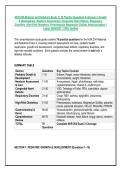
This comprehensive study guide contains 70 practice questions for the NUR 254 Maternal
and Pediatrics Exam 3, covering newborn assessment and care, pediatric health
supervision, growth and development, congenital heart defects, respiratory disorders, and
high-risk neonatal conditions . Each question includes the correct answer in bold with a
detailed rationale.
SUMMARY TABLE
Section Questions Key Topics Covered
Pediatric Growth & 1-10 Erikson, Piaget, motor milestones, toilet training,
Development immunizations, weight milestones
Newborn Assessment 11-20 Acrocyanosis, Apgar, phototherapy, safe sleep,
& Care cephalohematoma, Vitamin K, erythromycin
Congenital Heart 21-30 VSD, Tetralogy of Fallot, PDA, coarctation, digoxin
Defects administration
Respiratory Disorders 31-40 Croup, RSV, asthma, epiglottitis, pneumonia,
tracheostomy
High-Risk Obstetrics 41-55 Preeclampsia, eclampsia, Magnesium Sulfate, placenta
previa, placental abruption, HELLP, RhoGAM, PPROM
Gastrointestinal & 56-65 Intussusception, glomerulonephritis, celiac, pyloric
Renal stenosis, Hirschsprung, cystic fibrosis
Comprehensive 66-70 Kawasaki disease, heart failure, boggy uterus, newborn
Review reflexes
TOTAL 70 Complete NUR 254 Exam 3 Coverage
Questions
SECTION 1: PEDIATRIC GROWTH & DEVELOPMENT (Questions 1–15)
,1. The nurse is assessing a toddler's gross motor skills. Which milestone is expected
for an 18-month-old child?
A) Walking up and down stairs independently
B) Running well and jumping with both feet
C) Creeping up stairs
D) Building a tower of 6 cubes
Answer: C
At 15 months, toddlers creep upstairs. Running and jumping with both feet occur at 24
months. Walking up and down stairs independently and building a tower of 6 cubes are
milestones for a 24-month-old .
2. A preschooler is being assessed before surgery. Which Erikson stage applies to
this child?
A) Trust vs. mistrust
B) Autonomy vs. shame and doubt
C) Initiative vs. guilt
D) Industry vs. inferiority
Answer: C
Preschoolers (3-6 years) are in Erikson's initiative vs. guilt stage, where they begin planning
activities and feel guilty when criticized. Trust is infancy (0-12 months); autonomy is toddler
(1-3 years); industry is school-age (6-12 years) .
3. The nurse is evaluating toilet training readiness in a toddler. Which physical
finding indicates readiness?
A) Can walk up stairs
B) Has dry diapers for 2-hour periods
C) Can sit on a potty chair
D) Shows interest in the bathroom
Answer: B
, Dry diapers for 2-hour periods indicate bladder control and physiologic readiness for toilet
training in toddlers. Walking, sitting, and interest are developmental but not sufficient
physical indicators of readiness .
4. A school-age child is hospitalized. Which type of play is most appropriate for this
age group?
A) Parallel play
B) Cooperative play
C) Imitative play
D) Solitary play
Answer: B
School-age children (6-12 years) engage in cooperative play with rules and teamwork.
Parallel play is typical of toddlers; imitative play is common in preschoolers; solitary play is
seen in infants .
5. An infant's birth weight should double by what age?
A) 6 months
B) 9 months
C) 12 months
D) 15 months
Answer: A
Birth weight doubles by 6 months of age. It triples by 12 months of age .
6. The nurse is assessing a toddler's fine motor skills. Which finding is expected for a
2-year-old?
A) Holds a crayon with a fist grasp
B) Builds a tower of 4-6 blocks
C) Draws a circle
D) Uses a pincer grasp
Answer: B
& Development, Newborn Assessment, Congenital Heart Defects, Respiratory
Disorders, High-Risk Obstetrics, Preeclampsia, Magnesium Sulfate, Intussusception |
Latest 2026/2027 | 100% Verified
This comprehensive study guide contains 70 practice questions for the NUR 254 Maternal
and Pediatrics Exam 3, covering newborn assessment and care, pediatric health
supervision, growth and development, congenital heart defects, respiratory disorders, and
high-risk neonatal conditions . Each question includes the correct answer in bold with a
detailed rationale.
SUMMARY TABLE
Section Questions Key Topics Covered
Pediatric Growth & 1-10 Erikson, Piaget, motor milestones, toilet training,
Development immunizations, weight milestones
Newborn Assessment 11-20 Acrocyanosis, Apgar, phototherapy, safe sleep,
& Care cephalohematoma, Vitamin K, erythromycin
Congenital Heart 21-30 VSD, Tetralogy of Fallot, PDA, coarctation, digoxin
Defects administration
Respiratory Disorders 31-40 Croup, RSV, asthma, epiglottitis, pneumonia,
tracheostomy
High-Risk Obstetrics 41-55 Preeclampsia, eclampsia, Magnesium Sulfate, placenta
previa, placental abruption, HELLP, RhoGAM, PPROM
Gastrointestinal & 56-65 Intussusception, glomerulonephritis, celiac, pyloric
Renal stenosis, Hirschsprung, cystic fibrosis
Comprehensive 66-70 Kawasaki disease, heart failure, boggy uterus, newborn
Review reflexes
TOTAL 70 Complete NUR 254 Exam 3 Coverage
Questions
SECTION 1: PEDIATRIC GROWTH & DEVELOPMENT (Questions 1–15)
,1. The nurse is assessing a toddler's gross motor skills. Which milestone is expected
for an 18-month-old child?
A) Walking up and down stairs independently
B) Running well and jumping with both feet
C) Creeping up stairs
D) Building a tower of 6 cubes
Answer: C
At 15 months, toddlers creep upstairs. Running and jumping with both feet occur at 24
months. Walking up and down stairs independently and building a tower of 6 cubes are
milestones for a 24-month-old .
2. A preschooler is being assessed before surgery. Which Erikson stage applies to
this child?
A) Trust vs. mistrust
B) Autonomy vs. shame and doubt
C) Initiative vs. guilt
D) Industry vs. inferiority
Answer: C
Preschoolers (3-6 years) are in Erikson's initiative vs. guilt stage, where they begin planning
activities and feel guilty when criticized. Trust is infancy (0-12 months); autonomy is toddler
(1-3 years); industry is school-age (6-12 years) .
3. The nurse is evaluating toilet training readiness in a toddler. Which physical
finding indicates readiness?
A) Can walk up stairs
B) Has dry diapers for 2-hour periods
C) Can sit on a potty chair
D) Shows interest in the bathroom
Answer: B
, Dry diapers for 2-hour periods indicate bladder control and physiologic readiness for toilet
training in toddlers. Walking, sitting, and interest are developmental but not sufficient
physical indicators of readiness .
4. A school-age child is hospitalized. Which type of play is most appropriate for this
age group?
A) Parallel play
B) Cooperative play
C) Imitative play
D) Solitary play
Answer: B
School-age children (6-12 years) engage in cooperative play with rules and teamwork.
Parallel play is typical of toddlers; imitative play is common in preschoolers; solitary play is
seen in infants .
5. An infant's birth weight should double by what age?
A) 6 months
B) 9 months
C) 12 months
D) 15 months
Answer: A
Birth weight doubles by 6 months of age. It triples by 12 months of age .
6. The nurse is assessing a toddler's fine motor skills. Which finding is expected for a
2-year-old?
A) Holds a crayon with a fist grasp
B) Builds a tower of 4-6 blocks
C) Draws a circle
D) Uses a pincer grasp
Answer: B