

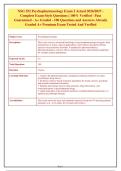
NSG 552 Psychopharmacology Exam 2 Actual 2026/2027 -
Complete Exam-Style Questions | 100% Verified - Pass
Guaranteed - A+ Graded - 100 Questions and Answers Already
Graded A+ Premium Exam Tested And Verified
Subject Area Psychopharmacology
Description This exam assesses advanced knowledge of psychopharmacological agents, their
mechanisms of action, clinical applications, and evidence-based prescribing
practices for psychiatric disorders. It emphasizes pharmacokinetics,
pharmacodynamics, adverse effects, drug interactions, and treatment guidelines
for complex patient populations.
Expected Grade A+
Total Questions 100
Duration 3 hours
Learning Outcomes 1. Analyze the pharmacodynamic and pharmacokinetic properties of major
psychotropic drug classes.
2. Evaluate evidence-based treatment algorithms for mood, anxiety, psychotic,
and neurodevelopmental disorders.
3. Identify and manage adverse drug reactions, drug interactions, and
contraindications in psychopharmacology.
4. Apply principles of personalized medicine, including pharmacogenomics, to
optimize psychotropic therapy.
Accreditation This exam meets the rigor and standards expected of top-tier US nursing graduate
programs (e.g., Ivy League, R1 research universities).
Page 1
,1. A patient with treatment-resistant depression has been on escitalopram 20 mg
daily for 8 weeks with minimal improvement. The provider considers augmentation
with a second-generation antipsychotic. Which of the following pharmacodynamic
mechanisms best explains the synergistic effect when combining an SSRI with
aripiprazole?
A. Aripiprazole's partial agonism at D2 receptors increases dopamine release in the
prefrontal cortex, counteracting SSRI-induced dopamine suppression.
B. Aripiprazole's antagonism at 5-HT2A receptors enhances serotonergic transmission in the
raphe nuclei, augmenting SSRI effects.
C. Aripiprazole's partial agonism at 5-HT1A receptors increases serotonergic firing rate,
potentiating SSRI efficacy.
D. Aripiprazole's antagonism at D3 receptors reduces negative feedback on dopamine
neurons, leading to increased dopamine in the striatum.
Answer: B. Aripiprazole's antagonism at 5-HT2A receptors enhances serotonergic
transmission in the raphe nuclei, augmenting SSRI effects.
Aripiprazole is a partial agonist at D2 receptors and a potent antagonist at 5-HT2A
receptors. The 5-HT2A antagonism is thought to augment SSRI effects by blocking
serotonin-induced inhibition of dopamine and norepinephrine release in the prefrontal
cortex, thereby improving depressive symptoms. Option A is incorrect because
aripiprazole's partial agonism at D2 receptors does not increase dopamine release; it
stabilizes dopamine tone. Option C is incorrect; aripiprazole has minimal activity at
5-HT1A receptors. Option D is incorrect; D3 antagonism is not a primary mechanism
for augmentation in depression.
Page 2
,2. A patient with bipolar I disorder is stabilized on lithium 900 mg/day with serum
level 0.8 mEq/L. The patient develops acute mania after missing several doses. The
provider decides to restart lithium and add a short-term antipsychotic. Which of the
following antipsychotics has the strongest evidence for rapid antimanic efficacy and
the lowest risk of metabolic side effects?
A. Olanzapine
B. Quetiapine
C. Risperidone
D. Asenapine
Answer: D. Asenapine
Asenapine has demonstrated rapid antimanic efficacy in clinical trials and is associated
with a lower risk of weight gain and metabolic disturbances compared to olanzapine,
quetiapine, and risperidone. Olanzapine (A) and quetiapine (B) have higher metabolic
side effect profiles. Risperidone (C) is effective but has a moderate risk of metabolic
side effects and is not considered the best option for minimizing metabolic risk.
Asenapine's sublingual administration also offers advantages in acute settings.
3. Which of the following pharmacogenetic variants is most strongly associated with
an increased risk of serotonin syndrome when a patient is treated with a standard
dose of fluoxetine?
A. CYP2D6 poor metabolizer phenotype
B. CYP2C19 ultrarapid metabolizer phenotype
C. SLC6A4 (serotonin transporter) long/long genotype
D. HTR2A (5-HT2A receptor) polymorphism rs6311
Answer: A. CYP2D6 poor metabolizer phenotype
Fluoxetine is primarily metabolized by CYP2D6 to its active metabolite norfluoxetine,
which is also a potent serotonin reuptake inhibitor. In CYP2D6 poor metabolizers,
fluoxetine and norfluoxetine accumulate to higher concentrations, increasing the risk of
serotonin syndrome, especially when combined with other serotonergic drugs.
CYP2C19 ultrarapid metabolizers (B) would clear fluoxetine faster, reducing risk. The
SLC6A4 long/long genotype (C) is associated with better SSRI response, not increased
toxicity. HTR2A polymorphisms (D) are linked to side effects like insomnia but not
directly to serotonin syndrome.
Page 3
, 4. A patient with generalized anxiety disorder (GAD) has failed trials of sertraline,
venlafaxine, and duloxetine due to lack of efficacy. The provider considers
pregabalin. Which mechanism of action distinguishes pregabalin from the previously
tried medications and supports its use in GAD?
A. Positive allosteric modulation of GABA-A receptors
B. Inhibition of voltage-gated calcium channels (2 subunit)
C. Antagonism of NMDA receptors
D. Inhibition of norepinephrine reuptake
Answer: B. Inhibition of voltage-gated calcium channels (2 subunit)
Pregabalin binds to the 2 subunit of voltage-gated calcium channels, reducing calcium
influx and decreasing the release of excitatory neurotransmitters such as glutamate,
norepinephrine, and substance P. This mechanism is distinct from SSRIs/SNRIs and is
thought to reduce anxiety by modulating neuronal excitability. Option A describes
benzodiazepines, not pregabalin. Option C is associated with drugs like ketamine.
Option D is the mechanism of SNRIs, which the patient has already failed.
5. A patient with schizophrenia is being switched from haloperidol decanoate to
paliperidone palmitate. Which pharmacokinetic consideration is most critical when
transitioning between these two long-acting injectable antipsychotics?
A. The need for a washout period of at least 2 weeks to avoid additive extrapyramidal
symptoms
B. Overlapping oral antipsychotic coverage for the first 2-3 weeks due to delayed release of
paliperidone palmitate
C. Monitoring for QTc prolongation because both drugs have additive effects on cardiac
repolarization
D. Adjusting the paliperidone dose based on the haloperidol decanoate dose to maintain
equivalent D2 receptor occupancy
Answer: B. Overlapping oral antipsychotic coverage for the first 2-3 weeks due to
delayed release of paliperidone palmitate
Paliperidone palmitate has a slow release profile, with therapeutic plasma levels
reached only after 2-3 weeks. Therefore, overlapping oral antipsychotic coverage is
recommended during the transition to prevent relapse. A washout period (A) is not
recommended because it would leave the patient unprotected. While QTc prolongation
(C) is a concern, it is not the most critical consideration for the transition itself. Dose
equivalence (D) is not straightforward due to different receptor binding profiles and
pharmacokinetics.
Page 4
Complete Exam-Style Questions | 100% Verified - Pass
Guaranteed - A+ Graded - 100 Questions and Answers Already
Graded A+ Premium Exam Tested And Verified
Subject Area Psychopharmacology
Description This exam assesses advanced knowledge of psychopharmacological agents, their
mechanisms of action, clinical applications, and evidence-based prescribing
practices for psychiatric disorders. It emphasizes pharmacokinetics,
pharmacodynamics, adverse effects, drug interactions, and treatment guidelines
for complex patient populations.
Expected Grade A+
Total Questions 100
Duration 3 hours
Learning Outcomes 1. Analyze the pharmacodynamic and pharmacokinetic properties of major
psychotropic drug classes.
2. Evaluate evidence-based treatment algorithms for mood, anxiety, psychotic,
and neurodevelopmental disorders.
3. Identify and manage adverse drug reactions, drug interactions, and
contraindications in psychopharmacology.
4. Apply principles of personalized medicine, including pharmacogenomics, to
optimize psychotropic therapy.
Accreditation This exam meets the rigor and standards expected of top-tier US nursing graduate
programs (e.g., Ivy League, R1 research universities).
Page 1
,1. A patient with treatment-resistant depression has been on escitalopram 20 mg
daily for 8 weeks with minimal improvement. The provider considers augmentation
with a second-generation antipsychotic. Which of the following pharmacodynamic
mechanisms best explains the synergistic effect when combining an SSRI with
aripiprazole?
A. Aripiprazole's partial agonism at D2 receptors increases dopamine release in the
prefrontal cortex, counteracting SSRI-induced dopamine suppression.
B. Aripiprazole's antagonism at 5-HT2A receptors enhances serotonergic transmission in the
raphe nuclei, augmenting SSRI effects.
C. Aripiprazole's partial agonism at 5-HT1A receptors increases serotonergic firing rate,
potentiating SSRI efficacy.
D. Aripiprazole's antagonism at D3 receptors reduces negative feedback on dopamine
neurons, leading to increased dopamine in the striatum.
Answer: B. Aripiprazole's antagonism at 5-HT2A receptors enhances serotonergic
transmission in the raphe nuclei, augmenting SSRI effects.
Aripiprazole is a partial agonist at D2 receptors and a potent antagonist at 5-HT2A
receptors. The 5-HT2A antagonism is thought to augment SSRI effects by blocking
serotonin-induced inhibition of dopamine and norepinephrine release in the prefrontal
cortex, thereby improving depressive symptoms. Option A is incorrect because
aripiprazole's partial agonism at D2 receptors does not increase dopamine release; it
stabilizes dopamine tone. Option C is incorrect; aripiprazole has minimal activity at
5-HT1A receptors. Option D is incorrect; D3 antagonism is not a primary mechanism
for augmentation in depression.
Page 2
,2. A patient with bipolar I disorder is stabilized on lithium 900 mg/day with serum
level 0.8 mEq/L. The patient develops acute mania after missing several doses. The
provider decides to restart lithium and add a short-term antipsychotic. Which of the
following antipsychotics has the strongest evidence for rapid antimanic efficacy and
the lowest risk of metabolic side effects?
A. Olanzapine
B. Quetiapine
C. Risperidone
D. Asenapine
Answer: D. Asenapine
Asenapine has demonstrated rapid antimanic efficacy in clinical trials and is associated
with a lower risk of weight gain and metabolic disturbances compared to olanzapine,
quetiapine, and risperidone. Olanzapine (A) and quetiapine (B) have higher metabolic
side effect profiles. Risperidone (C) is effective but has a moderate risk of metabolic
side effects and is not considered the best option for minimizing metabolic risk.
Asenapine's sublingual administration also offers advantages in acute settings.
3. Which of the following pharmacogenetic variants is most strongly associated with
an increased risk of serotonin syndrome when a patient is treated with a standard
dose of fluoxetine?
A. CYP2D6 poor metabolizer phenotype
B. CYP2C19 ultrarapid metabolizer phenotype
C. SLC6A4 (serotonin transporter) long/long genotype
D. HTR2A (5-HT2A receptor) polymorphism rs6311
Answer: A. CYP2D6 poor metabolizer phenotype
Fluoxetine is primarily metabolized by CYP2D6 to its active metabolite norfluoxetine,
which is also a potent serotonin reuptake inhibitor. In CYP2D6 poor metabolizers,
fluoxetine and norfluoxetine accumulate to higher concentrations, increasing the risk of
serotonin syndrome, especially when combined with other serotonergic drugs.
CYP2C19 ultrarapid metabolizers (B) would clear fluoxetine faster, reducing risk. The
SLC6A4 long/long genotype (C) is associated with better SSRI response, not increased
toxicity. HTR2A polymorphisms (D) are linked to side effects like insomnia but not
directly to serotonin syndrome.
Page 3
, 4. A patient with generalized anxiety disorder (GAD) has failed trials of sertraline,
venlafaxine, and duloxetine due to lack of efficacy. The provider considers
pregabalin. Which mechanism of action distinguishes pregabalin from the previously
tried medications and supports its use in GAD?
A. Positive allosteric modulation of GABA-A receptors
B. Inhibition of voltage-gated calcium channels (2 subunit)
C. Antagonism of NMDA receptors
D. Inhibition of norepinephrine reuptake
Answer: B. Inhibition of voltage-gated calcium channels (2 subunit)
Pregabalin binds to the 2 subunit of voltage-gated calcium channels, reducing calcium
influx and decreasing the release of excitatory neurotransmitters such as glutamate,
norepinephrine, and substance P. This mechanism is distinct from SSRIs/SNRIs and is
thought to reduce anxiety by modulating neuronal excitability. Option A describes
benzodiazepines, not pregabalin. Option C is associated with drugs like ketamine.
Option D is the mechanism of SNRIs, which the patient has already failed.
5. A patient with schizophrenia is being switched from haloperidol decanoate to
paliperidone palmitate. Which pharmacokinetic consideration is most critical when
transitioning between these two long-acting injectable antipsychotics?
A. The need for a washout period of at least 2 weeks to avoid additive extrapyramidal
symptoms
B. Overlapping oral antipsychotic coverage for the first 2-3 weeks due to delayed release of
paliperidone palmitate
C. Monitoring for QTc prolongation because both drugs have additive effects on cardiac
repolarization
D. Adjusting the paliperidone dose based on the haloperidol decanoate dose to maintain
equivalent D2 receptor occupancy
Answer: B. Overlapping oral antipsychotic coverage for the first 2-3 weeks due to
delayed release of paliperidone palmitate
Paliperidone palmitate has a slow release profile, with therapeutic plasma levels
reached only after 2-3 weeks. Therefore, overlapping oral antipsychotic coverage is
recommended during the transition to prevent relapse. A washout period (A) is not
recommended because it would leave the patient unprotected. While QTc prolongation
(C) is a concern, it is not the most critical consideration for the transition itself. Dose
equivalence (D) is not straightforward due to different receptor binding profiles and
pharmacokinetics.
Page 4


