

1
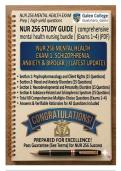
,Exams 1–4)– NUR 256 Study Guide Mental Health
Nursing Bundle | Galen College
1. A nurse is planning care for a client with major
depressive disorder. Which level of prevention is being
implemented when teaching stress reduction techniques to
a community group?
A. Primary prevention
B. Secondary prevention
C. Tertiary prevention
D. Rehabilitation
Answer: A
Rationale: Primary prevention aims to prevent mental
health problems before they occur by reducing risk
factors (e.g., stress). Secondary involves early detection,
tertiary focuses on rehabilitation.
2. Which statement by a client best indicates positive
mental health?
2
,A. “I have no problems at all.”
B. “I can cope with stress effectively and maintain
relationships.”
C. “I never feel sad or anxious.”
D. “I rely on others to make decisions for me.”
Answer: B
Rationale: Mental health involves effective coping,
resilience, and maintaining relationships, not absence of
distress or dependence.
3. A client tells the nurse, “I feel like dying.” What is the
nurse’s priority response?
A. “You have so much to live for.”
B. “Are you thinking of harming yourself?”
C. “Why do you feel that way?”
D. “Let’s talk about something positive.”
Answer: B
Rationale: Direct assessment of suicidal ideation is priority;
ask clearly and nonjudgmentally.
3
, 4. A nurse uses silence during a conversation with a
K K K K K K K K
K depressed client. This technique is therapeutic because it:
K K K K K K K
A. Forces the client to speak.
K K K K
B. Allows the client time to organize thoughts.
K K K K K K
C. Shows the nurse is uninterested.
K K K K
D. Increases client anxiety. K K
K Answer: B K
Rationale: Silence gives the client space to reflect and initiate
K K K K K K K K K
conversation.
K
5. Which ethical principle is violated when a nurse
K K K K K K K
K restrains a client without a physician’s order?
K K K K K K
A. Autonomy
B. Beneficence
C. Nonmaleficence
D. Justice
Answer: C
K K
Rationale: Nonmaleficence means “do no harm”; unnecessary
K K K K K K
restraint causes harm.
K K K
4
,Exams 1–4)– NUR 256 Study Guide Mental Health
Nursing Bundle | Galen College
1. A nurse is planning care for a client with major
depressive disorder. Which level of prevention is being
implemented when teaching stress reduction techniques to
a community group?
A. Primary prevention
B. Secondary prevention
C. Tertiary prevention
D. Rehabilitation
Answer: A
Rationale: Primary prevention aims to prevent mental
health problems before they occur by reducing risk
factors (e.g., stress). Secondary involves early detection,
tertiary focuses on rehabilitation.
2. Which statement by a client best indicates positive
mental health?
2
,A. “I have no problems at all.”
B. “I can cope with stress effectively and maintain
relationships.”
C. “I never feel sad or anxious.”
D. “I rely on others to make decisions for me.”
Answer: B
Rationale: Mental health involves effective coping,
resilience, and maintaining relationships, not absence of
distress or dependence.
3. A client tells the nurse, “I feel like dying.” What is the
nurse’s priority response?
A. “You have so much to live for.”
B. “Are you thinking of harming yourself?”
C. “Why do you feel that way?”
D. “Let’s talk about something positive.”
Answer: B
Rationale: Direct assessment of suicidal ideation is priority;
ask clearly and nonjudgmentally.
3
, 4. A nurse uses silence during a conversation with a
K K K K K K K K
K depressed client. This technique is therapeutic because it:
K K K K K K K
A. Forces the client to speak.
K K K K
B. Allows the client time to organize thoughts.
K K K K K K
C. Shows the nurse is uninterested.
K K K K
D. Increases client anxiety. K K
K Answer: B K
Rationale: Silence gives the client space to reflect and initiate
K K K K K K K K K
conversation.
K
5. Which ethical principle is violated when a nurse
K K K K K K K
K restrains a client without a physician’s order?
K K K K K K
A. Autonomy
B. Beneficence
C. Nonmaleficence
D. Justice
Answer: C
K K
Rationale: Nonmaleficence means “do no harm”; unnecessary
K K K K K K
restraint causes harm.
K K K
4


