

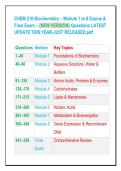
CHEM 210 Biochemistry – Module 1 to 8 Exams &
Final Exam – {NEW VERSION} Questions LATEST
UPDATE THIS YEAR-JUST RELEASED.pdf
Questions Section Key Topics
1–45 Module 1 Foundations of Biochemistry
46–90 Module 2 Aqueous Solutions, Water &
Buffers
91–125 Module 3 Amino Acids, Proteins & Enzymes
126–170 Module 4 Carbohydrates
171–215 Module 5 Lipids & Membranes
216–260 Module 6 Nucleic Acids
261–305 Module 7 Metabolism & Bioenergetics
306–340 Module 8 Gene Expression & Recombinant
DNA
341–359 Final Comprehensive Review
Exam
,SECTION 1: MODULE 1 EXAM – FUNDAMENTALS OF BIOCHEMISTRY (Questions 1–
45)
Question 1
pts
What do biochemists study?
A) The relationship between structure and function of biomolecules
B) Chemical reactions of organisms
C) Communication within and among organisms
D) All of the above
Answer: D) All of the above
Biochemists study all three aspects—the structure-function relationship of biomolecules,
chemical reactions in organisms, and intercellular communication .
Question 2
pts
True or False: Smaller elements are favored in biological systems because they can
form stable covalent bonds.
True
Answer
False
Smaller elements with smaller atomic shells are favored because they can form stable
,covalent bonds through significant overlap of atoms, such as carbon and hydrogen sharing
electrons. Larger elements tend to form ionic compounds .
Question 3
pts
What is the bond angle of a linear molecule?
Answer: 180 degrees
Linear molecules like CO₂ have a bond angle of 180° due to sp hybridization with no lone
pairs on the central atom .
Question 4
pts
What is the bond angle of a trigonal planar molecule?
Answer: 120 degrees
Trigonal planar molecules have bond angles of 120° due to sp² hybridization .
Question 5
pts
What is the bond angle of a trigonal pyramidal molecule?
Answer: 107.5 degrees
Trigonal pyramidal molecules like NH₃ have bond angles of approximately 107.5° due to
one lone pair of electrons .
, Question 6
pts
What is the bond angle of a tetrahedral molecule?
Answer: 109.5 degrees
Tetrahedral molecules like CH₄ have bond angles of 109.5° with no lone pairs on the
central atom .
Question 7
pts
What is carbon referred to in the chemical world?
Answer: The superglue
Carbon is called the "superglue" of the chemical world because it can form stable bonds
with itself and other elements, creating a vast diversity of molecules .
Question 8
pts
True or False: A compound with a molecular mass of 1,000 g/mol is considered a
macromolecule.
True
Answer
False
A macromolecule has a molecular mass of 5,000 g/mol or greater, not 1,000 g/mol .
Final Exam – {NEW VERSION} Questions LATEST
UPDATE THIS YEAR-JUST RELEASED.pdf
Questions Section Key Topics
1–45 Module 1 Foundations of Biochemistry
46–90 Module 2 Aqueous Solutions, Water &
Buffers
91–125 Module 3 Amino Acids, Proteins & Enzymes
126–170 Module 4 Carbohydrates
171–215 Module 5 Lipids & Membranes
216–260 Module 6 Nucleic Acids
261–305 Module 7 Metabolism & Bioenergetics
306–340 Module 8 Gene Expression & Recombinant
DNA
341–359 Final Comprehensive Review
Exam
,SECTION 1: MODULE 1 EXAM – FUNDAMENTALS OF BIOCHEMISTRY (Questions 1–
45)
Question 1
pts
What do biochemists study?
A) The relationship between structure and function of biomolecules
B) Chemical reactions of organisms
C) Communication within and among organisms
D) All of the above
Answer: D) All of the above
Biochemists study all three aspects—the structure-function relationship of biomolecules,
chemical reactions in organisms, and intercellular communication .
Question 2
pts
True or False: Smaller elements are favored in biological systems because they can
form stable covalent bonds.
True
Answer
False
Smaller elements with smaller atomic shells are favored because they can form stable
,covalent bonds through significant overlap of atoms, such as carbon and hydrogen sharing
electrons. Larger elements tend to form ionic compounds .
Question 3
pts
What is the bond angle of a linear molecule?
Answer: 180 degrees
Linear molecules like CO₂ have a bond angle of 180° due to sp hybridization with no lone
pairs on the central atom .
Question 4
pts
What is the bond angle of a trigonal planar molecule?
Answer: 120 degrees
Trigonal planar molecules have bond angles of 120° due to sp² hybridization .
Question 5
pts
What is the bond angle of a trigonal pyramidal molecule?
Answer: 107.5 degrees
Trigonal pyramidal molecules like NH₃ have bond angles of approximately 107.5° due to
one lone pair of electrons .
, Question 6
pts
What is the bond angle of a tetrahedral molecule?
Answer: 109.5 degrees
Tetrahedral molecules like CH₄ have bond angles of 109.5° with no lone pairs on the
central atom .
Question 7
pts
What is carbon referred to in the chemical world?
Answer: The superglue
Carbon is called the "superglue" of the chemical world because it can form stable bonds
with itself and other elements, creating a vast diversity of molecules .
Question 8
pts
True or False: A compound with a molecular mass of 1,000 g/mol is considered a
macromolecule.
True
Answer
False
A macromolecule has a molecular mass of 5,000 g/mol or greater, not 1,000 g/mol .


