

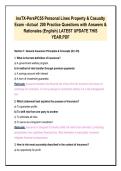
InsTX-PersPC55 Personal Lines Property & Casualty
Exam –Actual 200 Practice Questions with Answers &
Rationales (English) LATEST UPDATE THIS
YEAR.PDF
Section 1: General Insurance Principles & Concepts (Q1–35)
1. What is the best definition of insurance?
a) A government welfare program
b) A method of risk transfer through premium payments
c) A savings account with interest
d) A form of investment guarantee
Rationale: Insurance transfers the financial risk of loss from the insured to the insurer in
exchange for a premium. It is not a savings or investment vehicle; it is a risk management
tool.
2. Which statement best explains the purpose of insurance?
a) To guarantee profits
b) To shift risk from one party to another
c) To eliminate all risks
d) To serve as a long-term investment
Rationale: Insurance is designed to transfer (shift) risk rather than eliminate it, protecting
policyholders from significant financial loss. Risk elimination is impossible; insurance
mitigates financial consequences.
3. How is risk most accurately described in the context of insurance?
a) An opportunity for profit
,b) Uncertainty regarding future loss
c) A guaranteed event
d) A type of saving plan
Rationale: Risk in insurance refers to uncertainty about whether a loss will occur and its
potential severity. Insurance addresses pure risk (only loss or no loss), not speculative risk
(gain possible).
4. Which element is NOT essential in the definition of insurance?
a) Premium payment
b) Risk pooling
c) Guaranteed profit
d) Transfer of risk
Rationale: Insurance does not guarantee profit for either the insurer or the insured. The
essential elements are premium, risk pooling, transfer of risk, and indemnity.
5. What does the principle of indemnity state?
a) The insured must always profit from a loss
b) The insured is restored to their original financial position
c) The insurer should earn a profit on every claim
d) Losses must be replaced by new assets
Rationale: The principle of indemnity ensures that the insured is compensated only up to
the amount of their loss, preventing overcompensation.
6. What does the principle of indemnity prevent?
a) The insured from cancelling the policy
b) Double recovery from multiple policies
c) The insurer from raising premiums
d) The agent from earning commission
,Rationale: Double recovery is prohibited so that the insured does not profit from a loss. The
insured cannot collect from multiple insurers for more than the actual loss amount.
7. Why is the principle of indemnity important in insurance?
a) It increases premium costs
b) It maintains fairness between insurer and insured
c) It reduces the insurer's risk
d) It guarantees immediate payment
Rationale: Indemnity ensures fairness by reimbursing the insured only for the actual loss
incurred, preventing moral hazard (intentionally causing loss for profit) and maintaining
equitable relationships.
8. Which scenario best illustrates the principle of indemnity?
a) A payout that exceeds the insured's loss
b) Replacing a damaged item with a brand-new one even if it cost more
c) Reimbursing only the depreciated value of the damaged property
d) Awarding a fixed sum regardless of loss
Rationale: Indemnity means the compensation reflects the actual loss, often considering
depreciation (Actual Cash Value). Overcompensation violates the principle.
9. What distinguishes pure risk from speculative risk?
a) Pure risk involves both loss and profit possibilities
b) Speculative risk only involves potential profit
c) Pure risk involves only the possibility of loss
d) Speculative risk is not insurable
Rationale: Pure risk presents only the chance of loss (or no loss) and is typically insurable.
Speculative risk involves potential gain or loss and is generally NOT insurable.
, 10. Which of the following is an example of a speculative risk?
a) Fire damage to property
b) Loss from a car accident
c) Investment in the stock market
d) Theft of personal belongings
Rationale: Investing in the stock market involves potential for gain or loss—this is
speculative risk and is NOT insurable. Pure risks (fire, accident, theft) are insurable.
11. What is the term for the specific cause of a loss?
a) Hazard
b) Peril
c) Risk
d) Exposure
Rationale: A peril is the specific cause of a loss (e.g., fire, theft, windstorm, collision). A
hazard is a condition that increases the chance or severity of loss.
12. Which of the following is an example of a peril?
a) Icy roads
b) A fire that destroys a home
c) Poor housekeeping
d) Smoking
Rationale: A peril is the cause of the loss (fire). Hazards are conditions that increase risk
(icy roads, poor housekeeping, smoking).
13. What is a hazard?
a) The cause of a loss
b) A condition that increases the probability or severity of a loss
c) The amount paid by the insured
d) The insurance company's profit margin
Exam –Actual 200 Practice Questions with Answers &
Rationales (English) LATEST UPDATE THIS
YEAR.PDF
Section 1: General Insurance Principles & Concepts (Q1–35)
1. What is the best definition of insurance?
a) A government welfare program
b) A method of risk transfer through premium payments
c) A savings account with interest
d) A form of investment guarantee
Rationale: Insurance transfers the financial risk of loss from the insured to the insurer in
exchange for a premium. It is not a savings or investment vehicle; it is a risk management
tool.
2. Which statement best explains the purpose of insurance?
a) To guarantee profits
b) To shift risk from one party to another
c) To eliminate all risks
d) To serve as a long-term investment
Rationale: Insurance is designed to transfer (shift) risk rather than eliminate it, protecting
policyholders from significant financial loss. Risk elimination is impossible; insurance
mitigates financial consequences.
3. How is risk most accurately described in the context of insurance?
a) An opportunity for profit
,b) Uncertainty regarding future loss
c) A guaranteed event
d) A type of saving plan
Rationale: Risk in insurance refers to uncertainty about whether a loss will occur and its
potential severity. Insurance addresses pure risk (only loss or no loss), not speculative risk
(gain possible).
4. Which element is NOT essential in the definition of insurance?
a) Premium payment
b) Risk pooling
c) Guaranteed profit
d) Transfer of risk
Rationale: Insurance does not guarantee profit for either the insurer or the insured. The
essential elements are premium, risk pooling, transfer of risk, and indemnity.
5. What does the principle of indemnity state?
a) The insured must always profit from a loss
b) The insured is restored to their original financial position
c) The insurer should earn a profit on every claim
d) Losses must be replaced by new assets
Rationale: The principle of indemnity ensures that the insured is compensated only up to
the amount of their loss, preventing overcompensation.
6. What does the principle of indemnity prevent?
a) The insured from cancelling the policy
b) Double recovery from multiple policies
c) The insurer from raising premiums
d) The agent from earning commission
,Rationale: Double recovery is prohibited so that the insured does not profit from a loss. The
insured cannot collect from multiple insurers for more than the actual loss amount.
7. Why is the principle of indemnity important in insurance?
a) It increases premium costs
b) It maintains fairness between insurer and insured
c) It reduces the insurer's risk
d) It guarantees immediate payment
Rationale: Indemnity ensures fairness by reimbursing the insured only for the actual loss
incurred, preventing moral hazard (intentionally causing loss for profit) and maintaining
equitable relationships.
8. Which scenario best illustrates the principle of indemnity?
a) A payout that exceeds the insured's loss
b) Replacing a damaged item with a brand-new one even if it cost more
c) Reimbursing only the depreciated value of the damaged property
d) Awarding a fixed sum regardless of loss
Rationale: Indemnity means the compensation reflects the actual loss, often considering
depreciation (Actual Cash Value). Overcompensation violates the principle.
9. What distinguishes pure risk from speculative risk?
a) Pure risk involves both loss and profit possibilities
b) Speculative risk only involves potential profit
c) Pure risk involves only the possibility of loss
d) Speculative risk is not insurable
Rationale: Pure risk presents only the chance of loss (or no loss) and is typically insurable.
Speculative risk involves potential gain or loss and is generally NOT insurable.
, 10. Which of the following is an example of a speculative risk?
a) Fire damage to property
b) Loss from a car accident
c) Investment in the stock market
d) Theft of personal belongings
Rationale: Investing in the stock market involves potential for gain or loss—this is
speculative risk and is NOT insurable. Pure risks (fire, accident, theft) are insurable.
11. What is the term for the specific cause of a loss?
a) Hazard
b) Peril
c) Risk
d) Exposure
Rationale: A peril is the specific cause of a loss (e.g., fire, theft, windstorm, collision). A
hazard is a condition that increases the chance or severity of loss.
12. Which of the following is an example of a peril?
a) Icy roads
b) A fire that destroys a home
c) Poor housekeeping
d) Smoking
Rationale: A peril is the cause of the loss (fire). Hazards are conditions that increase risk
(icy roads, poor housekeeping, smoking).
13. What is a hazard?
a) The cause of a loss
b) A condition that increases the probability or severity of a loss
c) The amount paid by the insured
d) The insurance company's profit margin


