

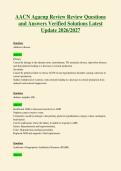
AACN Agacnp Review Review Questions
and Answers Verified Solutions Latest
Update 2026/2027
Question:
Addison's disease.
Answer:
Primary
Caused by damage to the adrenal cortex (autoimmune, TB, metastatic disease, deposition diseases,
and drug induced) leading to a decrease in cortisol production.
Secondary
Caused by pituitary failure to release ACTH (in any hypopituitary disorder) causing a decrease in
cortisol production.
Sudden withdrawal of systemic corticosteroids leading to a decrease in cortisol production from
induced corticosteroid suppression.
Question:
diabetes insipidus (DI).
Answer:
Insufficient ADH or decreased sensitivity to ADH
Nephron cannot conserve water.
Commonly caused by damage to the pituitary gland or hypothalamus (surgery, tumor, meningitis,
head injury).
Can be nephrogenic where the kidney in unable to respond to ADH.
Serum: Hypernatremia and hyperosmolarity.
Urine: Hyponatremia and hypoosmolality.
Replaced ADH and supportive fluid replacement.
Question:
Syndrome of Inapropriate Antidiuretic Hormone (SIADH).
Answer:
, Excess ADH production.
Nephron conserves excess water.
Caused by head injury and lung cancers.
Serum: Hyponatremia and hypoosmolality.
Urine: Hypernatremia and hyperosmolarity.
Fluid overload.
Treat with:
Free water restriction
Loop diuretic and NS
IN extremes 3% saline
Question:
Transudate pleural effusion.
Answer:
CHF
Constrictive pericarditis
Cirrhosis
SG <1.015
Protein <3 g/dl
LDH < 200
Fluid-serum protein ratio <0.5
Fluid -serum LDH ratio <0.5
Question:
Exudate pleural effusion.
Answer:
Lung parenchymal infection
Malignancy
PE
SG >1.015
Protein >3 g/dl
LDH >200
Fluid-serum protein ratio >0.5
Fluid-serum LDH ratio >0.5
Question:
and Answers Verified Solutions Latest
Update 2026/2027
Question:
Addison's disease.
Answer:
Primary
Caused by damage to the adrenal cortex (autoimmune, TB, metastatic disease, deposition diseases,
and drug induced) leading to a decrease in cortisol production.
Secondary
Caused by pituitary failure to release ACTH (in any hypopituitary disorder) causing a decrease in
cortisol production.
Sudden withdrawal of systemic corticosteroids leading to a decrease in cortisol production from
induced corticosteroid suppression.
Question:
diabetes insipidus (DI).
Answer:
Insufficient ADH or decreased sensitivity to ADH
Nephron cannot conserve water.
Commonly caused by damage to the pituitary gland or hypothalamus (surgery, tumor, meningitis,
head injury).
Can be nephrogenic where the kidney in unable to respond to ADH.
Serum: Hypernatremia and hyperosmolarity.
Urine: Hyponatremia and hypoosmolality.
Replaced ADH and supportive fluid replacement.
Question:
Syndrome of Inapropriate Antidiuretic Hormone (SIADH).
Answer:
, Excess ADH production.
Nephron conserves excess water.
Caused by head injury and lung cancers.
Serum: Hyponatremia and hypoosmolality.
Urine: Hypernatremia and hyperosmolarity.
Fluid overload.
Treat with:
Free water restriction
Loop diuretic and NS
IN extremes 3% saline
Question:
Transudate pleural effusion.
Answer:
CHF
Constrictive pericarditis
Cirrhosis
SG <1.015
Protein <3 g/dl
LDH < 200
Fluid-serum protein ratio <0.5
Fluid -serum LDH ratio <0.5
Question:
Exudate pleural effusion.
Answer:
Lung parenchymal infection
Malignancy
PE
SG >1.015
Protein >3 g/dl
LDH >200
Fluid-serum protein ratio >0.5
Fluid-serum LDH ratio >0.5
Question:


