

NUR 210 Final Exam Questions and Answers
with Verified Solutions | Latest Updated 2026
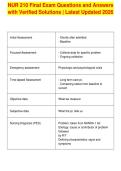
Initial Assessment - Shortly after admitted
- Baseline
Focused Assessment - Collects data for specific problem
- Ongoing collection
Emergency assessment Physiologic and psychological crisis
Time-lapsed Assessment - Long term care pt.
- Comparing status from baseline to
current
Objective data What we measure
Subjective data What the pt. tells us
Nursing Diagnosis (PED) Problem: taken from NANDA-1 list
Etiology: cause or contributor of problem
followed
by R/T
Defining characteristics: signs and
symptoms
,Risk Nursing Diagnosis when risk factors require intervention from
the
nurse and healthcare team prior to a real
problem
developing
problem-focused nursing clinical judgment concerning an
diagnosis undesirable
human response to health condition/life
processes
that exist in an individual, family, group, or
community
Health promotion nursing a clinical judgment concerning motivation
diagnosis and
desire to increase well-being and to
actualize
human health potential
Nursing Process Assessment: objective and subjective data
Analysis: determine pt. problems
Planning: create a plan for pt. problems
Implementation: take action to provide
care as
outlined in planning
Evaluation: evaluate effectiveness of the
interventions + pt. response
3 Elements of comprehensive initial, ongoing, discharge
planning
SMART goal Specific, Measurable, Attainable, Realistic,
Timely
, Cognitive pt. outcome describes an increase in pt. knowledge or
intellectual behaviors
Psychomotor pt. outcome describes pt. achievements of new skills
Affective pt. outcome describes changes in pt. values, beliefs
and
attitudes
Types of Implementation direct care, individuals, family, community,
nurse-
initiated treatments, provider initiated
treatments
3 parts of the evaluation reassessment: constant measuring and
monitoring
status
modification: priority change, changes in
pt.
condition, time frame, or change in
treatment plan
termination: when outcomes hav been
achieved,
turn focus on how the pt. will manage their
own
outside of the unit.
patient centered care Recognize the patient or designee as the
source of
control and full partner in providing
compassionate
and coordinated care based on respect for
patient's preferences, values, and needs.
with Verified Solutions | Latest Updated 2026
Initial Assessment - Shortly after admitted
- Baseline
Focused Assessment - Collects data for specific problem
- Ongoing collection
Emergency assessment Physiologic and psychological crisis
Time-lapsed Assessment - Long term care pt.
- Comparing status from baseline to
current
Objective data What we measure
Subjective data What the pt. tells us
Nursing Diagnosis (PED) Problem: taken from NANDA-1 list
Etiology: cause or contributor of problem
followed
by R/T
Defining characteristics: signs and
symptoms
,Risk Nursing Diagnosis when risk factors require intervention from
the
nurse and healthcare team prior to a real
problem
developing
problem-focused nursing clinical judgment concerning an
diagnosis undesirable
human response to health condition/life
processes
that exist in an individual, family, group, or
community
Health promotion nursing a clinical judgment concerning motivation
diagnosis and
desire to increase well-being and to
actualize
human health potential
Nursing Process Assessment: objective and subjective data
Analysis: determine pt. problems
Planning: create a plan for pt. problems
Implementation: take action to provide
care as
outlined in planning
Evaluation: evaluate effectiveness of the
interventions + pt. response
3 Elements of comprehensive initial, ongoing, discharge
planning
SMART goal Specific, Measurable, Attainable, Realistic,
Timely
, Cognitive pt. outcome describes an increase in pt. knowledge or
intellectual behaviors
Psychomotor pt. outcome describes pt. achievements of new skills
Affective pt. outcome describes changes in pt. values, beliefs
and
attitudes
Types of Implementation direct care, individuals, family, community,
nurse-
initiated treatments, provider initiated
treatments
3 parts of the evaluation reassessment: constant measuring and
monitoring
status
modification: priority change, changes in
pt.
condition, time frame, or change in
treatment plan
termination: when outcomes hav been
achieved,
turn focus on how the pt. will manage their
own
outside of the unit.
patient centered care Recognize the patient or designee as the
source of
control and full partner in providing
compassionate
and coordinated care based on respect for
patient's preferences, values, and needs.


