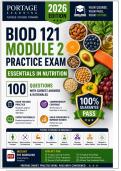
,BIOD 121 Module 2 Practice Exam Essentials in Nutrition | Portage Learning 100 Questions
with Correct Answers & Rationales 2026 Edition
This practice exam contains 100 questions designed to help you
prepare for the BIOD 121 Module 2 Exam at Portage Learning.
Questions cover the digestive system (GI tract, accessory organs,
sphincters), carbohydrates (classification, fiber, blood sugar
regulation), proteins (structure, function, digestion, amino acids),
lipids (types, digestion, lipoproteins), and related nutrition
concepts. Each question includes the correct answer and a
detailed rationale.
SECTION A: The Digestive System – GI Tract & Accessory
Organs (Questions 1–20)
Question 1
The alimentary canal is another name for the:
A) Respiratory tract
B) Urinary system
C) Gastrointestinal (GI) tract
D) Lymphatic system
Correct Answer: C
,Rationale: The alimentary canal is another name for
the gastrointestinal (GI) tract—the continuous tube that runs
from the mouth to the anus through which food passes. The GI
tract includes the mouth, esophagus, stomach, small intestine,
large intestine, and rectum.
Question 2
Specific parts of the GI tract include the mouth, esophagus,
________, small intestine, large intestine, and rectum.
A) Liver
B) Gallbladder
C) Stomach
D) Pancreas
Correct Answer: C
Rationale: The specific parts of the GI tract are the mouth,
esophagus, stomach, small intestine, large intestine, and
rectum. The liver, gallbladder, and pancreas are accessory
organs, not part of the GI tract itself.
Question 3
Which of the following is considered an accessory organ of
digestion?
, A) Stomach
B) Small intestine
C) Pancreas
D) Esophagus
Correct Answer: C
Rationale: Accessory organs of digestion include the salivary
glands, liver, gallbladder, and pancreas. These organs aid in
digestion but are not part of the actual GI tube. The stomach,
small intestine, and esophagus are part of the GI tract.
Question 4
The primary function of the stomach is to:
A) Absorb nutrients
B) Hold volume of food and mechanically and chemically digest it
C) Reabsorb water
D) Produce bile
Correct Answer: B
Rationale: The stomach's primary function is to hold volume of
food and mechanically and chemically digest it. The small
intestine is the primary site of digestion and absorption, while the
large intestine reabsorbs water and some vitamins.
with Correct Answers & Rationales 2026 Edition
This practice exam contains 100 questions designed to help you
prepare for the BIOD 121 Module 2 Exam at Portage Learning.
Questions cover the digestive system (GI tract, accessory organs,
sphincters), carbohydrates (classification, fiber, blood sugar
regulation), proteins (structure, function, digestion, amino acids),
lipids (types, digestion, lipoproteins), and related nutrition
concepts. Each question includes the correct answer and a
detailed rationale.
SECTION A: The Digestive System – GI Tract & Accessory
Organs (Questions 1–20)
Question 1
The alimentary canal is another name for the:
A) Respiratory tract
B) Urinary system
C) Gastrointestinal (GI) tract
D) Lymphatic system
Correct Answer: C
,Rationale: The alimentary canal is another name for
the gastrointestinal (GI) tract—the continuous tube that runs
from the mouth to the anus through which food passes. The GI
tract includes the mouth, esophagus, stomach, small intestine,
large intestine, and rectum.
Question 2
Specific parts of the GI tract include the mouth, esophagus,
________, small intestine, large intestine, and rectum.
A) Liver
B) Gallbladder
C) Stomach
D) Pancreas
Correct Answer: C
Rationale: The specific parts of the GI tract are the mouth,
esophagus, stomach, small intestine, large intestine, and
rectum. The liver, gallbladder, and pancreas are accessory
organs, not part of the GI tract itself.
Question 3
Which of the following is considered an accessory organ of
digestion?
, A) Stomach
B) Small intestine
C) Pancreas
D) Esophagus
Correct Answer: C
Rationale: Accessory organs of digestion include the salivary
glands, liver, gallbladder, and pancreas. These organs aid in
digestion but are not part of the actual GI tube. The stomach,
small intestine, and esophagus are part of the GI tract.
Question 4
The primary function of the stomach is to:
A) Absorb nutrients
B) Hold volume of food and mechanically and chemically digest it
C) Reabsorb water
D) Produce bile
Correct Answer: B
Rationale: The stomach's primary function is to hold volume of
food and mechanically and chemically digest it. The small
intestine is the primary site of digestion and absorption, while the
large intestine reabsorbs water and some vitamins.