

NRNP 6675 PMHNP Care Across the Lifespan I Final Exam | Walden University | 2026/2027
Final Exam: NRNP 6675
Psychiatric Mental Health Nurse Practitioner Care Across the Lifespan I
Questions and Verified Answers | 2026/2027 Newly Updated
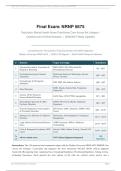
Comprehensive 150-Question Final Examination with NGN Integration
Walden University NRNP 6675 | DSM-5-TR Aligned | ANCC/AANP Blueprint Adherent
# Section Topic Coverage Questions
Advanced Psychiatric Assessment & MSE, DSM-5-TR, Differential Dx,
1 Q1 – Q25
Diagnostic Reasoning Developmental Theories
Psychopharmacology & Somatic Medication Selection, Monitoring, Adverse
2 Q26 – Q45
Treatments Effects, Geriatric
Psychotherapy & Therapeutic
3 CBT, DBT, MI, Sullivan, Erikson Q46 – Q55
Modalities
MDD, Bipolar, Suicide Risk, Postpartum
4 Mood Disorders Q56 – Q70
Depression
Anxiety, OCD, Trauma &
5 GAD, Panic, OCD, PTSD, Agoraphobia Q71 – Q82
Stressor-Related Disorders
Schizophrenia Spectrum & Other DSM-5-TR Criteria, Bleuler, Dopamine
6 Q83 – Q95
Psychotic Disorders Hypothesis
Neurodevelopmental, Neurocognitive PD Clusters A/B/C, Dementia, ADHD, ASD,
7 Q96 – Q110
& Personality Disorders Turner
Substance Use Disorders & Addictive Intoxication, Neuroadaptation, Contingency
8 Q111 – Q118
Disorders Management
Legal, Ethical & Professional Practice APRN Consensus, HIPAA, Medicare,
9 Q119 – Q135
Issues Credentialing
Crisis & Emergency Psychiatry (NGN Suicide, NMS, Lithium Toxicity, Tarasoff, DV
10 Q136 – Q150
Cases) Cycle
To 150
All ten content areas NGN clinical judgment integrated
tal Questions
Instructions: This 150-question final examination aligns with the Walden University NRNP 6675 PMHNP Care
Across the Lifespan I curriculum and integrates the Next Generation NCLEX (NGN) clinical judgment
framework (Recognizing Cues, Analyzing Cues, Generating Hypotheses, Prioritizing Hypotheses, Taking Actions,
Evaluating Outcomes). Each question has four options (A–D) with one verified correct answer and a
Z.ai | Verified Answers | A+ Graded Page 1
,NRNP 6675 PMHNP Care Across the Lifespan I Final Exam | Walden University | 2026/2027
comprehensive rationale citing DSM-5-TR criteria, ANCC/AANP certification standards, and evidence-based
PMHNP practice.
Cognitive distribution: 25% recall, 55% application, 20% analysis (including NGN clinical judgment). Style
distribution: 70% scenario-based, 20% direct recall, 10% NGN case analysis. Recommended strategy: Apply
ABC + suicide risk framework, least restrictive intervention, evidence-based pharmacotherapy with monitoring,
and trauma-informed, culturally responsive care. Verify lithium levels (0.6–1.2 mEq/L), geriatric dosing (start
low, go slow), and DSM-5-TR duration criteria for each disorder.
Z.ai | Verified Answers | A+ Graded Page 2
,NRNP 6675 PMHNP Care Across the Lifespan I Final Exam | Walden University | 2026/2027
Section 1: Advanced Psychiatric Assessment and Diagnostic
Reasoning
Questions Q1–Q25 • MSE, DSM-5-TR Criteria, Differential Diagnosis, Developmental Theories
This section contains 25 questions testing mse, dsm-5-tr criteria, differential diagnosis, developmental
theories.
Q1: A 32-year-old patient presents with pressured speech, flight of ideas, and 4 days of decreased need for
sleep. During the Mental Status Exam (MSE), which component is most critical to document when
distinguishing mania from schizophrenia?
A. Appearance and grooming
B. Thought process and thought content [CORRECT]
C. Mood and affect
D. Insight and judgment
Correct Answer: B
Rationale: Thought process (e.g., flight of ideas, loosening of associations) and thought content (e.g., delusions,
homicidality) are essential MSE components for distinguishing mood-driven psychotic features from a primary psychotic
disorder. While mood/affect and appearance are relevant, the DSM-5-TR differential between bipolar mania and
schizophrenia hinges on the quality and timing of thought disturbance relative to mood episodes.
Q2: During an MSE, the PMHNP observes that a patient's speech is vague, circumstantial, and tangential.
This finding is most consistent with which thought process disturbance?
A. Flight of ideas
B. Tangentiality [CORRECT]
C. Verbigeration
D. Mutism
Correct Answer: B
Rationale: Tangentiality is the inability to return to the goal of a thought—speech wanders to unrelated topics. Flight of
ideas is rapid, goal-directed shifting seen in mania. Verbigeration is meaningless repetition of words/phrases. Mutism is
the absence of speech. Documenting these distinctions precisely supports accurate DSM-5-TR diagnostic reasoning.
Q3: Which Erikson stage corresponds to the developmental task of forming intimate relationships, and
what is its associated virtue?
A. Stage 5: Identity vs. Role Confusion; Virtue: Fidelity
B. Stage 6: Intimacy vs. Isolation; Virtue: Love [CORRECT]
C. Stage 7: Generativity vs. Stagnation; Virtue: Care
D. Stage 8: Integrity vs. Despair; Virtue: Wisdom
Correct Answer: B
Rationale: Erikson Stage 6 (Intimacy vs. Isolation, ages 21-39) centers on the capacity to form deep, committed
relationships; its virtue is Love. Stage 5 (Identity vs. Role Confusion, ages 13-21) yields Fidelity. Stage 7 (Generativity vs.
Stagnation, ages 40-65) yields Care. Stage 8 (Integrity vs. Despair, 65+) yields Wisdom. Memorizing ages AND virtues is
a high-yield NRNP 6675 final exam target.
Z.ai | Verified Answers | A+ Graded Page 3
, NRNP 6675 PMHNP Care Across the Lifespan I Final Exam | Walden University | 2026/2027
Q4: A 4-year-old child is evaluated for developmental milestones. According to Erikson, which
psychosocial stage is this child navigating, and what is its virtue?
A. Stage 2: Autonomy vs. Shame & Doubt; Virtue: Will
B. Stage 3: Initiative vs. Guilt; Virtue: Purpose [CORRECT]
C. Stage 4: Industry vs. Inferiority; Virtue: Competence
D. Stage 1: Trust vs. Mistrust; Virtue: Hope
Correct Answer: B
Rationale: Stage 3 (Initiative vs. Guilt, ages 3-5 years) involves children taking initiative in activities; the virtue is
Purpose. Stage 2 (18 months-3 years) is Autonomy vs. Shame and Doubt (Will). Stage 4 (5-13 years) is Industry vs.
Inferiority (Competence). Stage 1 (birth-1 year) is Trust vs. Mistrust (Hope).
Q5: A 65-year-old patient reflects on life accomplishments with a sense of fulfillment. According to
Erikson, successful resolution of this stage results in which virtue?
A. Care
B. Love
C. Wisdom [CORRECT]
D. Fidelity
Correct Answer: C
Rationale: Stage 8 (Integrity vs. Despair, ages 65+) yields the virtue of Wisdom when patients achieve life acceptance.
Generativity vs. Stagnation (40-65) yields Care; Intimacy vs. Isolation (21-39) yields Love; Identity vs. Role Confusion
(13-21) yields Fidelity. Stage 7 virtues apply to those still working/productive.
Q6: Which statement best reflects Sullivan's Interpersonal Theory as applied to PMHNP practice?
A. Personality develops in isolation from social context.
B. Personality is shaped through interpersonal relationships and anxiety arises from interpersonal
disapproval. [CORRECT]
C. Development occurs in fixed biologically determined stages.
D. Behavior is governed solely by unconscious sexual drives.
Correct Answer: B
Rationale: Harry Sullivan's Interpersonal Theory posits that personality manifests in interpersonal relations; anxiety
stems from real or imagined disapproval by significant others. This contrasts with isolated or purely biologic models and
underlies PMHNP emphasis on therapeutic relationship and the mentor/mentee dyad, where goals are set mutually.
Q7: According to Sullivan, the goals for a mentoring relationship are:
A. Set exclusively by the mentor
B. Set exclusively by the mentee
C. Set mutually by mentor and mentee [CORRECT]
D. Determined by institutional policy only
Correct Answer: C
Rationale: Sullivan's interpersonal framework emphasizes collaboration; mentor/mentee goals are set mutually,
supporting shared accountability and development of self-system. Authoritative or policy-only models violate the
relational core of his theory—a commonly tested point on NRNP 6675 finals.
Z.ai | Verified Answers | A+ Graded Page 4
Final Exam: NRNP 6675
Psychiatric Mental Health Nurse Practitioner Care Across the Lifespan I
Questions and Verified Answers | 2026/2027 Newly Updated
Comprehensive 150-Question Final Examination with NGN Integration
Walden University NRNP 6675 | DSM-5-TR Aligned | ANCC/AANP Blueprint Adherent
# Section Topic Coverage Questions
Advanced Psychiatric Assessment & MSE, DSM-5-TR, Differential Dx,
1 Q1 – Q25
Diagnostic Reasoning Developmental Theories
Psychopharmacology & Somatic Medication Selection, Monitoring, Adverse
2 Q26 – Q45
Treatments Effects, Geriatric
Psychotherapy & Therapeutic
3 CBT, DBT, MI, Sullivan, Erikson Q46 – Q55
Modalities
MDD, Bipolar, Suicide Risk, Postpartum
4 Mood Disorders Q56 – Q70
Depression
Anxiety, OCD, Trauma &
5 GAD, Panic, OCD, PTSD, Agoraphobia Q71 – Q82
Stressor-Related Disorders
Schizophrenia Spectrum & Other DSM-5-TR Criteria, Bleuler, Dopamine
6 Q83 – Q95
Psychotic Disorders Hypothesis
Neurodevelopmental, Neurocognitive PD Clusters A/B/C, Dementia, ADHD, ASD,
7 Q96 – Q110
& Personality Disorders Turner
Substance Use Disorders & Addictive Intoxication, Neuroadaptation, Contingency
8 Q111 – Q118
Disorders Management
Legal, Ethical & Professional Practice APRN Consensus, HIPAA, Medicare,
9 Q119 – Q135
Issues Credentialing
Crisis & Emergency Psychiatry (NGN Suicide, NMS, Lithium Toxicity, Tarasoff, DV
10 Q136 – Q150
Cases) Cycle
To 150
All ten content areas NGN clinical judgment integrated
tal Questions
Instructions: This 150-question final examination aligns with the Walden University NRNP 6675 PMHNP Care
Across the Lifespan I curriculum and integrates the Next Generation NCLEX (NGN) clinical judgment
framework (Recognizing Cues, Analyzing Cues, Generating Hypotheses, Prioritizing Hypotheses, Taking Actions,
Evaluating Outcomes). Each question has four options (A–D) with one verified correct answer and a
Z.ai | Verified Answers | A+ Graded Page 1
,NRNP 6675 PMHNP Care Across the Lifespan I Final Exam | Walden University | 2026/2027
comprehensive rationale citing DSM-5-TR criteria, ANCC/AANP certification standards, and evidence-based
PMHNP practice.
Cognitive distribution: 25% recall, 55% application, 20% analysis (including NGN clinical judgment). Style
distribution: 70% scenario-based, 20% direct recall, 10% NGN case analysis. Recommended strategy: Apply
ABC + suicide risk framework, least restrictive intervention, evidence-based pharmacotherapy with monitoring,
and trauma-informed, culturally responsive care. Verify lithium levels (0.6–1.2 mEq/L), geriatric dosing (start
low, go slow), and DSM-5-TR duration criteria for each disorder.
Z.ai | Verified Answers | A+ Graded Page 2
,NRNP 6675 PMHNP Care Across the Lifespan I Final Exam | Walden University | 2026/2027
Section 1: Advanced Psychiatric Assessment and Diagnostic
Reasoning
Questions Q1–Q25 • MSE, DSM-5-TR Criteria, Differential Diagnosis, Developmental Theories
This section contains 25 questions testing mse, dsm-5-tr criteria, differential diagnosis, developmental
theories.
Q1: A 32-year-old patient presents with pressured speech, flight of ideas, and 4 days of decreased need for
sleep. During the Mental Status Exam (MSE), which component is most critical to document when
distinguishing mania from schizophrenia?
A. Appearance and grooming
B. Thought process and thought content [CORRECT]
C. Mood and affect
D. Insight and judgment
Correct Answer: B
Rationale: Thought process (e.g., flight of ideas, loosening of associations) and thought content (e.g., delusions,
homicidality) are essential MSE components for distinguishing mood-driven psychotic features from a primary psychotic
disorder. While mood/affect and appearance are relevant, the DSM-5-TR differential between bipolar mania and
schizophrenia hinges on the quality and timing of thought disturbance relative to mood episodes.
Q2: During an MSE, the PMHNP observes that a patient's speech is vague, circumstantial, and tangential.
This finding is most consistent with which thought process disturbance?
A. Flight of ideas
B. Tangentiality [CORRECT]
C. Verbigeration
D. Mutism
Correct Answer: B
Rationale: Tangentiality is the inability to return to the goal of a thought—speech wanders to unrelated topics. Flight of
ideas is rapid, goal-directed shifting seen in mania. Verbigeration is meaningless repetition of words/phrases. Mutism is
the absence of speech. Documenting these distinctions precisely supports accurate DSM-5-TR diagnostic reasoning.
Q3: Which Erikson stage corresponds to the developmental task of forming intimate relationships, and
what is its associated virtue?
A. Stage 5: Identity vs. Role Confusion; Virtue: Fidelity
B. Stage 6: Intimacy vs. Isolation; Virtue: Love [CORRECT]
C. Stage 7: Generativity vs. Stagnation; Virtue: Care
D. Stage 8: Integrity vs. Despair; Virtue: Wisdom
Correct Answer: B
Rationale: Erikson Stage 6 (Intimacy vs. Isolation, ages 21-39) centers on the capacity to form deep, committed
relationships; its virtue is Love. Stage 5 (Identity vs. Role Confusion, ages 13-21) yields Fidelity. Stage 7 (Generativity vs.
Stagnation, ages 40-65) yields Care. Stage 8 (Integrity vs. Despair, 65+) yields Wisdom. Memorizing ages AND virtues is
a high-yield NRNP 6675 final exam target.
Z.ai | Verified Answers | A+ Graded Page 3
, NRNP 6675 PMHNP Care Across the Lifespan I Final Exam | Walden University | 2026/2027
Q4: A 4-year-old child is evaluated for developmental milestones. According to Erikson, which
psychosocial stage is this child navigating, and what is its virtue?
A. Stage 2: Autonomy vs. Shame & Doubt; Virtue: Will
B. Stage 3: Initiative vs. Guilt; Virtue: Purpose [CORRECT]
C. Stage 4: Industry vs. Inferiority; Virtue: Competence
D. Stage 1: Trust vs. Mistrust; Virtue: Hope
Correct Answer: B
Rationale: Stage 3 (Initiative vs. Guilt, ages 3-5 years) involves children taking initiative in activities; the virtue is
Purpose. Stage 2 (18 months-3 years) is Autonomy vs. Shame and Doubt (Will). Stage 4 (5-13 years) is Industry vs.
Inferiority (Competence). Stage 1 (birth-1 year) is Trust vs. Mistrust (Hope).
Q5: A 65-year-old patient reflects on life accomplishments with a sense of fulfillment. According to
Erikson, successful resolution of this stage results in which virtue?
A. Care
B. Love
C. Wisdom [CORRECT]
D. Fidelity
Correct Answer: C
Rationale: Stage 8 (Integrity vs. Despair, ages 65+) yields the virtue of Wisdom when patients achieve life acceptance.
Generativity vs. Stagnation (40-65) yields Care; Intimacy vs. Isolation (21-39) yields Love; Identity vs. Role Confusion
(13-21) yields Fidelity. Stage 7 virtues apply to those still working/productive.
Q6: Which statement best reflects Sullivan's Interpersonal Theory as applied to PMHNP practice?
A. Personality develops in isolation from social context.
B. Personality is shaped through interpersonal relationships and anxiety arises from interpersonal
disapproval. [CORRECT]
C. Development occurs in fixed biologically determined stages.
D. Behavior is governed solely by unconscious sexual drives.
Correct Answer: B
Rationale: Harry Sullivan's Interpersonal Theory posits that personality manifests in interpersonal relations; anxiety
stems from real or imagined disapproval by significant others. This contrasts with isolated or purely biologic models and
underlies PMHNP emphasis on therapeutic relationship and the mentor/mentee dyad, where goals are set mutually.
Q7: According to Sullivan, the goals for a mentoring relationship are:
A. Set exclusively by the mentor
B. Set exclusively by the mentee
C. Set mutually by mentor and mentee [CORRECT]
D. Determined by institutional policy only
Correct Answer: C
Rationale: Sullivan's interpersonal framework emphasizes collaboration; mentor/mentee goals are set mutually,
supporting shared accountability and development of self-system. Authoritative or policy-only models violate the
relational core of his theory—a commonly tested point on NRNP 6675 finals.
Z.ai | Verified Answers | A+ Graded Page 4


