
NASM CPT Textbook Notes Ch 4 Exam
Questions and Answers with Verified
Solutions | Latest Updated 2026
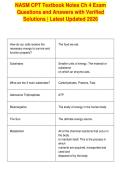
How do our cells receive the The food we eat.
necessary energy to survive and
function properly?
Substrates Smaller units of energy. The material or
substance
on which an enzyme acts.
What are the 3 main substrates? Carbohydrates, Proteins, Fats.
Adenosine Triphosphate ATP
Bioenergetics The study of energy in the human body
The Sun The ultimate energy source.
Metabolism All of the chemical reactions that occur in
the body
to maintain itself. This is the process in
which
nutrients are acquired, transported and
used and
disposed of by the body.
, What are the main sources of Carbohydrates, fats, proteins.
chemical energy for most
organisms?
Exercise Metabolism The examination of bioenergetics as it
relates to
the unique physiologic changes and
demands
placed on the body during exercise.
Lipids Fats
Carbohydrates Organic compounds of carbon, hydrogen,
and
oxygen, which include starches cellulose,
and
sugars, and are an important source of
energy. All
of these compounds are eventually broken
down in
the body to glucose, a simple sugar.
Glucose A simple sugar manufactured by the body
from
carbohydrates, fat, and to a lesser extent
protein,
which serves as the body's main source of
fuel.
Questions and Answers with Verified
Solutions | Latest Updated 2026
How do our cells receive the The food we eat.
necessary energy to survive and
function properly?
Substrates Smaller units of energy. The material or
substance
on which an enzyme acts.
What are the 3 main substrates? Carbohydrates, Proteins, Fats.
Adenosine Triphosphate ATP
Bioenergetics The study of energy in the human body
The Sun The ultimate energy source.
Metabolism All of the chemical reactions that occur in
the body
to maintain itself. This is the process in
which
nutrients are acquired, transported and
used and
disposed of by the body.
, What are the main sources of Carbohydrates, fats, proteins.
chemical energy for most
organisms?
Exercise Metabolism The examination of bioenergetics as it
relates to
the unique physiologic changes and
demands
placed on the body during exercise.
Lipids Fats
Carbohydrates Organic compounds of carbon, hydrogen,
and
oxygen, which include starches cellulose,
and
sugars, and are an important source of
energy. All
of these compounds are eventually broken
down in
the body to glucose, a simple sugar.
Glucose A simple sugar manufactured by the body
from
carbohydrates, fat, and to a lesser extent
protein,
which serves as the body's main source of
fuel.


