

Written by students who passed Immediately available after payment Read online or as PDF Wrong document? Swap it for free 4.6 TrustPilot
logo-home
Document preview thumbnail
Preview 3 out of 24 pages
Exam (elaborations)

Blueprint: RNSG 1327 – Exam #1 (Modules 1 & 2), with question and answers - Latest 2025/26.

Document preview thumbnail
Preview 3 out of 24 pages

Modules 1 & 2: Professional Nursing Foundations & Clinical Decision-Making Name: ____________________________ Date: _____________________________ Multiple Choice Questions Select the best answer for each question. Circle A, B, C, or D. 1. According to Benner’s Stages, which nurse is most likely to rely heavily on rules due to lack of experience? A. Competent B. Novice C. Proficient D. Expert 2. The Nursing Code of Ethics is best described as: A. A legal guide to determine malpractice B. A moral compass that guides professional nursing behavior C. A hospital-specific policy for nurses D. A guide to prioritize physician orders 3. What does the "Recognize Cues" step in the Clinical Judgment Model involve? A. Interpreting data B. Reassessing the plan C. Gathering and focusing on relevant information D. Planning patient education 4. Which component of the PICOT format identifies the measurable result? A. I B. O C. C D. T5. What is the primary benefit of Evidence-Based Practice (EBP)? A. Saves money B. Reduces nurse workload C. Combines research, expertise, and patient preferences D. Limits patient involvement in care 6. A patient is short of breath with chest pain. The nurse checks vitals and immediately notifies the provider. This demonstrates: A. Lack of critical thinking B. Benner’s novice stage C. Professional standards in critical thinking D. Improper prioritization 7. The correct order of the Nursing Process is: A. Planning → Assessment → Diagnosis → Evaluation → Implementation B. Assessment → Diagnosis → Planning → Implementation → Evaluation C. Diagnosis → Assessment → Planning → Implementation → Evaluation D. Evaluation → Diagnosis → Planning → Implementation → Assessment 8. Which is a correctly written SMART goal? A. Patient will feel better by tomorrow B. Administer Tylenol as needed C. Patient will report pain level 3/10 within 30 minutes after receiving pain medication D. Nurse will monitor vital signs 9. Which is not one of the 5 Rights of Delegation? A. Right person B. Right charting C. Right supervision D. Right communication 10. In SBAR, the "B" stands for: A. Baseline B. Background C. Behavior D. BalanceInfection Control and Safety 11. Which is the first element in the chain of infection? A. Susceptible host B. Mode of transmission C. Pathogen D. Portal of entry 12. When is a sterile field considered contaminated? A. When touched by another sterile item B. If an object drops 0.5 inches over the edge C. If sterile objects are kept at chest level D. When sterility is in doubt Fluid and Electrolyte Balance 13. Which IV solution is hypertonic and used to draw water out of cells into ECF? A. 0.9% NaCl B. 3% NaCl C. 0.45% NaCl D. D5W 14. Which of the following is a clinical sign of hypokalemia? A. Bradycardia and tall T waves B. Muscle weakness and leg cramps C. Flushed skin and low-grade fever D. Decreased reflexes and dry mouth15. What electrolyte imbalance is associated with positive Chvostek and Trousseau signs? A. Hypernatremia B. Hyperkalemia C. Hypocalcemia D. Hyperphosphatemia Acid-Base Balance 16. Which condition causes metabolic acidosis? A. Vomiting B. Diabetic ketoacidosis C. Anxiety attack D. Sedative overdose 17. What ABG imbalance is associated with hypoventilation? A. Respiratory alkalosis B. Metabolic alkalosis C. Metabolic acidosis D. Respiratory acidosis Electrolyte Values 18. A serum potassium level of 2.9 mEq/L indicates: A. Normal B. Hyperkalemia C. Hypokalemia D. Hypocalcemia 19. Which lab value is normal for calcium? A. 7.8 mg/dLB. 8.9 mg/dL C. 10.5 mg/dL D. 11.2 mg/dL Clinical Judgment & Scenarios 20.A nurse prioritizes care using ABCs. Which of the following would be the top priority? A. Fever of 102°F B. Complaints of back pain C. Wheezing and difficulty breathing D. Hypoglycemia 21. Using Maslow’s hierarchy, which patient need is highest? A. Pain management B. Self-esteem C. Family support D. Spiritual well-being 22.Which is an example of applying actual vs. potential problem prioritization? A. Monitoring for falls vs. treating a fracture B. Treating a pressure ulcer vs. repositioning every 2 hours C. Giving fluids vs. preventing dehydration D. Giving antibiotics for infection vs. educating about hygiene 23.A newly admitted patient reports vomiting and confusion. The nurse’s best first action is: A. Administer antiemetic B. Obtain electrolyte panel C. Perform focused assessment D. Notify the provider24.A patient in respiratory alkalosis needs: A. IV potassium B. Bag to rebreathe CO₂ C. Oxygen therapy D. Intubation 25.Which of the following best reflects critical thinking in nursing practice? A. Performing all ordered tasks without question B. Following hospital policy strictly in all cases C. Using clinical reasoning and questioning abnormal findings D. Asking other nurses to validate every clinical decision ️

Content preview

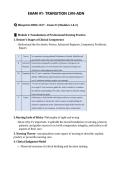
EXAM #1- TRANSITION LVN-ADN

🧠 Blueprint: RNSG 1327 – Exam #1 (Modules 1 & 2)


📘 Module 1: Foundations of Professional Nursing Practice
1. Benner’s Stages of Clinical Competence
 Understand the five levels: Novice, Advanced Beginner, Competent, Proficient,
Expert.


2.Nursing Code of Ethics- Philosophy of right and wrong
 Know why it’s important- it upholds the moral foundation or nursing, protects
patients, and guides nurses to act with compassion, integrity, and justice in all
aspects of their care .
3. Nursing Theory- conceptualizes some aspect of nursing to describe, explain,
predict, or prescribe nursing care.
4. Clinical Judgment Model
o Observed outcome of critical thinking and decision making

, Key components

Step Question Action
Recognize Cues What info is relevant? Gather and focus
Analyze Cues What does the data mean? Interpret
Prioritize Hypotheses What’s the most important problem? Prioritize
Generate Solutions What are my options? Plan
Take Action What will I do? Intervene
Evaluate Outcomes Did it work? Reassess

, 5. Evidence-Based Practice (EBP)- current practice / research –
-Problem -solving approach to clinical practice the combines the best evidence
with c;inician’s expertise, patient preferences and values, and health care
resources in the making decisions about patient care.
o Benefits
o Sources
o Challenge
 Use of current, relevant, and accurate evidence to guide care.
 PICOT format: Patient/Problem, Intervention, Comparison, Outcome,
Time.

Example:

Clinical Question:

In first-time mothers (P), does receiving postpartum lactation counseling (I) compared to no
counseling (C) improve exclusive breastfeeding rates (O) at 6 weeks postpartum (T)?

PICOT Breakdown:

• P: First-time mothers
• I: Postpartum lactation counseling
• C: No counseling
• O: Exclusive breastfeeding rates
• T: 6 weeks postpartum


Document information

Uploaded on
July 9, 2026
Number of pages
24
Written in
2025/2026
Type
Exam (elaborations)
Contains
Questions & answers
$16.99

Wrong document? Swap it for free Within 14 days of purchase and before downloading, you can choose a different document. You can simply spend the amount again.
Written by students who passed
Immediately available after payment
Read online or as PDF

Seller avatar
Reputation scores are based on the amount of documents a seller has sold for a fee and the reviews they have received for those documents. There are three levels: Bronze, Silver and Gold. The better the reputation, the more your can rely on the quality of the sellers work.
MindCraft
3.8
(47)
Sold
368
Followers
7
Items
2789
Last sold
8 hours ago


Why students choose Stuvia

Created by fellow students, verified by reviews

Quality you can trust: written by students who passed their tests and reviewed by others who've used these notes.

Didn't get what you expected? Choose another document

No worries! You can instantly pick a different document that better fits what you're looking for.

Pay as you like, start learning right away

No subscription, no commitments. Pay the way you're used to via credit card and download your PDF document instantly.

Student with book image

“Bought, downloaded, and aced it. It really can be that simple.”

Alisha Student

Working on your references?

Create accurate citations in APA, MLA and Harvard with our free citation generator.

Working on your references?

Frequently asked questions
