

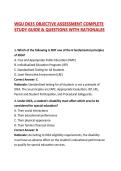
WGU D635 OBJECTIVE ASSESSMENT COMPLETE
STUDY GUIDE & QUESTIONS WITH RATIONALES
1. Which of the following is NOT one of the 6 fundamental principles
of IDEA?
A. Free and Appropriate Public Education (FAPE)
B. Individualized Education Programs (IEP)
C. Standardized Testing for All Students
D. Least Restrictive Environment (LRE)
Correct Answer: C
Rationale: Standardized testing for all students is not a principle of
IDEA. The six principles are FAPE, Appropriate Evaluation, IEP, LRE,
Parent and Student Participation, and Procedural Safeguards.
2. Under IDEA, a student's disability must affect which area to be
considered for special education?
A. Their social interactions
B. Their educational performance
C. Their physical appearance
D. Their family's financial status
Correct Answer: B
Rationale: According to IDEA eligibility requirements, the disability
must have an adverse effect on the student's educational performance
to qualify for special education services.
,3. What is the primary purpose of Title III of the Every Student
Succeeds Act (ESSA)?
A. To fund school infrastructure projects
B. To ensure English Learners (ELs) attain English proficiency and meet
academic standards
C. To mandate physical education requirements for all students
D. To provide free meals to all students
Correct Answer: B
Rationale: Title III focuses on helping ELs attain English proficiency and
meet state academic standards. It aims to assist ELs in overcoming
language barriers.
4. A student is given extended time to complete a test because they
have a processing speed issue. This is an example of a(n):
A. Modification
B. Accommodation
C. Alternative assessment
D. IEP goal
Correct Answer: B
Rationale: An accommodation changes how a student learns or is
tested without changing the content or standards. Extended time allows
the student to demonstrate knowledge without being rushed.
5. The "Least Restrictive Environment" (LRE) principle under IDEA
requires that:
A. Students with disabilities are educated in separate classrooms for
their safety
B. Students with disabilities are educated alongside their non-disabled
peers to the maximum extent appropriate
C. All students with disabilities must be in a general education
,classroom 100% of the time
D. Students with disabilities are restricted from participating in
extracurricular activities
Correct Answer: B
Rationale: LRE mandates that students with disabilities should be
educated with students without disabilities to the maximum extent
appropriate for their needs.
6. Which of the following is an example of a modification?
A. Providing a student with a quiet space to take a test
B. Allowing a student to use a calculator on a math test that assesses
computation skills
C. Reducing the number of math problems a student must complete
from 20 to 10
D. Providing a student with a copy of the teacher's notes
Correct Answer: C
Rationale: A modification changes what a student is expected to learn
or the standard itself. Reducing the number of problems changes the
expectations of the assignment.
7. The term "neurodivergence" encompasses all of the following
EXCEPT:
A. Dyslexia
B. ADHD
C. Aphasia
D. Autism Spectrum Disorder
Correct Answer: C
Rationale: While aphasia is a language disorder due to brain injury, it is
not generally classified as a neurodivergence like dyslexia, ADHD, or
, Autism, which are developmental and inherent differences in brain
function. Aphasia is typically an acquired condition.
8. What is the first stage of second language acquisition according to
Krashen?
A. Early Production
B. Speech Emergent
C. Pre-production
D. Intermediate Fluency
Correct Answer: C
Rationale: The first stage is Pre-production, also known as the "silent
period," where the learner is absorbing the new language and may not
speak yet.
9. A student who has difficulty producing sounds effectively for
speaking has a:
A. Language disorder
B. Speech disorder
C. Auditory Processing Disorder
D. Aphasia
Correct Answer: B
Rationale: A speech disorder specifically involves difficulty with the
physical production of sounds, fluency, or voice, whereas a language
disorder involves understanding or using language.
10. What is the role of a Home Language Survey?
A. To determine a student's academic standing in their native language
B. To help identify students who may need English language support
services upon enrollment
C. To decide a student's placement in a special education program
STUDY GUIDE & QUESTIONS WITH RATIONALES
1. Which of the following is NOT one of the 6 fundamental principles
of IDEA?
A. Free and Appropriate Public Education (FAPE)
B. Individualized Education Programs (IEP)
C. Standardized Testing for All Students
D. Least Restrictive Environment (LRE)
Correct Answer: C
Rationale: Standardized testing for all students is not a principle of
IDEA. The six principles are FAPE, Appropriate Evaluation, IEP, LRE,
Parent and Student Participation, and Procedural Safeguards.
2. Under IDEA, a student's disability must affect which area to be
considered for special education?
A. Their social interactions
B. Their educational performance
C. Their physical appearance
D. Their family's financial status
Correct Answer: B
Rationale: According to IDEA eligibility requirements, the disability
must have an adverse effect on the student's educational performance
to qualify for special education services.
,3. What is the primary purpose of Title III of the Every Student
Succeeds Act (ESSA)?
A. To fund school infrastructure projects
B. To ensure English Learners (ELs) attain English proficiency and meet
academic standards
C. To mandate physical education requirements for all students
D. To provide free meals to all students
Correct Answer: B
Rationale: Title III focuses on helping ELs attain English proficiency and
meet state academic standards. It aims to assist ELs in overcoming
language barriers.
4. A student is given extended time to complete a test because they
have a processing speed issue. This is an example of a(n):
A. Modification
B. Accommodation
C. Alternative assessment
D. IEP goal
Correct Answer: B
Rationale: An accommodation changes how a student learns or is
tested without changing the content or standards. Extended time allows
the student to demonstrate knowledge without being rushed.
5. The "Least Restrictive Environment" (LRE) principle under IDEA
requires that:
A. Students with disabilities are educated in separate classrooms for
their safety
B. Students with disabilities are educated alongside their non-disabled
peers to the maximum extent appropriate
C. All students with disabilities must be in a general education
,classroom 100% of the time
D. Students with disabilities are restricted from participating in
extracurricular activities
Correct Answer: B
Rationale: LRE mandates that students with disabilities should be
educated with students without disabilities to the maximum extent
appropriate for their needs.
6. Which of the following is an example of a modification?
A. Providing a student with a quiet space to take a test
B. Allowing a student to use a calculator on a math test that assesses
computation skills
C. Reducing the number of math problems a student must complete
from 20 to 10
D. Providing a student with a copy of the teacher's notes
Correct Answer: C
Rationale: A modification changes what a student is expected to learn
or the standard itself. Reducing the number of problems changes the
expectations of the assignment.
7. The term "neurodivergence" encompasses all of the following
EXCEPT:
A. Dyslexia
B. ADHD
C. Aphasia
D. Autism Spectrum Disorder
Correct Answer: C
Rationale: While aphasia is a language disorder due to brain injury, it is
not generally classified as a neurodivergence like dyslexia, ADHD, or
, Autism, which are developmental and inherent differences in brain
function. Aphasia is typically an acquired condition.
8. What is the first stage of second language acquisition according to
Krashen?
A. Early Production
B. Speech Emergent
C. Pre-production
D. Intermediate Fluency
Correct Answer: C
Rationale: The first stage is Pre-production, also known as the "silent
period," where the learner is absorbing the new language and may not
speak yet.
9. A student who has difficulty producing sounds effectively for
speaking has a:
A. Language disorder
B. Speech disorder
C. Auditory Processing Disorder
D. Aphasia
Correct Answer: B
Rationale: A speech disorder specifically involves difficulty with the
physical production of sounds, fluency, or voice, whereas a language
disorder involves understanding or using language.
10. What is the role of a Home Language Survey?
A. To determine a student's academic standing in their native language
B. To help identify students who may need English language support
services upon enrollment
C. To decide a student's placement in a special education program


