MNG3702 – Strategy Implementation and Control – Prescribed Book Summary – Willmary Murtz Year 2021
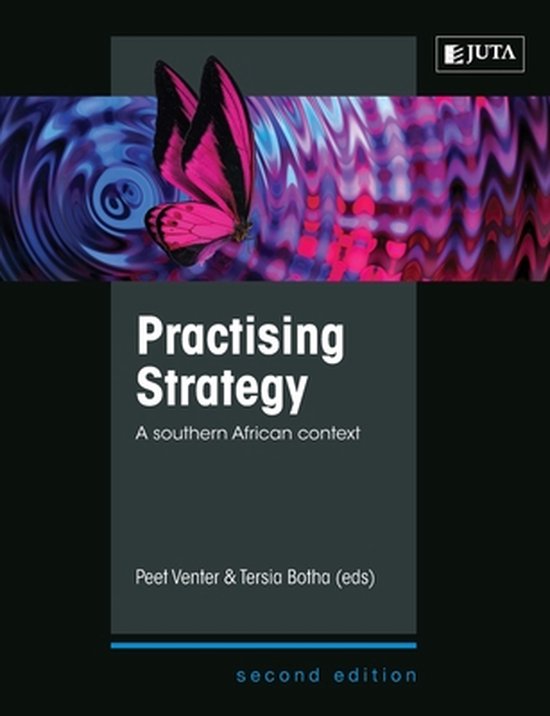
Prescribed Book: Venter, P & Botha, T (eds). 2019. Practising strategy – A southern African
context. 2nd ed. Cape Town: Juta. ISBN 9781485125150
Chapter 8: Strategy implementation as change management
8.1 What is Strategic Implementation?
Strategy Implementation: is the process during which the organization draws on both human and
non-human factors to ensure that its strategy is executed in line with the plans devised during the
strategy formation phase.
Strategy Implementation is the action phase of strategic management.
Strategy Implementation is the process whereby selected strategies are turned into action in
order to realise the vision, mission and goals of the organization.
Strategy Implementation deals primarily with change by translating organizational strategies into
action. What has been planned must now be executed.
It is the phase of the strategic management process where management aligns strategic
leadership, organizational culture, organizational structures, rewards systems, policies and
resource allocation with its chosen strategies.
Changes and Differences between Strategy formation and Implementation
Strategy formation and implementation differ from each other the following ways:
Strategy formation is regarded as the intellectual phase of strategic management, while strategy
implementation is the action phase.
Internal and external forces drive strategy formation, whereas strategy implementation is driven
by internal, organizational and operations related forces.
Strategy formation requires strategists to be intuitive with good analytical and forecasting abilities,
while strategy implementation requires strategists to have excellent motivation and leadership
skills, people related skills.
Strategy formation is regarded as the main responsibility of senior management, whereas lower
levels of management are regarded as having the responsibility to implement strategies.
Strategy formation is concerned with the overall goals and objectives of the organization,
whereas strategy implementation is concerned with the deliberate choice of a set of activities or
steps needed to achieve strategic goals.
Strategy formation follows a top-down approach – the strategic goals and plans that are
developed, lead to the development of tactical and operational goals and plans. On the
operational level, goals and plans for portfolios, programmes, projects, deliverables and activities
are developed.
Strategy implementation follows a bottom-up approach – the execution of activities leads to the
realization of planned deliverables, deliverables will realise project goals, the realisation of project
goals will lead to the realisation of programme and portfolio goals. Then, the realisation of
portfolio goals will lead to the realisation of operational, tactical and ultimately, strategic goals.
8.2 4 Barriers to Successful Strategy Implementation
1. People Barrier: Strategy Implementation is the action phase of strategic management, where
the successful execution of activities by various people is the first step in the realisation of
organizational goals and ultimately, its vision. It is imperative that organisational reward and
incentive systems be linked to strategy implementation to assist in overcoming the natural
resistance to change that can be expected.
2. Vision Barrier: the execution of all the activities, deliverables and the outcomes of the portfolios
should lead to the attainment of strategic goals and the organisation’s vision. Each individual
should have a clear understanding of the vision, of the strategy that the organization intends to
implement in order to realise its vision.
3. Management Barrier: Strategic management in practice is a fully integrated process with
overlaps between strategy formation, implementation and control - a process that needs to be
managed continuously.
4. Resource Barrier: Resources are needed for strategy formation, implementation and control,
and budgeting which plays a pivotal role in strategic management.
In order to increase value, organisations need to overcome these barriers to strategy implementation by
implementing a formal process. This can be achieved through five principles of Strategy Implementation.
8.3 Principles of Strategy Implementation
,MNG3702 – Strategy Implementation and Control – Prescribed Book Summary – Willmary Murtz Year 2021
Prescribed Book: Venter, P & Botha, T (eds). 2019. Practising strategy – A southern African
context. 2nd ed. Cape Town: Juta. ISBN 9781485125150
Principle 1: Translate the strategy to operational terms.
Translating the corporate strategy into the logical architecture of a strategy map and BSC to
specify the details of the critical elements of the corporate strategy.
A strategy map is drawn up by specifying strategic objectives for each element (financial,
customer, internal business processes, learning and growth) of the BSC.
The organisation should not have more than 20 objectives – tracking too many strategic
objectives will dilute the overall goals of the organisation.
Strategy maps can also have arrows between the objectives to show their main cause and effect
chain. By following the arrows paths, we can see the objectives in the lower perspectives
(learning and growth, internal business processes), drive the success of the higher ones
(customer and financial).
With a well-designed strategy map, every individual employee will know the vision and overall
strategy of the organisation. Also every employee will know where he/she fits into the big picture
of this overall vision and strategy.
This principle is imperative in creating a common understanding and point of reference for all
individuals, functional units and business units in the organisation.
It helps to overcome the vision barrier
Principle 2: Align the organisation to its corporate strategy
Organisations consist of various sectors, business units and functional departments, each with
their own operations and often, each with their own strategies.
Functional departments such as finance, marketing, procurement, have their own bodies of
knowledge, language and culture.
Functional silos may arise and become a major barrier in successful strategy implementation,
since organisations may experience difficulty in communicating and co-ordinating activities
across these specialized functions.
For an organisation to create synergy, individual strategies must be aligned, integrated and
linked.
The second principle involves the creation of synergy to ensure that these linkages actually
occur. It entails the aligning all hierarchical levels (business units, functional units and individual
and individual employees) to the strategy.
This will require the following:
(1) each business unit will develop a long-term plan and BSC consistent with strategic priorities;
and (2) each functional unit will develop a plan and BSC for best practice sharing to create
synergies across business units. When this process is complete, all units should have well-
defined strategies that are articulated and measured by BSCs and strategy maps. Linkages
should also be established across boundaries with external stakeholders, such as customers and
suppliers.
BSCs can also be developed to define the organisation’s relationship with these stakeholders.
The execution of this step will help overcome the people barrier through initiatives that support
strategy implementation. The importance of appropriate change management and effective
communication should be acknowledge in this steps.
Principle 3: Make Strategy everyone’s everyday job
Senior management and other strategists cannot implement strategies on their own – they need
the actions and ideas from everyone in the organisation.
The third principle requires that all employees understand the strategy and conduct their day-to-
day activities in such a way that it contributes to the success of the strategy.
During this stage, organisations should also link their reward systems to the BSC.
The execution of this stage is required to overcome the resource barrier.
,MNG3702 – Strategy Implementation and Control – Prescribed Book Summary – Willmary Murtz Year 2021
Prescribed Book: Venter, P & Botha, T (eds). 2019. Practising strategy – A southern African
context. 2nd ed. Cape Town: Juta. ISBN 9781485125150
8.3 Principles of Strategy Implementation
Principle 4: Viewing strategy as a continual process
The fourth principle introduces strategic management as a double-loop process, which
integrates the management of tactics with the management of strategy.
This is achieved through the execution of three steps of the double-loop process.
1. Organisations should link strategy to the budgeting process. In terms of budgeting, it is useful
to have two kinds of budgets, namely strategic and operational budget. Strategic budgets
enable organisations to develop entirely new capabilities, reach new customers and or new
markets, become good corporate citizens or improve existing processes and capabilities.
2. is the execution of management meetings (monthly or quarterly) to review strategy.
3. a process for learning and adapting the strategy should be executed. Management should be
alerted to emerging strategies, new opportunities and risks, and adapt where necessary.
Principle 5: Mobile leadership for change
Principle 1 to 4 focus on the BSC tool, framework and the processes that support it.
To become a truly strategic-focused organisation, requires more than tools and processes.
First, it requires ownership and the involvement of the executive team.
Second, it requires change from virtually every part of the organisation.
To be considered strategic, organisations cannot carry on what they were doing (ie. business as usual).
Furthermore, being strategic is not a quick fix of small change – it requires a large and sustained change
effort over a long period of time.
The focus should be on the mobilization of leadership for change, to get the change process started.
Once started the focus shifts to governance to install the changes.
A strategic management system evolves. This system will institutionalise the new cultural values and
process into a new system for managing.
8.4 Change – A fundamental strategy implementation element
Change is an essential and inevitable feature of organisational life.
Change can be defined as the action to make the form, nature, content or future course of something
different from what it is or from what it would be if left alone.
Organisational change can be defined as a process in which an organisation changes its working
methods or aims. Sometimes, deep organisational change is necessary to maintain a competitive
advantage.
Strategic change involves a change in the strategic direction of the organisation and the
implementation of new strategies, involving major changes to the normal or previous routines in the
organisation.
Strategic change seeks to improve an organisation’s competitive position by improving certain of its
features, for example, its cost position or differentiation in terms of its product and/or service offerings.
Strategic change causes change in other areas of the organisation. For example structure, culture,
systems and technology to support successful implementation of Naspers’ strategy that necessitated
various strategic change.
, MNG3702 – Strategy Implementation and Control – Prescribed Book Summary – Willmary Murtz Year 2021
Prescribed Book: Venter, P & Botha, T (eds). 2019. Practising strategy – A southern African
context. 2nd ed. Cape Town: Juta. ISBN 9781485125150
8.4 Change – A fundamental strategy implementation element
Type of Strategic Change
Strategic change can take many forms, for example a change in the organisation’s
vision, mission, strategy, goals and objectives
products and/or services that it offers
market to which it offers its products and/or services
processes used to offer products and/or services to the market
technology used to offer products and/or services to the market
values, corporate culture and/or shared beliefs
outcomes, the way in which people work, or its performance
location (including internationalisation)
structure
Strategic change can be classified based on two variables, namely
1. the extent of the change required, and
2. the speed of the change that is to be achieved.
8.5 Type of Strategic Change
Based on these two variables, the following four types of strategic changes are distinguished:
1. Evolution (transformation; incremental). Evolutionary change refers to transformational
change that is implemented gradually (or incrementally) through inter related initiatives. This type
of change is likely to be proactive, undertaken in anticipation of the need for future change.
These changes are seen as opportunities for the organisation to improve, aspects such as
project management techniques that spread with use or improved administrative management
process.
2. Adaptation (realignment; incremental). Adaptation change refers to change undertaken to
realign the way in which the organisation operates. It is usually implemented in a series of steps.
This type of change is most common in organisations and occurs incrementally according to
changing circumstances.
3. Revolution (transformation; “big bang”). This refers to transformational change that occurs
through simultaneous initiatives on many aspects. Revolutionary change is usually forced and
reactive because of a changing competitive condition that an organisation is facing such as a
potential takeover that threatens the existence of the organisation. Another example is when
information technology department fails an audit and immediate changes need to be made.
4. Reconstruction (realignment; “big bang”). This refers to change undertaken to realign the way
in which the organisation operates with many initiatives implemented simultaneously. This type of
change is usually forced because of a changing competitive position condition that an
organisation is facing. Reconstruction may involve a good deal of disruption in an organisation.
For example a turnaround strategy may be implemented, followed by a major structural
adjustment or a major cost-cutting programme may be implemented in reaction to declining
financial performance or changing market conditions.
8.6 Models of planned change
The majority of models of change management are founded on the notion that change can be viewed as
a planned activity that requires management.
Planned change can be defined as an approach to manage change that assumes that change is an
activity that can be managed, organised and led by the senior management of an organisation.
The notion that change can be viewed as a planned activity, is also predicated upon the assumption that
an organisation can move from one stable state to another.
8.6 Models of planned change
Prescribed Book: Venter, P & Botha, T (eds). 2019. Practising strategy – A southern African
context. 2nd ed. Cape Town: Juta. ISBN 9781485125150
Chapter 8: Strategy implementation as change management
8.1 What is Strategic Implementation?
Strategy Implementation: is the process during which the organization draws on both human and
non-human factors to ensure that its strategy is executed in line with the plans devised during the
strategy formation phase.
Strategy Implementation is the action phase of strategic management.
Strategy Implementation is the process whereby selected strategies are turned into action in
order to realise the vision, mission and goals of the organization.
Strategy Implementation deals primarily with change by translating organizational strategies into
action. What has been planned must now be executed.
It is the phase of the strategic management process where management aligns strategic
leadership, organizational culture, organizational structures, rewards systems, policies and
resource allocation with its chosen strategies.
Changes and Differences between Strategy formation and Implementation
Strategy formation and implementation differ from each other the following ways:
Strategy formation is regarded as the intellectual phase of strategic management, while strategy
implementation is the action phase.
Internal and external forces drive strategy formation, whereas strategy implementation is driven
by internal, organizational and operations related forces.
Strategy formation requires strategists to be intuitive with good analytical and forecasting abilities,
while strategy implementation requires strategists to have excellent motivation and leadership
skills, people related skills.
Strategy formation is regarded as the main responsibility of senior management, whereas lower
levels of management are regarded as having the responsibility to implement strategies.
Strategy formation is concerned with the overall goals and objectives of the organization,
whereas strategy implementation is concerned with the deliberate choice of a set of activities or
steps needed to achieve strategic goals.
Strategy formation follows a top-down approach – the strategic goals and plans that are
developed, lead to the development of tactical and operational goals and plans. On the
operational level, goals and plans for portfolios, programmes, projects, deliverables and activities
are developed.
Strategy implementation follows a bottom-up approach – the execution of activities leads to the
realization of planned deliverables, deliverables will realise project goals, the realisation of project
goals will lead to the realisation of programme and portfolio goals. Then, the realisation of
portfolio goals will lead to the realisation of operational, tactical and ultimately, strategic goals.
8.2 4 Barriers to Successful Strategy Implementation
1. People Barrier: Strategy Implementation is the action phase of strategic management, where
the successful execution of activities by various people is the first step in the realisation of
organizational goals and ultimately, its vision. It is imperative that organisational reward and
incentive systems be linked to strategy implementation to assist in overcoming the natural
resistance to change that can be expected.
2. Vision Barrier: the execution of all the activities, deliverables and the outcomes of the portfolios
should lead to the attainment of strategic goals and the organisation’s vision. Each individual
should have a clear understanding of the vision, of the strategy that the organization intends to
implement in order to realise its vision.
3. Management Barrier: Strategic management in practice is a fully integrated process with
overlaps between strategy formation, implementation and control - a process that needs to be
managed continuously.
4. Resource Barrier: Resources are needed for strategy formation, implementation and control,
and budgeting which plays a pivotal role in strategic management.
In order to increase value, organisations need to overcome these barriers to strategy implementation by
implementing a formal process. This can be achieved through five principles of Strategy Implementation.
8.3 Principles of Strategy Implementation
,MNG3702 – Strategy Implementation and Control – Prescribed Book Summary – Willmary Murtz Year 2021
Prescribed Book: Venter, P & Botha, T (eds). 2019. Practising strategy – A southern African
context. 2nd ed. Cape Town: Juta. ISBN 9781485125150
Principle 1: Translate the strategy to operational terms.
Translating the corporate strategy into the logical architecture of a strategy map and BSC to
specify the details of the critical elements of the corporate strategy.
A strategy map is drawn up by specifying strategic objectives for each element (financial,
customer, internal business processes, learning and growth) of the BSC.
The organisation should not have more than 20 objectives – tracking too many strategic
objectives will dilute the overall goals of the organisation.
Strategy maps can also have arrows between the objectives to show their main cause and effect
chain. By following the arrows paths, we can see the objectives in the lower perspectives
(learning and growth, internal business processes), drive the success of the higher ones
(customer and financial).
With a well-designed strategy map, every individual employee will know the vision and overall
strategy of the organisation. Also every employee will know where he/she fits into the big picture
of this overall vision and strategy.
This principle is imperative in creating a common understanding and point of reference for all
individuals, functional units and business units in the organisation.
It helps to overcome the vision barrier
Principle 2: Align the organisation to its corporate strategy
Organisations consist of various sectors, business units and functional departments, each with
their own operations and often, each with their own strategies.
Functional departments such as finance, marketing, procurement, have their own bodies of
knowledge, language and culture.
Functional silos may arise and become a major barrier in successful strategy implementation,
since organisations may experience difficulty in communicating and co-ordinating activities
across these specialized functions.
For an organisation to create synergy, individual strategies must be aligned, integrated and
linked.
The second principle involves the creation of synergy to ensure that these linkages actually
occur. It entails the aligning all hierarchical levels (business units, functional units and individual
and individual employees) to the strategy.
This will require the following:
(1) each business unit will develop a long-term plan and BSC consistent with strategic priorities;
and (2) each functional unit will develop a plan and BSC for best practice sharing to create
synergies across business units. When this process is complete, all units should have well-
defined strategies that are articulated and measured by BSCs and strategy maps. Linkages
should also be established across boundaries with external stakeholders, such as customers and
suppliers.
BSCs can also be developed to define the organisation’s relationship with these stakeholders.
The execution of this step will help overcome the people barrier through initiatives that support
strategy implementation. The importance of appropriate change management and effective
communication should be acknowledge in this steps.
Principle 3: Make Strategy everyone’s everyday job
Senior management and other strategists cannot implement strategies on their own – they need
the actions and ideas from everyone in the organisation.
The third principle requires that all employees understand the strategy and conduct their day-to-
day activities in such a way that it contributes to the success of the strategy.
During this stage, organisations should also link their reward systems to the BSC.
The execution of this stage is required to overcome the resource barrier.
,MNG3702 – Strategy Implementation and Control – Prescribed Book Summary – Willmary Murtz Year 2021
Prescribed Book: Venter, P & Botha, T (eds). 2019. Practising strategy – A southern African
context. 2nd ed. Cape Town: Juta. ISBN 9781485125150
8.3 Principles of Strategy Implementation
Principle 4: Viewing strategy as a continual process
The fourth principle introduces strategic management as a double-loop process, which
integrates the management of tactics with the management of strategy.
This is achieved through the execution of three steps of the double-loop process.
1. Organisations should link strategy to the budgeting process. In terms of budgeting, it is useful
to have two kinds of budgets, namely strategic and operational budget. Strategic budgets
enable organisations to develop entirely new capabilities, reach new customers and or new
markets, become good corporate citizens or improve existing processes and capabilities.
2. is the execution of management meetings (monthly or quarterly) to review strategy.
3. a process for learning and adapting the strategy should be executed. Management should be
alerted to emerging strategies, new opportunities and risks, and adapt where necessary.
Principle 5: Mobile leadership for change
Principle 1 to 4 focus on the BSC tool, framework and the processes that support it.
To become a truly strategic-focused organisation, requires more than tools and processes.
First, it requires ownership and the involvement of the executive team.
Second, it requires change from virtually every part of the organisation.
To be considered strategic, organisations cannot carry on what they were doing (ie. business as usual).
Furthermore, being strategic is not a quick fix of small change – it requires a large and sustained change
effort over a long period of time.
The focus should be on the mobilization of leadership for change, to get the change process started.
Once started the focus shifts to governance to install the changes.
A strategic management system evolves. This system will institutionalise the new cultural values and
process into a new system for managing.
8.4 Change – A fundamental strategy implementation element
Change is an essential and inevitable feature of organisational life.
Change can be defined as the action to make the form, nature, content or future course of something
different from what it is or from what it would be if left alone.
Organisational change can be defined as a process in which an organisation changes its working
methods or aims. Sometimes, deep organisational change is necessary to maintain a competitive
advantage.
Strategic change involves a change in the strategic direction of the organisation and the
implementation of new strategies, involving major changes to the normal or previous routines in the
organisation.
Strategic change seeks to improve an organisation’s competitive position by improving certain of its
features, for example, its cost position or differentiation in terms of its product and/or service offerings.
Strategic change causes change in other areas of the organisation. For example structure, culture,
systems and technology to support successful implementation of Naspers’ strategy that necessitated
various strategic change.
, MNG3702 – Strategy Implementation and Control – Prescribed Book Summary – Willmary Murtz Year 2021
Prescribed Book: Venter, P & Botha, T (eds). 2019. Practising strategy – A southern African
context. 2nd ed. Cape Town: Juta. ISBN 9781485125150
8.4 Change – A fundamental strategy implementation element
Type of Strategic Change
Strategic change can take many forms, for example a change in the organisation’s
vision, mission, strategy, goals and objectives
products and/or services that it offers
market to which it offers its products and/or services
processes used to offer products and/or services to the market
technology used to offer products and/or services to the market
values, corporate culture and/or shared beliefs
outcomes, the way in which people work, or its performance
location (including internationalisation)
structure
Strategic change can be classified based on two variables, namely
1. the extent of the change required, and
2. the speed of the change that is to be achieved.
8.5 Type of Strategic Change
Based on these two variables, the following four types of strategic changes are distinguished:
1. Evolution (transformation; incremental). Evolutionary change refers to transformational
change that is implemented gradually (or incrementally) through inter related initiatives. This type
of change is likely to be proactive, undertaken in anticipation of the need for future change.
These changes are seen as opportunities for the organisation to improve, aspects such as
project management techniques that spread with use or improved administrative management
process.
2. Adaptation (realignment; incremental). Adaptation change refers to change undertaken to
realign the way in which the organisation operates. It is usually implemented in a series of steps.
This type of change is most common in organisations and occurs incrementally according to
changing circumstances.
3. Revolution (transformation; “big bang”). This refers to transformational change that occurs
through simultaneous initiatives on many aspects. Revolutionary change is usually forced and
reactive because of a changing competitive condition that an organisation is facing such as a
potential takeover that threatens the existence of the organisation. Another example is when
information technology department fails an audit and immediate changes need to be made.
4. Reconstruction (realignment; “big bang”). This refers to change undertaken to realign the way
in which the organisation operates with many initiatives implemented simultaneously. This type of
change is usually forced because of a changing competitive position condition that an
organisation is facing. Reconstruction may involve a good deal of disruption in an organisation.
For example a turnaround strategy may be implemented, followed by a major structural
adjustment or a major cost-cutting programme may be implemented in reaction to declining
financial performance or changing market conditions.
8.6 Models of planned change
The majority of models of change management are founded on the notion that change can be viewed as
a planned activity that requires management.
Planned change can be defined as an approach to manage change that assumes that change is an
activity that can be managed, organised and led by the senior management of an organisation.
The notion that change can be viewed as a planned activity, is also predicated upon the assumption that
an organisation can move from one stable state to another.
8.6 Models of planned change