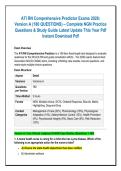
ATI RN Comprehensive Predictor Exams 2026:
Version A (180 QUESTIONS) – Complete NGN Practice
Questions & Study Guide Latest Update This Year Pdf
Instant Download Pdf
Exam Overview
The ATI RN Comprehensive Predictor is a 180-item fixed-length test designed to evaluate
readiness for the NCLEX-RN and guide remediation efforts . The 2026 exams feature Next
Generation NCLEX (NGN) items, including unfolding case studies, bow-tie questions, and
matrix-style multiple-choice questions.
Exam Structure:
Aspect Detail
Versions Versions A
Questions 180
per Version
Time Allotted 3 hours
Format NGN: Multiple-choice, SATA, Ordered Response, Bow-tie, Matrix,
Highlighting, Drag-and-Drop
Content Management of Care (20%), Pharmacology (18%), Physiological
Categories Adaptation (14%), Safety/Infection Control (12%), Health Promotion
(9%), Psychosocial Integrity (9%), Basic Care (6%), Risk Reduction
(12%)
Version A: Core Clinical Judgment & NGN Case Studies (Questions 1-180)
1. A home health nurse is caring for a child who has Lyme disease. Which of the
following is an appropriate action for the nurse to take?
A) Ensure the state health department has been notified
B) Administer antitoxin
, C) Educate the family to avoid sharing personal belongings
D) Assess for skin necrosis
Rationale: Lyme disease is a reportable communicable disease. The nurse must ensure
proper notification to public health authorities. Antitoxin is not used; antibiotics are. Skin
necrosis is not characteristic; erythema migrans is the classic rash .
2. A nurse is caring for a client who has been admitted to the hospital. (NGN - Select
5 actions the nurse should take)
A) Provide frequent rest periods
B) Restrict client sodium intake
C) Advise client to avoid using soap and alcohol-based lotions
D) Encourage fluid intake
E) Monitor for signs of infection
F) Assess vital signs every 4 hours
Correct Answers: A, C, E, F, and D
Rationale: Frequent rest periods conserve energy; avoiding soap/alcohol lotions prevents
skin dryness and breakdown; monitoring for infection and vital signs ensures early detection
of complications; fluid intake prevents dehydration .
3. A nurse is providing discharge teaching for a client who has an implantable
cardioverter defibrillator. Which of the following statements demonstrates
understanding of the teaching?
A) "I will soak in the tub rather than showering"
B) "I will wear loose clothing around my ICD"
C) "I will stop using my microwave oven at home because of my ICD"
D) "I can hold my cellphone on the same side of my body as the ICD"
,Rationale: Loose clothing prevents irritation over the ICD site. Tub soaking is not
recommended; microwave ovens do not interfere with ICDs; cellphones should be held on
the opposite side .
4. A nurse is assessing a newborn who has a blood glucose level of 30 mg/dL. Which
of the following manifestations should the nurse expect?
A) Loose stools
B) Jitteriness
C) Hypertonia
D) Abdominal distention
Rationale: Jitteriness is a classic sign of neonatal hypoglycemia. Loose stools, hypertonia,
and abdominal distention are not characteristic findings .
5. A nurse is caring for a client who is at 14 weeks gestation and reports feelings of
ambivalence about being pregnant. Which of the following responses should the
nurse make?
A) "Describe your feelings to me about being pregnant"
B) "You should discuss your feelings about being pregnant with your provider"
C) "Have you discussed these feelings with your partner?"
D) "When did you start having these feelings?"
Rationale: Open-ended questions encourage the client to express feelings. Ambivalence is
common in the first trimester .
6. A nurse is planning care for a client who has a prescription for a bowel-training
program following a spinal cord injury. Which of the following actions should the
nurse include in the plan of care?
A) Encourage a maximum fluid intake of 1,500 mL per day
B) Increase the amount of refined grains in the client's diet
, C) Provide the client with a cold drink prior to defecation
D) Administer a rectal suppository 30 minutes prior to scheduled defecation
times
Rationale: A rectal suppository stimulates defecation and should be given 30 minutes
before scheduled bowel movements to establish a routine .
7. A nurse is caring for a client who is in active labor and requests pain management.
Which of the following actions should the nurse take?
A) Administer ondansetron
B) Place the client in a warm shower
C) Apply fundal pressure during contractions
D) Assist the client to a supine position
Rationale: Warm showers provide non-pharmacologic pain relief during labor. Fundal
pressure is contraindicated; supine position can cause supine hypotension .
8. A nurse in an emergency department is performing triage for multiple clients
following a disaster. Which of the following clients should the nurse prioritize?
A) A client with a minor laceration
B) A client with a fractured arm
C) A client with indications of hypovolemic shock
D) A client with a panic attack
Rationale: In mass casualty triage, life-threatening conditions such as hypovolemic shock
are the highest priority .
9. A nurse in a provider's office is reviewing the laboratory results of a group of
clients. Which of the following sexually transmitted infections is a nationally
notifiable infectious disease that should be reported to the state health department?
A) Chlamydia
Version A (180 QUESTIONS) – Complete NGN Practice
Questions & Study Guide Latest Update This Year Pdf
Instant Download Pdf
Exam Overview
The ATI RN Comprehensive Predictor is a 180-item fixed-length test designed to evaluate
readiness for the NCLEX-RN and guide remediation efforts . The 2026 exams feature Next
Generation NCLEX (NGN) items, including unfolding case studies, bow-tie questions, and
matrix-style multiple-choice questions.
Exam Structure:
Aspect Detail
Versions Versions A
Questions 180
per Version
Time Allotted 3 hours
Format NGN: Multiple-choice, SATA, Ordered Response, Bow-tie, Matrix,
Highlighting, Drag-and-Drop
Content Management of Care (20%), Pharmacology (18%), Physiological
Categories Adaptation (14%), Safety/Infection Control (12%), Health Promotion
(9%), Psychosocial Integrity (9%), Basic Care (6%), Risk Reduction
(12%)
Version A: Core Clinical Judgment & NGN Case Studies (Questions 1-180)
1. A home health nurse is caring for a child who has Lyme disease. Which of the
following is an appropriate action for the nurse to take?
A) Ensure the state health department has been notified
B) Administer antitoxin
, C) Educate the family to avoid sharing personal belongings
D) Assess for skin necrosis
Rationale: Lyme disease is a reportable communicable disease. The nurse must ensure
proper notification to public health authorities. Antitoxin is not used; antibiotics are. Skin
necrosis is not characteristic; erythema migrans is the classic rash .
2. A nurse is caring for a client who has been admitted to the hospital. (NGN - Select
5 actions the nurse should take)
A) Provide frequent rest periods
B) Restrict client sodium intake
C) Advise client to avoid using soap and alcohol-based lotions
D) Encourage fluid intake
E) Monitor for signs of infection
F) Assess vital signs every 4 hours
Correct Answers: A, C, E, F, and D
Rationale: Frequent rest periods conserve energy; avoiding soap/alcohol lotions prevents
skin dryness and breakdown; monitoring for infection and vital signs ensures early detection
of complications; fluid intake prevents dehydration .
3. A nurse is providing discharge teaching for a client who has an implantable
cardioverter defibrillator. Which of the following statements demonstrates
understanding of the teaching?
A) "I will soak in the tub rather than showering"
B) "I will wear loose clothing around my ICD"
C) "I will stop using my microwave oven at home because of my ICD"
D) "I can hold my cellphone on the same side of my body as the ICD"
,Rationale: Loose clothing prevents irritation over the ICD site. Tub soaking is not
recommended; microwave ovens do not interfere with ICDs; cellphones should be held on
the opposite side .
4. A nurse is assessing a newborn who has a blood glucose level of 30 mg/dL. Which
of the following manifestations should the nurse expect?
A) Loose stools
B) Jitteriness
C) Hypertonia
D) Abdominal distention
Rationale: Jitteriness is a classic sign of neonatal hypoglycemia. Loose stools, hypertonia,
and abdominal distention are not characteristic findings .
5. A nurse is caring for a client who is at 14 weeks gestation and reports feelings of
ambivalence about being pregnant. Which of the following responses should the
nurse make?
A) "Describe your feelings to me about being pregnant"
B) "You should discuss your feelings about being pregnant with your provider"
C) "Have you discussed these feelings with your partner?"
D) "When did you start having these feelings?"
Rationale: Open-ended questions encourage the client to express feelings. Ambivalence is
common in the first trimester .
6. A nurse is planning care for a client who has a prescription for a bowel-training
program following a spinal cord injury. Which of the following actions should the
nurse include in the plan of care?
A) Encourage a maximum fluid intake of 1,500 mL per day
B) Increase the amount of refined grains in the client's diet
, C) Provide the client with a cold drink prior to defecation
D) Administer a rectal suppository 30 minutes prior to scheduled defecation
times
Rationale: A rectal suppository stimulates defecation and should be given 30 minutes
before scheduled bowel movements to establish a routine .
7. A nurse is caring for a client who is in active labor and requests pain management.
Which of the following actions should the nurse take?
A) Administer ondansetron
B) Place the client in a warm shower
C) Apply fundal pressure during contractions
D) Assist the client to a supine position
Rationale: Warm showers provide non-pharmacologic pain relief during labor. Fundal
pressure is contraindicated; supine position can cause supine hypotension .
8. A nurse in an emergency department is performing triage for multiple clients
following a disaster. Which of the following clients should the nurse prioritize?
A) A client with a minor laceration
B) A client with a fractured arm
C) A client with indications of hypovolemic shock
D) A client with a panic attack
Rationale: In mass casualty triage, life-threatening conditions such as hypovolemic shock
are the highest priority .
9. A nurse in a provider's office is reviewing the laboratory results of a group of
clients. Which of the following sexually transmitted infections is a nationally
notifiable infectious disease that should be reported to the state health department?
A) Chlamydia