

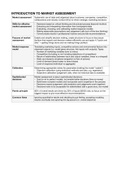
INTRODUCTION TO MARKET ASSESSMENT
Market assessment Systematic use of data and judgement about customer, companies, competition,
collaborators and industry context (5Cs) to inform strategic marketing decisions
Skills for e ective - Decisions based on critical thinking and structured process (beyond intuition)
market assessment - Extracting and interpreting information from text/graphs/data
- Evaluating, choosing, and calibrating market response models
- Making reasonable assumptions and judgement calls (out-of-the-box thinking)
- Communicate results in professional manner and provide recommendations
Purpose of market Enable and simplify decision making, create structure to focus on key issues
assessment (bottom-line impact) and decision makers e ciently use and apply it (“quick and
dirty” = getting things done and not making things perfect)
Market response Translating marketing inputs, competitive actions and environmental factors into
model observed outputs (i.e. model gives structure, link inputs with outputs). Types:
- Number of marketing variables (one vs many)
- Competition (including vs not including (re)actions of competitors)
- Nature of relationship (between input and output variables, linear vs s-shaped)
- Static and dynamic situations (snapshot vs ow of actions)
- Level of demand (brand sales vs brand share)
- Level of response (individual vs aggregate)
Calibration Determining appropriate values for parameters (making the model “usable”)
- Objective calibration (using statistical methods and data, e.g. regression)
- Subjective calibration (judgement calls, when no historical data is available)
Sophisticated Market assessment is about sophisticated decisions:
decisions - Goal is not to perfect models, but enable better decisions (time is money)
- Build fewer complex models and incorporate user’s expertise in the process
- Decisions require judgement calls (analytics and judgements work together)
- Decisions have to be acceptable for stakeholders (sell a good story, not model)
Pareto principle 80% of overall results are driven by 20% of inputs (80/20 rule), so focus on the
biggest impact to give most e ective recommendations.
Common aws Ignoring quantitative results and deciding by gut feeling, accepting modeling
results uncritically and ignoring the big picture (i.e. overall objective)
flff ff ffi
fl
, SEGMENTATION & TARGETING
3-step approach STP 1. Segmentation (identify segments with similar needs, wants and responses)
2. Targeting (select segment, look at attractiveness (size x willingness to pay),
pro tability and reachability)
3. Positioning (position rm’s o ering in relation to competition in segment)
Why segmentation? - Markets are heterogeneous (put homogenous customers in a segment)
- By segmenting a market, rms can better understand customers (same needs)
- Need to de ne, describe and select segments (which are pro table)
Phases segmenting 1. Segment the market using cluster analysis (build segments)
and targeting a. Select variables (where segmentation should be based on)
b. Decide on procedure (k-means vs hierarchical, distance measure)
c. Decide on number of segments (optimization vs feasibility)
2. Describe market segments that are identi ed to understand them (pro ling)
a. Use meaningful variables such as past behavior, demographics,
psychographics, geography and media usage
3. Evaluate attractiveness of each segment, by looking at:
a. Pro t characteristics (size, growth, pro tability)
b. Structural characteristics (competition, protectability, environmental risk)
c. Company-segment t (coherence with company, synergy with segments)
4. Select one or more target segments
a. Based on pro t potential and t to company (look at nancial value)
b. Determine level of resources allocated to each segment
5. Find and reach customers within target segment (how to sell the product)
a. Descriptors to nd target customers (demographics and past behavior)
b. Reach customers with appropriate marketing communications
Cluster Similar customers: homogenous within group, heterogeneous across groups
Cluster analysis 1. Hierarchical clustering (no prior de nition of number of clusters, nd elbow)
2. K-means clustering (de ne number of clusters a priori, more e ciently)
Euclidean distance How to measure similarity between two customers. It makes large distances
larger and small distances smaller —> close customers moved together
(homogeneous) and further apart customers pushed even further (heterogenous)
With one variable, you don’t need the formula
Usefulness clusters Pro le clusters by describing each segment and de ne easily understandable
for managers buyer personas, check if clusters are managerial meaningful for the company
Buyer personas To translate complex segment info in managerial actionable marketing strategy
Key considerations - Product categorization (products with common features) is not market
segmentation (cluster consumers with common needs)
- Customer needs can change (keep monitoring them)
- Company needs to be able to target a segment, check:
- If segment is actually pro table ( nancial value)
- If needs within segment are su ciently homogenous
- If segment can be identi ed and e ectively reached
- Market segment should have the following characteristics: measurable,
substantial, accessible, di erentiable and actionable
fi
fi fi fi fifi fififififf ff fiffifi fffi fi fi fi fi fiffi fi fi
Market assessment Systematic use of data and judgement about customer, companies, competition,
collaborators and industry context (5Cs) to inform strategic marketing decisions
Skills for e ective - Decisions based on critical thinking and structured process (beyond intuition)
market assessment - Extracting and interpreting information from text/graphs/data
- Evaluating, choosing, and calibrating market response models
- Making reasonable assumptions and judgement calls (out-of-the-box thinking)
- Communicate results in professional manner and provide recommendations
Purpose of market Enable and simplify decision making, create structure to focus on key issues
assessment (bottom-line impact) and decision makers e ciently use and apply it (“quick and
dirty” = getting things done and not making things perfect)
Market response Translating marketing inputs, competitive actions and environmental factors into
model observed outputs (i.e. model gives structure, link inputs with outputs). Types:
- Number of marketing variables (one vs many)
- Competition (including vs not including (re)actions of competitors)
- Nature of relationship (between input and output variables, linear vs s-shaped)
- Static and dynamic situations (snapshot vs ow of actions)
- Level of demand (brand sales vs brand share)
- Level of response (individual vs aggregate)
Calibration Determining appropriate values for parameters (making the model “usable”)
- Objective calibration (using statistical methods and data, e.g. regression)
- Subjective calibration (judgement calls, when no historical data is available)
Sophisticated Market assessment is about sophisticated decisions:
decisions - Goal is not to perfect models, but enable better decisions (time is money)
- Build fewer complex models and incorporate user’s expertise in the process
- Decisions require judgement calls (analytics and judgements work together)
- Decisions have to be acceptable for stakeholders (sell a good story, not model)
Pareto principle 80% of overall results are driven by 20% of inputs (80/20 rule), so focus on the
biggest impact to give most e ective recommendations.
Common aws Ignoring quantitative results and deciding by gut feeling, accepting modeling
results uncritically and ignoring the big picture (i.e. overall objective)
flff ff ffi
fl
, SEGMENTATION & TARGETING
3-step approach STP 1. Segmentation (identify segments with similar needs, wants and responses)
2. Targeting (select segment, look at attractiveness (size x willingness to pay),
pro tability and reachability)
3. Positioning (position rm’s o ering in relation to competition in segment)
Why segmentation? - Markets are heterogeneous (put homogenous customers in a segment)
- By segmenting a market, rms can better understand customers (same needs)
- Need to de ne, describe and select segments (which are pro table)
Phases segmenting 1. Segment the market using cluster analysis (build segments)
and targeting a. Select variables (where segmentation should be based on)
b. Decide on procedure (k-means vs hierarchical, distance measure)
c. Decide on number of segments (optimization vs feasibility)
2. Describe market segments that are identi ed to understand them (pro ling)
a. Use meaningful variables such as past behavior, demographics,
psychographics, geography and media usage
3. Evaluate attractiveness of each segment, by looking at:
a. Pro t characteristics (size, growth, pro tability)
b. Structural characteristics (competition, protectability, environmental risk)
c. Company-segment t (coherence with company, synergy with segments)
4. Select one or more target segments
a. Based on pro t potential and t to company (look at nancial value)
b. Determine level of resources allocated to each segment
5. Find and reach customers within target segment (how to sell the product)
a. Descriptors to nd target customers (demographics and past behavior)
b. Reach customers with appropriate marketing communications
Cluster Similar customers: homogenous within group, heterogeneous across groups
Cluster analysis 1. Hierarchical clustering (no prior de nition of number of clusters, nd elbow)
2. K-means clustering (de ne number of clusters a priori, more e ciently)
Euclidean distance How to measure similarity between two customers. It makes large distances
larger and small distances smaller —> close customers moved together
(homogeneous) and further apart customers pushed even further (heterogenous)
With one variable, you don’t need the formula
Usefulness clusters Pro le clusters by describing each segment and de ne easily understandable
for managers buyer personas, check if clusters are managerial meaningful for the company
Buyer personas To translate complex segment info in managerial actionable marketing strategy
Key considerations - Product categorization (products with common features) is not market
segmentation (cluster consumers with common needs)
- Customer needs can change (keep monitoring them)
- Company needs to be able to target a segment, check:
- If segment is actually pro table ( nancial value)
- If needs within segment are su ciently homogenous
- If segment can be identi ed and e ectively reached
- Market segment should have the following characteristics: measurable,
substantial, accessible, di erentiable and actionable
fi
fi fi fi fifi fififififf ff fiffifi fffi fi fi fi fi fiffi fi fi


