

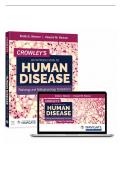
, TESTBANK FOR Crowley's An Introduction to Human Disease Twelfth
Edition Reisner
Important Notes
The file includes the complete test bank, organized chapter by chapter.
A sample of selected pages has been provided for preview.
All available appendices and Excel files (if included in the original resources) are
provided.
Quizzes, Midterm and final exams are included (if available in the original resources).
We continuously update our files to ensure you receive the latest and most accurate
editions.
New editions are added regularly – stay connected for updates!
⚠️Note on Answer Keys: If the answer key is not included within the chapter
questions, you will find the complete answers and solutions at the end of each
chapter.
✅ Why Buy From Us?
📚 Complete & organized chapter-by-chapter – no missing content, no guessing.
⚡ Instant digital delivery – get your file the moment you pay, no waiting.
📅 Always up to date – we track new editions so you always get the latest version.
💬 Friendly support – real humans ready to help, anytime you need us.
🔒 Safe & secure – thousands of satisfied students trust us every semester.
🛡️Our Guarantees
💰 Money-Back Guarantee: Not satisfied? We offer a full refund – no questions asked.
🔄 Wrong File? No Problem: Contact us and we will replace it immediately with the
correct version, free of charge.
⏰ 24/7 Support: We are always here – reach out anytime and expect a fast response.
,Crowley’s Introduction to Human Disease: Pathology and Pathophysiology, Twelfth Edition
Emily Reisner and Howard Reisner
Test Bank
Import Settings:
Base Settings: Brownstone Default
Information Field: Complexity
Information Field: A-head
Information Field: Subject
Information Field: Title
Highest Answer Letter: D
Multiple Keywords in Same Paragraph: No
NAS ISBN13: 9781284303063
Chapter: Chapter 01 - Quiz
Multiple Choice
1. A governmental agency proposes a pilot program to screen the population for a disease by using a
blood test. Which of the following characteristics about the disease or screening test indicates that the
proposed screening is not likely to be worthwhile?
A) The disease occurs at some frequency (1 per 1000 people screened).
B) The disease progresses slowly in affected people.
C) No specific method of treatment is currently available.
D) The test can detect the disease in its early stage and is relatively inexpensive.
Ans: C
Complexity: Difficult
A-head: Choosing a Diagnostic Test
Subject: Chapter 1
Title: General Concepts of Disease: Principles of Diagnosis
2. A young woman has a skin rash caused by an allergic reaction to an antibiotic. Which of the following
is the best classification for this patient’s condition?
A) A congenital disease
B) Inflammation
C) A fungus
D) A neoplastic disease
Ans: B
Complexity: Easy
A-head: Classifications of Disease
Subject: Chapter 1
Title: General Concepts of Disease: Principles of Diagnosis
3. Which of the following tests measures the electrical activity of the heart?
A) EEG
B) ECG
C) Radioisotope (radionuclide) studies
D) EMG
Copyright © 2027 by Jones & Bartlett Learning, LLC, an Ascend Learning Company 1
,Crowley’s Introduction to Human Disease: Pathology and Pathophysiology, Twelfth Edition
Emily Reisner and Howard Reisner
Test Bank
Ans: B
Complexity: Easy
A-head: Classification of Diagnostic Tests and Procedures
Subject: Chapter 1
Title: General Concepts of Disease: Principles of Diagnosis
4. Which of the following refers to how a disease develops?
A) Etiology
B) Pathogenesis
C) Social history
D) Diagnosis
Ans: B
Complexity: Easy
A-head: How Do We Know We Are Sick?
Subject: Chapter 1
Title: General Concepts of Disease: Principles of Diagnosis
5. Which of the following is a noninvasive procedure?
A) Biopsy
B) Endoscopy
C) X-ray
D) Pap smear
Ans: C
Complexity: Moderate
A-head: Principles of Diagnosis
Subject: Chapter 1
Title: General Concepts of Disease: Principles of Diagnosis
6. Which of the following types of medicine seeks to determine the risk–benefit–cost ratios of test choice?
A) Evidence-based medicine
B) Patient-centered medicine
C) Holistic medicine
D) Traditional medicine
Ans: A
Complexity: Moderate
A-head: Choosing a Diagnostic Test
Subject: Chapter 1
Title: General Concepts of Disease: Principles of Diagnosis
7. Which of the following would be used to determine the specificity of a diagnostic test?
A) False Positives / (True Negatives + False Positives)
B) True Negatives / (False Positives + False Negatives)
C) True Negatives / (True Negatives + False Positives)
D) False Negatives/ (False Negatives + False Positive)
Ans: C
Complexity: Moderate
Copyright © 2027 by Jones & Bartlett Learning, LLC, an Ascend Learning Company 2
,Crowley’s Introduction to Human Disease: Pathology and Pathophysiology, Twelfth Edition
Emily Reisner and Howard Reisner
Test Bank
A-head: Choosing a Diagnostic Test
Subject: Chapter 1
Title: General Concepts of Disease: Principles of Diagnosis
8. Which of the following is a physician’s opinion concerning the eventual outcome of a disease in a
patient?
A) Diagnosis
B) Prognosis
C) Etiology
D) Pathology
Ans: B
Complexity: Moderate
A-head: Principles of Diagnosis
Subject: Chapter 1
Title: General Concepts of Disease: Principles of Diagnosis
9. Which of the following is a test based on echoes produced in tissues by high-frequency sound waves?
A) EEG
B) ECG
C) Ultrasound examination
D) MRI examination
Ans: C
Complexity: Easy
A-head: Classification of Diagnostic Tests and Procedures
Subject: Chapter 1
Title: General Concepts of Disease: Principles of Diagnosis
10. Which of the following is the determination of the nature and cause of a patient’s illness by a
physician or other health practitioner?
A) Diagnosis
B) Prognosis
C) Etiology
D) Treatment
Ans: A
Complexity: Easy
A-head: Principles of Diagnosis
Subject: Chapter 1
Title: General Concepts of Disease: Principles of Diagnosis
Multiple Response
1. Which of the following abbreviations refers to a test of electrical activity? Select all that apply.
A) MRI
B) ECG
Copyright © 2027 by Jones & Bartlett Learning, LLC, an Ascend Learning Company 3
,Crowley’s Introduction to Human Disease: Pathology and Pathophysiology, Twelfth Edition
Emily Reisner and Howard Reisner
Test Bank
C) EMG
D) EEG
Ans: B, C, D
Complexity: Moderate
A-head: Classification of Diagnostic Tests and Procedures
Subject: Chapter 1
Title: General Concepts of Disease: Principles of Diagnosis
2. Which of the following statements correctly describes the concept of disease and health continuum?
Select all that apply.
A) Absolute wellness is a commonly attained state of complete physical and mental health.
B) Disease refers to any disturbance of normal body function or homeostasis.
C) As people age, their average position on the health–disease continuum generally shifts toward illness.
D) Health and disease lie on a continuum ranging from complete wellness to severe illness.
Ans: B, C, D
Complexity: Difficult
A-head: What is Disease?
Subject: Chapter 1
Title: General Concepts of Disease: Principles of Diagnosis
True/False
1. True or False? Specificity and sensitivity are used to classify laboratory tests.
Ans: True
Complexity: Moderate
A-head: Choosing a Diagnostic Test
Subject: Chapter 1
Title: General Concepts of Disease: Principles of Diagnosis
2. True or False? In a differential diagnosis, the practitioner considers multiple diseases that are
characterized by the patient’s symptoms.
Ans: True
Complexity: Easy
A-head: Principles of Diagnosis
Subject: Chapter 1
Title: General Concepts of Disease: Principles of Diagnosis
3. True or False? Specialists in public health might design screening systems for early diagnosis of
diseases in populations.
Ans: True
Complexity: Easy
A-head: Choosing a Diagnostic Test
Subject: Chapter 1
Title: General Concepts of Disease: Principles of Diagnosis
Copyright © 2027 by Jones & Bartlett Learning, LLC, an Ascend Learning Company 4
,Crowley’s Introduction to Human Disease: Pathology and Pathophysiology, Twelfth Edition
Emily Reisner and Howard Reisner
Test Bank
4. True or False? A colonoscope is an instrument used to examine the rectum and the sigmoid colon.
Ans: True
Complexity: Easy
A-head: Classifications of Disease
Subject: Chapter 1
Title: General Concepts of Disease: Principles of Diagnosis
5. True or False? False negatives are people with a disease who are misclassified as not having it.
Ans: True
Complexity: Moderate
A-head: Choosing a Diagnostic Test
Subject: Chapter 1
Title: General Concepts of Disease: Principles of Diagnosis
6. True or False? Prescribing antibiotics to a patient with an ear infection is an example of symptomatic
treatment.
Answer: False
Complexity: Moderate
A-head: Classification of Diagnostic Tests and Procedures
Subject: Chapter 1
Title: General Concepts of Disease: Principles of Diagnosis
7. True or False? A fine needle aspiration is a form of biopsy.
Answer: True
Complexity: Difficult
A-head: Classification of Diagnostic Tests and Procedures
Subject: Chapter 1
Title: General Concepts of Disease: Principles of Diagnosis
Fill-in-the-Blank
1. A(n) ________ diagnoses and classifies diseases, while a clinician cares for patients.
Answer: pathologist
Complexity: Difficult
A-head: Principles of Diagnosis
Subject: Chapter 1
Title: General Concepts of Disease: Principles of Diagnosis
Copyright © 2027 by Jones & Bartlett Learning, LLC, an Ascend Learning Company 5
,Crowley’s Introduction to Human Disease: Pathology and Pathophysiology, Twelfth Edition
Emily Reisner and Howard Reisner
Test Bank
Import Settings:
Base Settings: Brownstone Default
Information Field: Complexity
Information Field: Ahead
Information Field: Subject
Information Field: Title
Highest Answer Letter: D
Multiple Keywords in Same Paragraph: No
NAS ISBN13: 9781284303063, add to Ahead, Title tags
Chapter: Chapter 02 - Quiz
Multiple Choice
1. Which of the following statements best differentiates necrosis from ischemic infarction in the context of
cellular death mechanisms?
A) Necrosis is a form of programmed cell death triggered by genetic regulation, while infarction results
solely from trauma-induced rupture of cell membranes.
B) Infarction refers to cell death caused by interruption of blood supply leading to oxygen deprivation,
whereas necrosis encompasses cell death from diverse causes such as infection, toxicity, or ischemia.
C) Necrosis and infarction are synonymous, both describing genetically regulated cell death due to
apoptosis.
D) Infarction occurs when cells die from infection or toxins, whereas necrosis is limited to oxygen
deprivation–related damage.
Ans: B
Complexity: Difficult
A-head: Cell Injury, Cell Death and Cell Necrosis
Subject: Chapter 2
Title: Cells and Tissues: Their Structure and Function in Health and Disease
2. The normal osmolarity of blood and body fluids is 300 mOsm/L. A person with severe diabetes and
greatly elevated blood glucose has a blood osmolarity of 370 mOsm/L. Which of the following events will
result from the increased osmolarity?
A) Water shifts by osmosis from the cells into the extracellular fluid.
B) No water shifts will occur between the cells and the extracellular fluids.
C) Water shifts by osmosis from the extracellular fluid into the cells.
D) Equal amounts of water move from the cells into the extracellular fluid and from the extracellular fluid
into the cells; thus, there is no net change in the water content of either the cells or the extracellular fluid.
Ans: A
Complexity: Difficult
A-head: Movement of Materials into and out of Cells
Subject: Chapter 2
Title: Cells and Tissues: Their Structure and Function in Health and Disease
Copyright © 2027 by Jones & Bartlett Learning, LLC, an Ascend Learning Company 1
,Crowley’s Introduction to Human Disease: Pathology and Pathophysiology, Twelfth Edition
Emily Reisner and Howard Reisner
Test Bank
3. Mitochondria, endoplasmic reticulum, Golgi apparatus, lysosomes, and centrioles are all examples of
which of the following?
A) Cell membranes
B) Organelles
C) Enzymes
D) Organs
Ans: B
Complexity: Easy
A-head: The Cell
Subject: Chapter 2
Title: Cells and Tissues: Their Structure and Function in Health and Disease
4. Paracrine and endocrine are examples of which type of biological mechanism?
A) Cell signaling
B) Organ systems
C) Tissues
D) Connective tissue
Ans: A
Complexity: Easy
A-head: Organization of Cells
Subject: Chapter 2
Title: Cells and Tissues: Their Structure and Function in Health and Disease
5. Dysplasia of epithelial cells sometimes results from which of the following?
A) Excessive sodium intake
B) Chronic irritation or inflammation
C) Increased enzyme synthesis
D) Apoptosis
Ans: B
Complexity: Moderate
A-head: Adaptations of Cells to Changing Conditions
Subject: Chapter 2
Title: Cells and Tissues: Their Structure and Function in Health and Disease
6. An organ system is composed of which of the following?
A) Three distinct layers called germ layers
B) Connective and supporting tissues
C) A group of organs organized to perform complementary functions
D) Muscle and nerve tissues
Ans: C
Complexity: Moderate
A-head: Organs and Organ Systems
Subject: Chapter 2
Title: Cells and Tissues: Their Structure and Function in Health and Disease
7. What is the Hayflick limit?
Copyright © 2027 by Jones & Bartlett Learning, LLC, an Ascend Learning Company 2
, Crowley’s Introduction to Human Disease: Pathology and Pathophysiology, Twelfth Edition
Emily Reisner and Howard Reisner
Test Bank
A) The age at which human organs stop functioning
B) The number of times a normal human cell can divide before it dies
C) The maximum life span of the human body
D) The process by which telomerase repairs DNA damage
Ans: B
Complexity: Easy
A-head: Aging and the Cell
Subject: Chapter 2
Title: Cells and Tissues: Their Structure and Function in Health and Disease
8. An organ is best described as:
A) an object within the abdominal cavity that processes food, water, and air.
B) a complex structure that evolves from a single cell.
C) a group of different tissues integrated to perform a specific function.
D) a collection of similar cells that have an identical function.
Ans: C
Complexity: Easy
A-head: Organs and Organ Systems
Subject: Chapter 2
Title: Cells and Tissues: Their Structure and Function in Health and Disease
9. The function of lysosomes is to:
A) break down particles or worn-out cellular components.
B) convert food materials into energy.
C) produce digestive enzymes and antibody proteins.
D) aid in cell division.
Ans: A
Complexity: Easy
A-head: The Cell
Subject: Chapter 2
Title: Cells and Tissues: Their Structure and Function in Health and Disease
True/False
1. True or False? Fat stored in adipose tissue functions only as padding and insulation and not as an
energy source.
Ans: False
Complexity: Moderate
A-head: Tissues
Subject: Chapter 2
Title: Cells and Tissues: Their Structure and Function in Health and Disease
2. True or False? Endocrine glands discharge their secretions directly into the bloodstream, while
secretions from exocrine glands discharge through ducts.
Copyright © 2027 by Jones & Bartlett Learning, LLC, an Ascend Learning Company 3
Edition Reisner
Important Notes
The file includes the complete test bank, organized chapter by chapter.
A sample of selected pages has been provided for preview.
All available appendices and Excel files (if included in the original resources) are
provided.
Quizzes, Midterm and final exams are included (if available in the original resources).
We continuously update our files to ensure you receive the latest and most accurate
editions.
New editions are added regularly – stay connected for updates!
⚠️Note on Answer Keys: If the answer key is not included within the chapter
questions, you will find the complete answers and solutions at the end of each
chapter.
✅ Why Buy From Us?
📚 Complete & organized chapter-by-chapter – no missing content, no guessing.
⚡ Instant digital delivery – get your file the moment you pay, no waiting.
📅 Always up to date – we track new editions so you always get the latest version.
💬 Friendly support – real humans ready to help, anytime you need us.
🔒 Safe & secure – thousands of satisfied students trust us every semester.
🛡️Our Guarantees
💰 Money-Back Guarantee: Not satisfied? We offer a full refund – no questions asked.
🔄 Wrong File? No Problem: Contact us and we will replace it immediately with the
correct version, free of charge.
⏰ 24/7 Support: We are always here – reach out anytime and expect a fast response.
,Crowley’s Introduction to Human Disease: Pathology and Pathophysiology, Twelfth Edition
Emily Reisner and Howard Reisner
Test Bank
Import Settings:
Base Settings: Brownstone Default
Information Field: Complexity
Information Field: A-head
Information Field: Subject
Information Field: Title
Highest Answer Letter: D
Multiple Keywords in Same Paragraph: No
NAS ISBN13: 9781284303063
Chapter: Chapter 01 - Quiz
Multiple Choice
1. A governmental agency proposes a pilot program to screen the population for a disease by using a
blood test. Which of the following characteristics about the disease or screening test indicates that the
proposed screening is not likely to be worthwhile?
A) The disease occurs at some frequency (1 per 1000 people screened).
B) The disease progresses slowly in affected people.
C) No specific method of treatment is currently available.
D) The test can detect the disease in its early stage and is relatively inexpensive.
Ans: C
Complexity: Difficult
A-head: Choosing a Diagnostic Test
Subject: Chapter 1
Title: General Concepts of Disease: Principles of Diagnosis
2. A young woman has a skin rash caused by an allergic reaction to an antibiotic. Which of the following
is the best classification for this patient’s condition?
A) A congenital disease
B) Inflammation
C) A fungus
D) A neoplastic disease
Ans: B
Complexity: Easy
A-head: Classifications of Disease
Subject: Chapter 1
Title: General Concepts of Disease: Principles of Diagnosis
3. Which of the following tests measures the electrical activity of the heart?
A) EEG
B) ECG
C) Radioisotope (radionuclide) studies
D) EMG
Copyright © 2027 by Jones & Bartlett Learning, LLC, an Ascend Learning Company 1
,Crowley’s Introduction to Human Disease: Pathology and Pathophysiology, Twelfth Edition
Emily Reisner and Howard Reisner
Test Bank
Ans: B
Complexity: Easy
A-head: Classification of Diagnostic Tests and Procedures
Subject: Chapter 1
Title: General Concepts of Disease: Principles of Diagnosis
4. Which of the following refers to how a disease develops?
A) Etiology
B) Pathogenesis
C) Social history
D) Diagnosis
Ans: B
Complexity: Easy
A-head: How Do We Know We Are Sick?
Subject: Chapter 1
Title: General Concepts of Disease: Principles of Diagnosis
5. Which of the following is a noninvasive procedure?
A) Biopsy
B) Endoscopy
C) X-ray
D) Pap smear
Ans: C
Complexity: Moderate
A-head: Principles of Diagnosis
Subject: Chapter 1
Title: General Concepts of Disease: Principles of Diagnosis
6. Which of the following types of medicine seeks to determine the risk–benefit–cost ratios of test choice?
A) Evidence-based medicine
B) Patient-centered medicine
C) Holistic medicine
D) Traditional medicine
Ans: A
Complexity: Moderate
A-head: Choosing a Diagnostic Test
Subject: Chapter 1
Title: General Concepts of Disease: Principles of Diagnosis
7. Which of the following would be used to determine the specificity of a diagnostic test?
A) False Positives / (True Negatives + False Positives)
B) True Negatives / (False Positives + False Negatives)
C) True Negatives / (True Negatives + False Positives)
D) False Negatives/ (False Negatives + False Positive)
Ans: C
Complexity: Moderate
Copyright © 2027 by Jones & Bartlett Learning, LLC, an Ascend Learning Company 2
,Crowley’s Introduction to Human Disease: Pathology and Pathophysiology, Twelfth Edition
Emily Reisner and Howard Reisner
Test Bank
A-head: Choosing a Diagnostic Test
Subject: Chapter 1
Title: General Concepts of Disease: Principles of Diagnosis
8. Which of the following is a physician’s opinion concerning the eventual outcome of a disease in a
patient?
A) Diagnosis
B) Prognosis
C) Etiology
D) Pathology
Ans: B
Complexity: Moderate
A-head: Principles of Diagnosis
Subject: Chapter 1
Title: General Concepts of Disease: Principles of Diagnosis
9. Which of the following is a test based on echoes produced in tissues by high-frequency sound waves?
A) EEG
B) ECG
C) Ultrasound examination
D) MRI examination
Ans: C
Complexity: Easy
A-head: Classification of Diagnostic Tests and Procedures
Subject: Chapter 1
Title: General Concepts of Disease: Principles of Diagnosis
10. Which of the following is the determination of the nature and cause of a patient’s illness by a
physician or other health practitioner?
A) Diagnosis
B) Prognosis
C) Etiology
D) Treatment
Ans: A
Complexity: Easy
A-head: Principles of Diagnosis
Subject: Chapter 1
Title: General Concepts of Disease: Principles of Diagnosis
Multiple Response
1. Which of the following abbreviations refers to a test of electrical activity? Select all that apply.
A) MRI
B) ECG
Copyright © 2027 by Jones & Bartlett Learning, LLC, an Ascend Learning Company 3
,Crowley’s Introduction to Human Disease: Pathology and Pathophysiology, Twelfth Edition
Emily Reisner and Howard Reisner
Test Bank
C) EMG
D) EEG
Ans: B, C, D
Complexity: Moderate
A-head: Classification of Diagnostic Tests and Procedures
Subject: Chapter 1
Title: General Concepts of Disease: Principles of Diagnosis
2. Which of the following statements correctly describes the concept of disease and health continuum?
Select all that apply.
A) Absolute wellness is a commonly attained state of complete physical and mental health.
B) Disease refers to any disturbance of normal body function or homeostasis.
C) As people age, their average position on the health–disease continuum generally shifts toward illness.
D) Health and disease lie on a continuum ranging from complete wellness to severe illness.
Ans: B, C, D
Complexity: Difficult
A-head: What is Disease?
Subject: Chapter 1
Title: General Concepts of Disease: Principles of Diagnosis
True/False
1. True or False? Specificity and sensitivity are used to classify laboratory tests.
Ans: True
Complexity: Moderate
A-head: Choosing a Diagnostic Test
Subject: Chapter 1
Title: General Concepts of Disease: Principles of Diagnosis
2. True or False? In a differential diagnosis, the practitioner considers multiple diseases that are
characterized by the patient’s symptoms.
Ans: True
Complexity: Easy
A-head: Principles of Diagnosis
Subject: Chapter 1
Title: General Concepts of Disease: Principles of Diagnosis
3. True or False? Specialists in public health might design screening systems for early diagnosis of
diseases in populations.
Ans: True
Complexity: Easy
A-head: Choosing a Diagnostic Test
Subject: Chapter 1
Title: General Concepts of Disease: Principles of Diagnosis
Copyright © 2027 by Jones & Bartlett Learning, LLC, an Ascend Learning Company 4
,Crowley’s Introduction to Human Disease: Pathology and Pathophysiology, Twelfth Edition
Emily Reisner and Howard Reisner
Test Bank
4. True or False? A colonoscope is an instrument used to examine the rectum and the sigmoid colon.
Ans: True
Complexity: Easy
A-head: Classifications of Disease
Subject: Chapter 1
Title: General Concepts of Disease: Principles of Diagnosis
5. True or False? False negatives are people with a disease who are misclassified as not having it.
Ans: True
Complexity: Moderate
A-head: Choosing a Diagnostic Test
Subject: Chapter 1
Title: General Concepts of Disease: Principles of Diagnosis
6. True or False? Prescribing antibiotics to a patient with an ear infection is an example of symptomatic
treatment.
Answer: False
Complexity: Moderate
A-head: Classification of Diagnostic Tests and Procedures
Subject: Chapter 1
Title: General Concepts of Disease: Principles of Diagnosis
7. True or False? A fine needle aspiration is a form of biopsy.
Answer: True
Complexity: Difficult
A-head: Classification of Diagnostic Tests and Procedures
Subject: Chapter 1
Title: General Concepts of Disease: Principles of Diagnosis
Fill-in-the-Blank
1. A(n) ________ diagnoses and classifies diseases, while a clinician cares for patients.
Answer: pathologist
Complexity: Difficult
A-head: Principles of Diagnosis
Subject: Chapter 1
Title: General Concepts of Disease: Principles of Diagnosis
Copyright © 2027 by Jones & Bartlett Learning, LLC, an Ascend Learning Company 5
,Crowley’s Introduction to Human Disease: Pathology and Pathophysiology, Twelfth Edition
Emily Reisner and Howard Reisner
Test Bank
Import Settings:
Base Settings: Brownstone Default
Information Field: Complexity
Information Field: Ahead
Information Field: Subject
Information Field: Title
Highest Answer Letter: D
Multiple Keywords in Same Paragraph: No
NAS ISBN13: 9781284303063, add to Ahead, Title tags
Chapter: Chapter 02 - Quiz
Multiple Choice
1. Which of the following statements best differentiates necrosis from ischemic infarction in the context of
cellular death mechanisms?
A) Necrosis is a form of programmed cell death triggered by genetic regulation, while infarction results
solely from trauma-induced rupture of cell membranes.
B) Infarction refers to cell death caused by interruption of blood supply leading to oxygen deprivation,
whereas necrosis encompasses cell death from diverse causes such as infection, toxicity, or ischemia.
C) Necrosis and infarction are synonymous, both describing genetically regulated cell death due to
apoptosis.
D) Infarction occurs when cells die from infection or toxins, whereas necrosis is limited to oxygen
deprivation–related damage.
Ans: B
Complexity: Difficult
A-head: Cell Injury, Cell Death and Cell Necrosis
Subject: Chapter 2
Title: Cells and Tissues: Their Structure and Function in Health and Disease
2. The normal osmolarity of blood and body fluids is 300 mOsm/L. A person with severe diabetes and
greatly elevated blood glucose has a blood osmolarity of 370 mOsm/L. Which of the following events will
result from the increased osmolarity?
A) Water shifts by osmosis from the cells into the extracellular fluid.
B) No water shifts will occur between the cells and the extracellular fluids.
C) Water shifts by osmosis from the extracellular fluid into the cells.
D) Equal amounts of water move from the cells into the extracellular fluid and from the extracellular fluid
into the cells; thus, there is no net change in the water content of either the cells or the extracellular fluid.
Ans: A
Complexity: Difficult
A-head: Movement of Materials into and out of Cells
Subject: Chapter 2
Title: Cells and Tissues: Their Structure and Function in Health and Disease
Copyright © 2027 by Jones & Bartlett Learning, LLC, an Ascend Learning Company 1
,Crowley’s Introduction to Human Disease: Pathology and Pathophysiology, Twelfth Edition
Emily Reisner and Howard Reisner
Test Bank
3. Mitochondria, endoplasmic reticulum, Golgi apparatus, lysosomes, and centrioles are all examples of
which of the following?
A) Cell membranes
B) Organelles
C) Enzymes
D) Organs
Ans: B
Complexity: Easy
A-head: The Cell
Subject: Chapter 2
Title: Cells and Tissues: Their Structure and Function in Health and Disease
4. Paracrine and endocrine are examples of which type of biological mechanism?
A) Cell signaling
B) Organ systems
C) Tissues
D) Connective tissue
Ans: A
Complexity: Easy
A-head: Organization of Cells
Subject: Chapter 2
Title: Cells and Tissues: Their Structure and Function in Health and Disease
5. Dysplasia of epithelial cells sometimes results from which of the following?
A) Excessive sodium intake
B) Chronic irritation or inflammation
C) Increased enzyme synthesis
D) Apoptosis
Ans: B
Complexity: Moderate
A-head: Adaptations of Cells to Changing Conditions
Subject: Chapter 2
Title: Cells and Tissues: Their Structure and Function in Health and Disease
6. An organ system is composed of which of the following?
A) Three distinct layers called germ layers
B) Connective and supporting tissues
C) A group of organs organized to perform complementary functions
D) Muscle and nerve tissues
Ans: C
Complexity: Moderate
A-head: Organs and Organ Systems
Subject: Chapter 2
Title: Cells and Tissues: Their Structure and Function in Health and Disease
7. What is the Hayflick limit?
Copyright © 2027 by Jones & Bartlett Learning, LLC, an Ascend Learning Company 2
, Crowley’s Introduction to Human Disease: Pathology and Pathophysiology, Twelfth Edition
Emily Reisner and Howard Reisner
Test Bank
A) The age at which human organs stop functioning
B) The number of times a normal human cell can divide before it dies
C) The maximum life span of the human body
D) The process by which telomerase repairs DNA damage
Ans: B
Complexity: Easy
A-head: Aging and the Cell
Subject: Chapter 2
Title: Cells and Tissues: Their Structure and Function in Health and Disease
8. An organ is best described as:
A) an object within the abdominal cavity that processes food, water, and air.
B) a complex structure that evolves from a single cell.
C) a group of different tissues integrated to perform a specific function.
D) a collection of similar cells that have an identical function.
Ans: C
Complexity: Easy
A-head: Organs and Organ Systems
Subject: Chapter 2
Title: Cells and Tissues: Their Structure and Function in Health and Disease
9. The function of lysosomes is to:
A) break down particles or worn-out cellular components.
B) convert food materials into energy.
C) produce digestive enzymes and antibody proteins.
D) aid in cell division.
Ans: A
Complexity: Easy
A-head: The Cell
Subject: Chapter 2
Title: Cells and Tissues: Their Structure and Function in Health and Disease
True/False
1. True or False? Fat stored in adipose tissue functions only as padding and insulation and not as an
energy source.
Ans: False
Complexity: Moderate
A-head: Tissues
Subject: Chapter 2
Title: Cells and Tissues: Their Structure and Function in Health and Disease
2. True or False? Endocrine glands discharge their secretions directly into the bloodstream, while
secretions from exocrine glands discharge through ducts.
Copyright © 2027 by Jones & Bartlett Learning, LLC, an Ascend Learning Company 3


