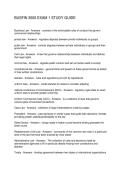
BUSFIN 3500 EXAM 1 STUDY GUIDE
Business Law - Answers - consists of the enforceable rules of conduct that govern
commercial relationships
private law - Answers - regulates disputes between private individuals or groups
public law - Answers - controls disputes between private individuals or groups and their
government
Civil Law - Answers - A law that governs relationships between individuals and defines
their legal rights.
criminal law - Answers - regulate public conduct and set out duties owed to society
constitutional law - Answers - general limits and powers of these governments as stated
in their written constitutions
statutes - Answers - rules and regulations put forth by legislatures
uniform laws - Answers - model statutes for states to consider adopting
national conference of commissioners (NCC) - Answers - regularly urges state to enact
uniform laws to provide greater uniformity.
Uniform Commercial Code (UCC) - Answers - is a collection of laws that governs
various types of business transactions
Case Law - Answers - collection of legal interpretations made by judges
Precedent - Answers - past decisions in similar cases that guide later decisions, thereby
providing greater stability/predictability to the law
Stare Decisis - Answers - rulings made in higher courts become binding precedent for
lower courts
Restatements of the Law - Answers - summaries of the common law rules in a particular
area of the law that have been enacted by most states
Administrative Law - Answers - The collection of rules and decisions made by
administrative agencies to fill in particular details missing from constitutions and
statutes.
Treaty - Answers - binding agreement between two states or international organizations
, Levels of government - Answers - federal, state, local
Federalism - Answers - A system in which power is divided between the national and
state governments
Judicial Review - Answers - Allows the court to determine the constitutionality of laws
Supremacy clause - Answers - Article VI of the Constitution, which makes the
Constitution, national laws, and treaties supreme over state laws when the national
government is acting within its constitutional limits.
Concurrent authority - Answers - both governments have the power to regulate the
same subject matter
Federal preemption - Answers - Areas where the state and federal governments have
concurrent authority, the federal government can decide to regulate that area
exclusively.
Commerce clause - Answers - The clause in the Constitution (Article I, Section 8,
Clause 1) that gives Congress the power to regulate all business activities that cross
state lines or affect more than one state or other nations.
Police Power - Answers - residual powers retained by each state to safeguard the
health and welfare of its citizenry
Dormant Commerce Clause - Answers - restriction on states' authority to pass laws that
substantially affect interstate commerce
Privileges and immunities clause - Answers - prohibits states from discriminating
against citizens of other states when those nonresidents engage in ordinary and
essential activities
Full Faith and Credit Clause - Answers - Courts in all states uphold contracts and public
acts established in other states
Contract Clause - Answers - no law can be passed that will unreasonably interfere with
existing contracts
5th amendment - Answers - Criminal Proceedings; Due Process; Eminent Domain;
Double Jeopardy; Protection from Self incrimination
Establishment Clause - Answers - Clause in the First Amendment that says the
government may not establish an official religion.
Business Law - Answers - consists of the enforceable rules of conduct that govern
commercial relationships
private law - Answers - regulates disputes between private individuals or groups
public law - Answers - controls disputes between private individuals or groups and their
government
Civil Law - Answers - A law that governs relationships between individuals and defines
their legal rights.
criminal law - Answers - regulate public conduct and set out duties owed to society
constitutional law - Answers - general limits and powers of these governments as stated
in their written constitutions
statutes - Answers - rules and regulations put forth by legislatures
uniform laws - Answers - model statutes for states to consider adopting
national conference of commissioners (NCC) - Answers - regularly urges state to enact
uniform laws to provide greater uniformity.
Uniform Commercial Code (UCC) - Answers - is a collection of laws that governs
various types of business transactions
Case Law - Answers - collection of legal interpretations made by judges
Precedent - Answers - past decisions in similar cases that guide later decisions, thereby
providing greater stability/predictability to the law
Stare Decisis - Answers - rulings made in higher courts become binding precedent for
lower courts
Restatements of the Law - Answers - summaries of the common law rules in a particular
area of the law that have been enacted by most states
Administrative Law - Answers - The collection of rules and decisions made by
administrative agencies to fill in particular details missing from constitutions and
statutes.
Treaty - Answers - binding agreement between two states or international organizations
, Levels of government - Answers - federal, state, local
Federalism - Answers - A system in which power is divided between the national and
state governments
Judicial Review - Answers - Allows the court to determine the constitutionality of laws
Supremacy clause - Answers - Article VI of the Constitution, which makes the
Constitution, national laws, and treaties supreme over state laws when the national
government is acting within its constitutional limits.
Concurrent authority - Answers - both governments have the power to regulate the
same subject matter
Federal preemption - Answers - Areas where the state and federal governments have
concurrent authority, the federal government can decide to regulate that area
exclusively.
Commerce clause - Answers - The clause in the Constitution (Article I, Section 8,
Clause 1) that gives Congress the power to regulate all business activities that cross
state lines or affect more than one state or other nations.
Police Power - Answers - residual powers retained by each state to safeguard the
health and welfare of its citizenry
Dormant Commerce Clause - Answers - restriction on states' authority to pass laws that
substantially affect interstate commerce
Privileges and immunities clause - Answers - prohibits states from discriminating
against citizens of other states when those nonresidents engage in ordinary and
essential activities
Full Faith and Credit Clause - Answers - Courts in all states uphold contracts and public
acts established in other states
Contract Clause - Answers - no law can be passed that will unreasonably interfere with
existing contracts
5th amendment - Answers - Criminal Proceedings; Due Process; Eminent Domain;
Double Jeopardy; Protection from Self incrimination
Establishment Clause - Answers - Clause in the First Amendment that says the
government may not establish an official religion.