

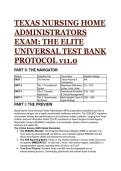
TEXAS NURSING HOME
ADMINISTRATORS
EXAM: THE ELITE
UNIVERSAL TEST BANK
PROTOCOL v11.0
PART 0: THE NAVIGATOR
Section Cognitive Tier Focus Area Question Range
PART I The Preview Critical Axioms & N/A
Frameworks
PART II Tier 1: Foundational Regulatory Definitions, Q1 – Q15
Syntax Syntax, Hard Limits
PART II Tier 2: Complex Operational Simulation Q16 – Q35
Application & Clinical Management
PART II Tier 3: Grandmaster Multi-Variable Crises & Q36 – Q60
Synthesis Legal Strategy
PART I: THE PREVIEW
Mastering the Texas Nursing Facility Administrator (NFA) jurisprudence transforms you from a
reactionary manager into a legally impenetrable healthcare executive. The 2026/2027 regulatory
environment dictates that administrators must synthesize volatile variables—ranging from Texas
Unified Licensure Information Portal (TULIP) compliance to Search Engine for Multi-Agency
Reportable Conduct (SEMARC) mandates—into immediate, decisive action to preserve
licensure and patient life.
The Critical Axioms (2026 Global Standards):
● The SEMARC Mandate: The Employee Misconduct Registry (EMR) is obsolete. You
must verify all unlicensed staff, contractors, and volunteers against SEMARC and the
Nurse Aide Registry (NAR) pre-employment and annually.
● The ANE Reporting Matrix: Abuse or any incident resulting in serious bodily injury must
be reported IMMEDIATELY, no later than 2 hours. Non-serious neglect, exploitation, or
misappropriation requires reporting within 24 hours via TULIP.
● Trust Fund Physics: Resident funds over $50 must be segregated into an
interest-bearing account. Commingling operational and resident funds is strictly
, prohibited. Uncorrected discrepancies freeze Title XIX funds after 60 days.
● The CHOW Protocol: A Change of Ownership (CHOW) triggers the moment a facility's
Employer Identification Number (EIN) changes. The application must be filed in TULIP 30
days prior to the effective date.
● The IDR Window: Informal Dispute Resolution (IDR) requests must be submitted within
10 calendar days of receiving the official Statement of Deficiencies (Form 2567).
PART II: THE ELITE TEST BANK
Q1: A newly licensed Texas Nursing Facility Administrator (NFA) is preparing for their first
biennial license renewal in 2026. Based on the principles of 26 TAC Chapter 555, which action
is MANDATORY for successful renewal? A) Completing 50 hours of Continuing Education (CE),
including 10 hours of ethics. B) Submitting a paper application and a $500 fee to the Texas
Health and Human Services Commission (HHSC). C) Completing 40 hours of CE, including 6
hours of ethics and the HHSC Infection Control and PPE course. D) Retaking the National
Association of Long-Term Care Administrator Boards (NAB) Core examination.
● The Answer: C (Completing 40 hours of CE, including 6 hours of ethics and the HHSC
Infection Control and PPE course.)
● Distractor Analysis:
○ A is incorrect: The requirement is 40 total hours and 6 hours of ethics, not 50 and
10.
○ B is incorrect: Renewals must be processed digitally through TULIP, and the
standard renewal fee is $250, not $500.
○ D is incorrect: Retaking the NAB exam is only required if the license has been
expired for 365 days or voluntarily surrendered.
The Mentor's Analysis: Regulatory survival begins with licensure preservation. The immediate
priority is recognizing the rigid arithmetic of continuing education. By utilizing TULIP and
securing the exact categorical CE hours, you bypass the trap of administrative delinquency.
Professional/Academic Intuition: The state demands digital compliance and hyper-specific
categorical training (Infection Control/Ethics) to maintain the privilege of licensure.
Q2: During the onboarding process in 2026, a Texas nursing facility HR director prepares to
verify a new dietary aide's background. Based on the principles of Senate Bill 1849 and 26 TAC
§554.1921, which database is the facility REQUIRED to query prior to an offer of employment?
A) The Employee Misconduct Registry (EMR). B) The Search Engine for Multi-Agency
Reportable Conduct (SEMARC) and the Nurse Aide Registry (NAR). C) The National
Practitioner Data Bank (NPDB) exclusively. D) The facility's internal grievance log.
● The Answer: B (The Search Engine for Multi-Agency Reportable Conduct (SEMARC)
and the Nurse Aide Registry (NAR).)
● Distractor Analysis:
○ A is incorrect: The EMR was rendered obsolete and replaced by SEMARC for
interagency background checks under SB 1849.
○ C is incorrect: The NPDB tracks licensed medical practitioners, not unlicensed
personnel.
○ D is incorrect: Internal logs hold no regulatory weight for state employability
verification.
The Mentor's Analysis: Employing prohibited individuals instantly jeopardizes the facility's
license. When hiring unlicensed staff, the priority is verifying statutory employability status. By
, utilizing SEMARC, you bypass the legacy trap of searching the retired EMR.
Professional/Academic Intuition: SEMARC is the absolute gateway for unlicensed
employment in Texas long-term care.
Q3: A resident's daughter reports to the Charge Nurse that her mother's diamond ring is missing
from her nightstand. The resident is unharmed and exhibits no signs of distress. Based on the
principles of HHSC Incident Reporting under Provider Letter 2024-14, what is the MOST
APPROPRIATE reporting timeframe? A) Immediately, but no later than 2 hours after the
allegation is made. B) Within 24 hours, utilizing the TULIP incident submission portal. C) Within
5 working days, alongside the final internal investigation report. D) At the next quarterly Quality
Assurance and Performance Improvement (QAPI) meeting.
● The Answer: B (Within 24 hours, utilizing the TULIP incident submission portal.)
● Distractor Analysis: * A is incorrect: The 2-hour rule is strictly reserved for allegations of
abuse or incidents resulting in serious bodily injury.
○ C is incorrect: The 5-day rule applies to the submission of the investigation results,
not the initial incident report.
○ D is incorrect: Internal QAPI reviews never supersede state-mandated reporting
timelines.
The Mentor's Analysis: Timelines are unforgiving legal boundaries. When facing
misappropriation without physical harm, the immediate priority is securing the 24-hour reporting
window. By utilizing TULIP Incident Intake, you bypass the common trap of over-escalating
non-injury events to the 2-hour threshold while remaining fully compliant.
Professional/Academic Intuition: Harm dictates velocity. Serious injury or abuse equals 2
hours; property or non-serious events equal 24 hours.
Q4: A facility currently manages the personal funds of a Medicaid resident. The resident's
balance reaches $75. Based on the principles of 26 TAC §554.405, what action is
IMMEDIATELY required of the facility? A) Return the excess $25 to the resident's family. B)
Transfer the entire $75 into the facility's general operating account. C) Deposit the funds
exceeding $50 into an interest-bearing account separate from operating funds. D) Spend the
excess $25 on facility-provided toiletries to keep the balance under $50.
● The Answer: C (Deposit the funds exceeding $50 into an interest-bearing account
separate from operating funds.)
● Distractor Analysis:
○ A is incorrect: The facility manages the funds; returning them arbitrarily violates the
fiduciary agreement.
○ B is incorrect: Commingling resident funds with operational capital is a severe
regulatory violation and constitutes financial exploitation.
○ D is incorrect: Facilities cannot charge residents for items required to be provided
under the standard Medicaid daily rate.
The Mentor's Analysis: Fiduciary duty is absolute. When managing trust funds, the priority is
strict financial segregation and interest generation. By utilizing Separate Interest-Bearing
Accounts for amounts over $50, you bypass the trap of financial commingling.
Professional/Academic Intuition: Resident money is never facility money. Cross the $50
threshold, and interest must accrue to the resident.
Q5: An investment group purchases a privately-owned nursing facility. The federal Employer
Identification Number (EIN) is officially transferred to the new entity. Based on the principles of
Texas HHSC licensure, this transaction constitutes a Change of Ownership (CHOW). When
MUST the new owner submit the CHOW application via TULIP? A) Exactly on the day the
transaction closes. B) Within 14 days after the effective date of the transition. C) At least 30
ADMINISTRATORS
EXAM: THE ELITE
UNIVERSAL TEST BANK
PROTOCOL v11.0
PART 0: THE NAVIGATOR
Section Cognitive Tier Focus Area Question Range
PART I The Preview Critical Axioms & N/A
Frameworks
PART II Tier 1: Foundational Regulatory Definitions, Q1 – Q15
Syntax Syntax, Hard Limits
PART II Tier 2: Complex Operational Simulation Q16 – Q35
Application & Clinical Management
PART II Tier 3: Grandmaster Multi-Variable Crises & Q36 – Q60
Synthesis Legal Strategy
PART I: THE PREVIEW
Mastering the Texas Nursing Facility Administrator (NFA) jurisprudence transforms you from a
reactionary manager into a legally impenetrable healthcare executive. The 2026/2027 regulatory
environment dictates that administrators must synthesize volatile variables—ranging from Texas
Unified Licensure Information Portal (TULIP) compliance to Search Engine for Multi-Agency
Reportable Conduct (SEMARC) mandates—into immediate, decisive action to preserve
licensure and patient life.
The Critical Axioms (2026 Global Standards):
● The SEMARC Mandate: The Employee Misconduct Registry (EMR) is obsolete. You
must verify all unlicensed staff, contractors, and volunteers against SEMARC and the
Nurse Aide Registry (NAR) pre-employment and annually.
● The ANE Reporting Matrix: Abuse or any incident resulting in serious bodily injury must
be reported IMMEDIATELY, no later than 2 hours. Non-serious neglect, exploitation, or
misappropriation requires reporting within 24 hours via TULIP.
● Trust Fund Physics: Resident funds over $50 must be segregated into an
interest-bearing account. Commingling operational and resident funds is strictly
, prohibited. Uncorrected discrepancies freeze Title XIX funds after 60 days.
● The CHOW Protocol: A Change of Ownership (CHOW) triggers the moment a facility's
Employer Identification Number (EIN) changes. The application must be filed in TULIP 30
days prior to the effective date.
● The IDR Window: Informal Dispute Resolution (IDR) requests must be submitted within
10 calendar days of receiving the official Statement of Deficiencies (Form 2567).
PART II: THE ELITE TEST BANK
Q1: A newly licensed Texas Nursing Facility Administrator (NFA) is preparing for their first
biennial license renewal in 2026. Based on the principles of 26 TAC Chapter 555, which action
is MANDATORY for successful renewal? A) Completing 50 hours of Continuing Education (CE),
including 10 hours of ethics. B) Submitting a paper application and a $500 fee to the Texas
Health and Human Services Commission (HHSC). C) Completing 40 hours of CE, including 6
hours of ethics and the HHSC Infection Control and PPE course. D) Retaking the National
Association of Long-Term Care Administrator Boards (NAB) Core examination.
● The Answer: C (Completing 40 hours of CE, including 6 hours of ethics and the HHSC
Infection Control and PPE course.)
● Distractor Analysis:
○ A is incorrect: The requirement is 40 total hours and 6 hours of ethics, not 50 and
10.
○ B is incorrect: Renewals must be processed digitally through TULIP, and the
standard renewal fee is $250, not $500.
○ D is incorrect: Retaking the NAB exam is only required if the license has been
expired for 365 days or voluntarily surrendered.
The Mentor's Analysis: Regulatory survival begins with licensure preservation. The immediate
priority is recognizing the rigid arithmetic of continuing education. By utilizing TULIP and
securing the exact categorical CE hours, you bypass the trap of administrative delinquency.
Professional/Academic Intuition: The state demands digital compliance and hyper-specific
categorical training (Infection Control/Ethics) to maintain the privilege of licensure.
Q2: During the onboarding process in 2026, a Texas nursing facility HR director prepares to
verify a new dietary aide's background. Based on the principles of Senate Bill 1849 and 26 TAC
§554.1921, which database is the facility REQUIRED to query prior to an offer of employment?
A) The Employee Misconduct Registry (EMR). B) The Search Engine for Multi-Agency
Reportable Conduct (SEMARC) and the Nurse Aide Registry (NAR). C) The National
Practitioner Data Bank (NPDB) exclusively. D) The facility's internal grievance log.
● The Answer: B (The Search Engine for Multi-Agency Reportable Conduct (SEMARC)
and the Nurse Aide Registry (NAR).)
● Distractor Analysis:
○ A is incorrect: The EMR was rendered obsolete and replaced by SEMARC for
interagency background checks under SB 1849.
○ C is incorrect: The NPDB tracks licensed medical practitioners, not unlicensed
personnel.
○ D is incorrect: Internal logs hold no regulatory weight for state employability
verification.
The Mentor's Analysis: Employing prohibited individuals instantly jeopardizes the facility's
license. When hiring unlicensed staff, the priority is verifying statutory employability status. By
, utilizing SEMARC, you bypass the legacy trap of searching the retired EMR.
Professional/Academic Intuition: SEMARC is the absolute gateway for unlicensed
employment in Texas long-term care.
Q3: A resident's daughter reports to the Charge Nurse that her mother's diamond ring is missing
from her nightstand. The resident is unharmed and exhibits no signs of distress. Based on the
principles of HHSC Incident Reporting under Provider Letter 2024-14, what is the MOST
APPROPRIATE reporting timeframe? A) Immediately, but no later than 2 hours after the
allegation is made. B) Within 24 hours, utilizing the TULIP incident submission portal. C) Within
5 working days, alongside the final internal investigation report. D) At the next quarterly Quality
Assurance and Performance Improvement (QAPI) meeting.
● The Answer: B (Within 24 hours, utilizing the TULIP incident submission portal.)
● Distractor Analysis: * A is incorrect: The 2-hour rule is strictly reserved for allegations of
abuse or incidents resulting in serious bodily injury.
○ C is incorrect: The 5-day rule applies to the submission of the investigation results,
not the initial incident report.
○ D is incorrect: Internal QAPI reviews never supersede state-mandated reporting
timelines.
The Mentor's Analysis: Timelines are unforgiving legal boundaries. When facing
misappropriation without physical harm, the immediate priority is securing the 24-hour reporting
window. By utilizing TULIP Incident Intake, you bypass the common trap of over-escalating
non-injury events to the 2-hour threshold while remaining fully compliant.
Professional/Academic Intuition: Harm dictates velocity. Serious injury or abuse equals 2
hours; property or non-serious events equal 24 hours.
Q4: A facility currently manages the personal funds of a Medicaid resident. The resident's
balance reaches $75. Based on the principles of 26 TAC §554.405, what action is
IMMEDIATELY required of the facility? A) Return the excess $25 to the resident's family. B)
Transfer the entire $75 into the facility's general operating account. C) Deposit the funds
exceeding $50 into an interest-bearing account separate from operating funds. D) Spend the
excess $25 on facility-provided toiletries to keep the balance under $50.
● The Answer: C (Deposit the funds exceeding $50 into an interest-bearing account
separate from operating funds.)
● Distractor Analysis:
○ A is incorrect: The facility manages the funds; returning them arbitrarily violates the
fiduciary agreement.
○ B is incorrect: Commingling resident funds with operational capital is a severe
regulatory violation and constitutes financial exploitation.
○ D is incorrect: Facilities cannot charge residents for items required to be provided
under the standard Medicaid daily rate.
The Mentor's Analysis: Fiduciary duty is absolute. When managing trust funds, the priority is
strict financial segregation and interest generation. By utilizing Separate Interest-Bearing
Accounts for amounts over $50, you bypass the trap of financial commingling.
Professional/Academic Intuition: Resident money is never facility money. Cross the $50
threshold, and interest must accrue to the resident.
Q5: An investment group purchases a privately-owned nursing facility. The federal Employer
Identification Number (EIN) is officially transferred to the new entity. Based on the principles of
Texas HHSC licensure, this transaction constitutes a Change of Ownership (CHOW). When
MUST the new owner submit the CHOW application via TULIP? A) Exactly on the day the
transaction closes. B) Within 14 days after the effective date of the transition. C) At least 30


