

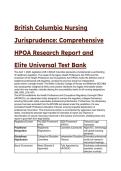
British Columbia Nursing
Jurisprudence: Comprehensive
HPOA Research Report and
Elite Universal Test Bank
The April 1, 2026, legislative shift in British Columbia represents a fundamental re-architecting
of healthcare regulation. The repeal of the legacy Health Professions Act (HPA) and the
enactment of the Health Professions and Occupations Act (HPOA) marks the definitive end of
traditional professional self-regulation, pivoting the province toward an independent,
public-centric oversight model. The British Columbia College of Nurses and Midwives (BCCNM)
has subsequently realigned all ethics and practice standards into legally enforceable bylaws
under this new mandate, radically altering the accountability matrix for all nursing designations
(RN, RPN, LPN, NP).
The HPOA establishes the Health Professions and Occupations Regulatory Oversight Office
(HPOROO), an independent entity designed to oversee the regulatory colleges themselves,
ensuring that public safety supersedes professional protectionism. Furthermore, the disciplinary
process has been extracted from the BCCNM and placed under the jurisdiction of a new,
centralized Health Professions Discipline Tribunal, ensuring impartial adjudication of
professional misconduct. This structural evolution is accompanied by aggressive new statutory
duties, including the absolute legal mandate for licensees to report any instance of
discrimination or sexual misconduct observed in the practice environment, shielding those who
report in good faith from legal liability.
Regulatory Domain Pre-2026 Framework 2026 Framework Clinical & Legal
(HPA) (HPOA) Implication
Practitioner Registrants Licensees (Licensure) Aligns B.C. terminology
Designation (Registration) with global licensing
standards.
Disciplinary College-led Discipline Independent Discipline Eliminates professional
Adjudication Committee Tribunal conflict of interest in
misconduct hearings.
Board Governance Mixed (Elected & Fully Appointed by Eradicates professional
Appointed) HPOROO popularity contests;
selection is strictly
,Regulatory Domain Pre-2026 Framework 2026 Framework Clinical & Legal
(HPA) (HPOA) Implication
merit-based.
Reporting Mandates Focus on Explicit duty to report Weaponizes the
incompetence/impairm discrimination & sexual regulatory framework
ent misconduct against systemic
racism and abuse.
Public Transparency Selected disciplinary All summary protection Maximizes public
outcomes orders & disciplinary access to practitioner
actions misconduct histories.
Beyond the HPOA, the 2026 regulatory landscape demands mastery of interlocking legislative
frameworks. Under the Infants Act, pediatric consent is determined entirely by cognitive
capability ("mature minor" doctrine) rather than chronological age. Within mental health
jurisprudence, the Mental Health Act (MHA) authorizes Nurse Practitioners (NPs) to initiate
involuntary holds via Form 4.1 but strictly prohibits them from executing the continuation
documents (Form 4.2 or Form 6), reserving that authority for physicians. Additionally, the Adult
Guardianship Act bifurcates financial incapability assessments, authorizing nurses (RNs, RPNs,
NPs) to conduct the functional component of the assessment, while a physician must conduct
the medical diagnosis. The integration of these legal parameters with the 2026 BCCNM
standard on Delegation to Unregulated Care Providers—which restricts delegation to stable
clients and forbids diagnosing, prescribing, or the application of hazardous energy—forms the
critical operational boundary for modern nursing practice.
PART 0: THE NAVIGATOR
● Tier 1 (Questions 1–28) - Foundational Syntax & Application: Testing "Hard Deck"
definitions, core HPOA terminology, Mental Health Act constraints, and primary BCCNM
theories through realistic clinical scenarios.
● Tier 2 (Questions 29–58) - Complex Application & Simulation: Situation-based clinical
judgment requiring immediate action regarding mature minors, duty to report, privacy
breaches, and delegation mechanics.
● Tier 3 (Questions 59–88) - Grandmaster Synthesis: Paragraph-long, high-stakes
scenarios requiring the synthesis of multiple, competing legislative concepts (e.g., MHA
overlaps with the Infants Act, emergency consent exemptions, and complex
interprofessional liabilities) to avert critical failure.
PART I: THE PRIMER
Mastering this rigorous jurisprudence test bank forges the operational mindset required to
navigate the complex legal and ethical architecture of the 2026 British Columbia healthcare
system. Flawless execution of these parameters translates directly into elite clinical
accountability, safeguarding both the public and the licensee against critical legal vulnerabilities.
● The HPOA Directive: "Registrants" are now "Licensees." The HPOROO oversees the
BCCNM, and the independent Discipline Tribunal handles misconduct. Reporting
discrimination and sexual misconduct is an absolute, legally protected statutory duty.
● The Delegation Axiom: Delegation to Unregulated Care Providers (UCPs) is legally void
if the client is unstable or unpredictable. Nurses can NEVER delegate diagnosing,
, prescribing, or the application of hazardous energy.
● The Consent & Capability Law: Under the Infants Act, a capable minor's consent is
absolute; chronological age is legally irrelevant. Under the Adult Guardianship Act, nurses
execute the functional capability assessment, not the medical diagnosis.
● The Involuntary Doctrine: Under the Mental Health Act, an NP may execute Form 4.1
(valid for 48 hours) but is legally barred from executing Form 4.2 or Form 6. Certification
constitutes deemed consent for psychiatric treatment only.
PART II: THE ELITE TEST BANK
Tier 1 - Foundational Syntax & Application
Q1: Effective April 1, 2026, the Health Professions and Occupations Act (HPOA) established a
new regulatory framework. Based on the principles of the HPOA, which structural change is the
MOST ACCURATE regarding professional oversight? A) The BCCNM Board of Directors is now
elected exclusively by practicing nurses to ensure professional representation. B) Disciplinary
hearings are conducted by a committee entirely composed of BCCNM staff members. C) The
Health Professions Discipline Tribunal, housed within the independent HPOROO, now conducts
hearings and determines discipline. D) The HPOA established a new non-practising licensure
class for retired nurses.
The Answer: C (The Health Professions Discipline Tribunal, housed within the independent
HPOROO, now conducts hearings and determines discipline.)
Distractor Analysis:
● A is incorrect: The HPOA eliminated elected board members; all members are now
appointed by the HPOROO based on competency.
● B is incorrect: Disciplinary functions were removed from the regulatory colleges to prevent
conflicts of interest.
● D is incorrect: The HPOA explicitly ended the non-practising registration class for nurses.
The Mentor's Analysis: The HPOA was designed to dismantle professional protectionism by
severing disciplinary adjudication from the regulatory college. Professional/Academic Intuition:
Under the 2026 framework, the college investigates, but an independent tribunal
adjudicates.
Q2: A Nurse Practitioner (NP) evaluates a highly agitated patient in the emergency department.
The NP determines the patient requires involuntary admission under Section 22 of the Mental
Health Act. Which action aligns perfectly with the NP's legal authority? A) The NP completes
Form 4.1 and subsequently completes Form 4.2 to finalize the one-month admission. B) The NP
completes Form 4.1, which serves as the first medical certificate, but cannot complete Form 4.2.
C) The NP must defer all involuntary certification forms to a registered psychiatrist. D) The NP
completes Form 6 to renew the patient's involuntary status for an additional month.
The Answer: B (The NP completes Form 4.1, which serves as the first medical certificate, but
cannot complete Form 4.2.)
Distractor Analysis:
● A is incorrect: BCCNM standards explicitly prohibit an NP from completing the second
medical certificate (Form 4.2).
● C is incorrect: NPs are legally authorized to complete the first medical certificate (Form
4.1).
● D is incorrect: NPs are explicitly prohibited from completing Form 6 (Renewal Certificate).
, The Mentor's Analysis: The deprivation of physical liberty requires interprofessional validation.
The law grants NPs initiating authority for involuntary holds but mandates a physician for
continuation. Professional/Academic Intuition: NPs hold the authority to initiate the
involuntary hold (Form 4.1), but only a physician can sustain it (Form 4.2).
Q3: A 14-year-old client requests a routine immunization at a public health clinic but states their
parents strictly oppose all vaccines. Based on the principles of the Infants Act, which action
MUST the nurse take FIRST? A) Decline the vaccination because the client is under the legal
age of medical consent (16 years). B) Contact the parents to obtain written consent, as they
retain overriding guardianship. C) Assess the client's capacity to understand the nature,
consequences, risks, and benefits of the vaccine. D) Administer the vaccine immediately under
the emergency preservation of health exemption.
The Answer: C (Assess the client's capacity to understand the nature, consequences, risks, and
benefits of the vaccine.)
Distractor Analysis:
● A is incorrect: British Columbia legislation sets no fixed chronological age for health care
consent.
● B is incorrect: A mature minor's consent supersedes parental opposition; contacting
parents breaches confidentiality.
● D is incorrect: A routine vaccination does not meet the legal threshold for an emergency
exemption to consent.
The Mentor's Analysis: The Infants Act operationalizes the "mature minor" doctrine, prioritizing
cognitive capability over chronological age. Professional/Academic Intuition: Capability
dictates authority; a capable minor holds the exclusive legal right to consent to or refuse
treatment.
Q4: Under the 2026 BCCNM standard for Delegation to Unregulated Care Providers (UCPs), a
Registered Nurse (RN) intends to delegate a restricted activity. Which condition ABSOLUTELY
prohibits this delegation? A) The UCP is an unpaid health care student working in a clinical
placement. B) The restricted activity involves the application of hazardous energy, such as
ultrasound. C) The client requires care in a rural community setting without a physician present.
D) The restricted activity is routine oral medication administration.
The Answer: B (The restricted activity involves the application of hazardous energy, such as
ultrasound.)
Distractor Analysis:
● A is incorrect: UCPs explicitly include students in training programs or unpaid individuals.
● C is incorrect: The standard allows flexibility across diverse settings if safety conditions
are met.
● D is incorrect: Routine oral medication administration for a stable client is a highly
common delegable task.
The Mentor's Analysis: The delegation standard ring-fences high-risk, unpredictable procedures
to protect public safety from unregulated execution. Professional/Academic Intuition: Nurses
can never delegate diagnosing, prescribing, or the application of hazardous energy to an
unregulated provider.
Q5: A licensee observes a colleague openly mocking a patient's sexual orientation, resulting in
the patient leaving the facility without receiving necessary care. Under the HPOA (2026), what is
the licensee's IMMEDIATE legal obligation? A) Document the incident in the patient's chart to
preserve the legal record. B) Confront the colleague to provide peer-to-peer education on
cultural humility. C) Report the colleague's discriminatory conduct, as it constitutes an actionable
duty to report under the Act. D) File a formal grievance with the healthcare facility's union
Jurisprudence: Comprehensive
HPOA Research Report and
Elite Universal Test Bank
The April 1, 2026, legislative shift in British Columbia represents a fundamental re-architecting
of healthcare regulation. The repeal of the legacy Health Professions Act (HPA) and the
enactment of the Health Professions and Occupations Act (HPOA) marks the definitive end of
traditional professional self-regulation, pivoting the province toward an independent,
public-centric oversight model. The British Columbia College of Nurses and Midwives (BCCNM)
has subsequently realigned all ethics and practice standards into legally enforceable bylaws
under this new mandate, radically altering the accountability matrix for all nursing designations
(RN, RPN, LPN, NP).
The HPOA establishes the Health Professions and Occupations Regulatory Oversight Office
(HPOROO), an independent entity designed to oversee the regulatory colleges themselves,
ensuring that public safety supersedes professional protectionism. Furthermore, the disciplinary
process has been extracted from the BCCNM and placed under the jurisdiction of a new,
centralized Health Professions Discipline Tribunal, ensuring impartial adjudication of
professional misconduct. This structural evolution is accompanied by aggressive new statutory
duties, including the absolute legal mandate for licensees to report any instance of
discrimination or sexual misconduct observed in the practice environment, shielding those who
report in good faith from legal liability.
Regulatory Domain Pre-2026 Framework 2026 Framework Clinical & Legal
(HPA) (HPOA) Implication
Practitioner Registrants Licensees (Licensure) Aligns B.C. terminology
Designation (Registration) with global licensing
standards.
Disciplinary College-led Discipline Independent Discipline Eliminates professional
Adjudication Committee Tribunal conflict of interest in
misconduct hearings.
Board Governance Mixed (Elected & Fully Appointed by Eradicates professional
Appointed) HPOROO popularity contests;
selection is strictly
,Regulatory Domain Pre-2026 Framework 2026 Framework Clinical & Legal
(HPA) (HPOA) Implication
merit-based.
Reporting Mandates Focus on Explicit duty to report Weaponizes the
incompetence/impairm discrimination & sexual regulatory framework
ent misconduct against systemic
racism and abuse.
Public Transparency Selected disciplinary All summary protection Maximizes public
outcomes orders & disciplinary access to practitioner
actions misconduct histories.
Beyond the HPOA, the 2026 regulatory landscape demands mastery of interlocking legislative
frameworks. Under the Infants Act, pediatric consent is determined entirely by cognitive
capability ("mature minor" doctrine) rather than chronological age. Within mental health
jurisprudence, the Mental Health Act (MHA) authorizes Nurse Practitioners (NPs) to initiate
involuntary holds via Form 4.1 but strictly prohibits them from executing the continuation
documents (Form 4.2 or Form 6), reserving that authority for physicians. Additionally, the Adult
Guardianship Act bifurcates financial incapability assessments, authorizing nurses (RNs, RPNs,
NPs) to conduct the functional component of the assessment, while a physician must conduct
the medical diagnosis. The integration of these legal parameters with the 2026 BCCNM
standard on Delegation to Unregulated Care Providers—which restricts delegation to stable
clients and forbids diagnosing, prescribing, or the application of hazardous energy—forms the
critical operational boundary for modern nursing practice.
PART 0: THE NAVIGATOR
● Tier 1 (Questions 1–28) - Foundational Syntax & Application: Testing "Hard Deck"
definitions, core HPOA terminology, Mental Health Act constraints, and primary BCCNM
theories through realistic clinical scenarios.
● Tier 2 (Questions 29–58) - Complex Application & Simulation: Situation-based clinical
judgment requiring immediate action regarding mature minors, duty to report, privacy
breaches, and delegation mechanics.
● Tier 3 (Questions 59–88) - Grandmaster Synthesis: Paragraph-long, high-stakes
scenarios requiring the synthesis of multiple, competing legislative concepts (e.g., MHA
overlaps with the Infants Act, emergency consent exemptions, and complex
interprofessional liabilities) to avert critical failure.
PART I: THE PRIMER
Mastering this rigorous jurisprudence test bank forges the operational mindset required to
navigate the complex legal and ethical architecture of the 2026 British Columbia healthcare
system. Flawless execution of these parameters translates directly into elite clinical
accountability, safeguarding both the public and the licensee against critical legal vulnerabilities.
● The HPOA Directive: "Registrants" are now "Licensees." The HPOROO oversees the
BCCNM, and the independent Discipline Tribunal handles misconduct. Reporting
discrimination and sexual misconduct is an absolute, legally protected statutory duty.
● The Delegation Axiom: Delegation to Unregulated Care Providers (UCPs) is legally void
if the client is unstable or unpredictable. Nurses can NEVER delegate diagnosing,
, prescribing, or the application of hazardous energy.
● The Consent & Capability Law: Under the Infants Act, a capable minor's consent is
absolute; chronological age is legally irrelevant. Under the Adult Guardianship Act, nurses
execute the functional capability assessment, not the medical diagnosis.
● The Involuntary Doctrine: Under the Mental Health Act, an NP may execute Form 4.1
(valid for 48 hours) but is legally barred from executing Form 4.2 or Form 6. Certification
constitutes deemed consent for psychiatric treatment only.
PART II: THE ELITE TEST BANK
Tier 1 - Foundational Syntax & Application
Q1: Effective April 1, 2026, the Health Professions and Occupations Act (HPOA) established a
new regulatory framework. Based on the principles of the HPOA, which structural change is the
MOST ACCURATE regarding professional oversight? A) The BCCNM Board of Directors is now
elected exclusively by practicing nurses to ensure professional representation. B) Disciplinary
hearings are conducted by a committee entirely composed of BCCNM staff members. C) The
Health Professions Discipline Tribunal, housed within the independent HPOROO, now conducts
hearings and determines discipline. D) The HPOA established a new non-practising licensure
class for retired nurses.
The Answer: C (The Health Professions Discipline Tribunal, housed within the independent
HPOROO, now conducts hearings and determines discipline.)
Distractor Analysis:
● A is incorrect: The HPOA eliminated elected board members; all members are now
appointed by the HPOROO based on competency.
● B is incorrect: Disciplinary functions were removed from the regulatory colleges to prevent
conflicts of interest.
● D is incorrect: The HPOA explicitly ended the non-practising registration class for nurses.
The Mentor's Analysis: The HPOA was designed to dismantle professional protectionism by
severing disciplinary adjudication from the regulatory college. Professional/Academic Intuition:
Under the 2026 framework, the college investigates, but an independent tribunal
adjudicates.
Q2: A Nurse Practitioner (NP) evaluates a highly agitated patient in the emergency department.
The NP determines the patient requires involuntary admission under Section 22 of the Mental
Health Act. Which action aligns perfectly with the NP's legal authority? A) The NP completes
Form 4.1 and subsequently completes Form 4.2 to finalize the one-month admission. B) The NP
completes Form 4.1, which serves as the first medical certificate, but cannot complete Form 4.2.
C) The NP must defer all involuntary certification forms to a registered psychiatrist. D) The NP
completes Form 6 to renew the patient's involuntary status for an additional month.
The Answer: B (The NP completes Form 4.1, which serves as the first medical certificate, but
cannot complete Form 4.2.)
Distractor Analysis:
● A is incorrect: BCCNM standards explicitly prohibit an NP from completing the second
medical certificate (Form 4.2).
● C is incorrect: NPs are legally authorized to complete the first medical certificate (Form
4.1).
● D is incorrect: NPs are explicitly prohibited from completing Form 6 (Renewal Certificate).
, The Mentor's Analysis: The deprivation of physical liberty requires interprofessional validation.
The law grants NPs initiating authority for involuntary holds but mandates a physician for
continuation. Professional/Academic Intuition: NPs hold the authority to initiate the
involuntary hold (Form 4.1), but only a physician can sustain it (Form 4.2).
Q3: A 14-year-old client requests a routine immunization at a public health clinic but states their
parents strictly oppose all vaccines. Based on the principles of the Infants Act, which action
MUST the nurse take FIRST? A) Decline the vaccination because the client is under the legal
age of medical consent (16 years). B) Contact the parents to obtain written consent, as they
retain overriding guardianship. C) Assess the client's capacity to understand the nature,
consequences, risks, and benefits of the vaccine. D) Administer the vaccine immediately under
the emergency preservation of health exemption.
The Answer: C (Assess the client's capacity to understand the nature, consequences, risks, and
benefits of the vaccine.)
Distractor Analysis:
● A is incorrect: British Columbia legislation sets no fixed chronological age for health care
consent.
● B is incorrect: A mature minor's consent supersedes parental opposition; contacting
parents breaches confidentiality.
● D is incorrect: A routine vaccination does not meet the legal threshold for an emergency
exemption to consent.
The Mentor's Analysis: The Infants Act operationalizes the "mature minor" doctrine, prioritizing
cognitive capability over chronological age. Professional/Academic Intuition: Capability
dictates authority; a capable minor holds the exclusive legal right to consent to or refuse
treatment.
Q4: Under the 2026 BCCNM standard for Delegation to Unregulated Care Providers (UCPs), a
Registered Nurse (RN) intends to delegate a restricted activity. Which condition ABSOLUTELY
prohibits this delegation? A) The UCP is an unpaid health care student working in a clinical
placement. B) The restricted activity involves the application of hazardous energy, such as
ultrasound. C) The client requires care in a rural community setting without a physician present.
D) The restricted activity is routine oral medication administration.
The Answer: B (The restricted activity involves the application of hazardous energy, such as
ultrasound.)
Distractor Analysis:
● A is incorrect: UCPs explicitly include students in training programs or unpaid individuals.
● C is incorrect: The standard allows flexibility across diverse settings if safety conditions
are met.
● D is incorrect: Routine oral medication administration for a stable client is a highly
common delegable task.
The Mentor's Analysis: The delegation standard ring-fences high-risk, unpredictable procedures
to protect public safety from unregulated execution. Professional/Academic Intuition: Nurses
can never delegate diagnosing, prescribing, or the application of hazardous energy to an
unregulated provider.
Q5: A licensee observes a colleague openly mocking a patient's sexual orientation, resulting in
the patient leaving the facility without receiving necessary care. Under the HPOA (2026), what is
the licensee's IMMEDIATE legal obligation? A) Document the incident in the patient's chart to
preserve the legal record. B) Confront the colleague to provide peer-to-peer education on
cultural humility. C) Report the colleague's discriminatory conduct, as it constitutes an actionable
duty to report under the Act. D) File a formal grievance with the healthcare facility's union


