

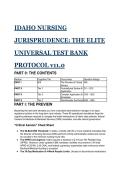
IDAHO NURSING
JURISPRUDENCE: THE ELITE
UNIVERSAL TEST BANK
PROTOCOL v11.0
PART 0: THE CONTENTS
Section Cognitive Tier Focus Area Question Range
PART I N/A The Preview & Critical N/A
Axioms
PART II Tier 1 Foundational Syntax & Q1 – Q15
Application
PART II Tier 2 Complex Application & Q16 – Q35
Simulation
PART II Tier 3 Grandmaster Synthesis Q36 – Q60
PART I: THE PREVIEW
Mastering this test bank elevates you from a standard administrative manager to an apex
regulatory tactician in the long-term care industry. These 60 operational simulations forge the
cognitive pathways required to navigate the lethal intersections of Idaho state statutes, federal
Centers for Medicare & Medicaid Services (CMS) mandates, and elite clinical governance.
"Critical Axioms" Cheat Sheet
● The 60-Bed DNS Threshold: In Idaho, a facility with 60 or more residents mandates that
the Director of Nursing Services (DNS) performs strictly administrative duties and cannot
be counted in the minimum nursing hours ratio.
● The HPRD Convergence: Idaho requires a baseline of 2.4 Hours Per Resident Day
(HPRD). However, under updated CMS mandates, facilities must achieve 3.48 total
HPRD (0.55 RN, 2.45 CNA), and federal supremacy supersedes state minimums where
Medicare/Medicaid funding is accepted.
● The 30-Day Medication & 4-Week Respite Limits: Unused or discontinued medications
, must not accumulate for longer than 30 days. Respite care stays cannot exceed 4 weeks
without a specific state variance.
● The 21-Day Fingerprint Mandate: Background check fingerprints must be submitted
within 21 days of hire. A new check is mandatory if an individual accepts employment with
a new employer and their last check was completed more than three years prior.
● The AIT & Preceptor Matrix: An Administrator-in-Training (AIT) must complete 1,000
hours under a preceptor. Preceptors must have two consecutive years of experience and
pass a 6-hour board-approved orientation.
PART II: THE ELITE TEST BANK
Tier 1: Foundational Syntax & Application
Q1: A newly constructed skilled nursing facility in Boise accepts its 61st resident. Under IDAPA
16.03.02, what is the IMMEDIATE legal implication for the facility’s Director of Nursing Services
(DNS)? A) The DNS must immediately schedule an additional licensed practical nurse for the
night shift to maintain ratios. B) The DNS may continue to serve as the charge nurse, provided
the total nursing hours exceed 2.4 HPRD. C) The DNS must transition to strictly nursing
administrative duties and can no longer be counted in the minimum staffing ratio. D) The DNS
must notify the Division of Occupational and Professional Licenses (DOPL) of the census
increase within 14 days.
● The Answer: C (The DNS must transition to strictly nursing administrative duties and can
no longer be counted in the minimum staffing ratio.)
● Distractor Analysis:
○ A is incorrect: The 61st resident triggers the DNS administrative restriction, not an
automatic LPN night shift mandate.
○ B is incorrect: Facilities with 59 or fewer residents allow the DNS to act as a
supervising nurse; crossing to 60 explicitly forbids this.
○ D is incorrect: Census fluctuations do not require direct DOPL notification; this is a
Department of Health and Welfare (DHW) staffing parameter.
The Mentor's Analysis: The state draws a hard line at the 60-bed threshold. When facing
census expansion, the immediate priority is protecting the administrative oversight capability of
your chief clinical officer. By utilizing strictly nursing administrative duties, you bypass the
common trap of diluting clinical leadership to plug staffing holes. Professional/Academic
Intuition: A census of 60 or more legally transforms the DNS from a floor asset to an
exclusive administrative commander.
Q2: During a complaint investigation, an Idaho surveyor notes that a resident has been in a
mechanical restraint. To comply with IDAPA regulations, how frequently must the staff check the
resident and keep a record of such checks? A) Every 15 minutes. B) Every 30 minutes. C)
Every 60 minutes. D) Every 2 hours, concurrently with turning and repositioning.
● The Answer: B (Every 30 minutes.)
● Distractor Analysis:
○ A is incorrect: 15-minute checks are standard for acute psychiatric seclusions, not
standard long-term care mechanical restraints.
○ C is incorrect: 60 minutes violates the state minimum standard, constituting neglect
of a restrained resident.
○ D is incorrect: 2-hour intervals apply to turning and repositioning, or releasing the
, restraint, but observation checks must be far more frequent.
The Mentor's Analysis: Restraints inherently restrict freedom and introduce physical peril.
When facing mechanical restraints, the immediate priority is verifying continuous physiological
safety. By utilizing 30-minute documented checks, you bypass the common trap of combining
restraint checks with standard 2-hour ADL rounding. Professional/Academic Intuition:
Mechanical restraints require 30-minute observational intervals; failure to document this
is a fast track to a Class A deficiency.
Q3: An applicant for an Idaho Nursing Home Administrator license holds a master’s degree in
health administration from an accredited institution and has worked for 14 months as a manager
in an inpatient health care facility. Regarding the Administrator-in-Training (AIT) requirement
under Idaho Code 54-1610, which conclusion is MOST ACCURATE? A) They must complete
the full 1,000-hour AIT program because their management experience is less than two years.
B) They must complete a reduced 500-hour AIT program based on their advanced degree. C)
They are entirely exempt from the 1,000-hour AIT requirement. D) They must pass the NAB
exam before the AIT requirement can be waived.
● The Answer: C (They are entirely exempt from the 1,000-hour AIT requirement.)
● Distractor Analysis:
○ A is incorrect: The two-year experience rule applies to those substituting experience
for an undergraduate degree, not master's degree holders.
○ B is incorrect: The law provides a complete exemption, not a prorated reduction, for
this specific qualification.
○ D is incorrect: Exam passage is a separate requirement for licensure, not a
prerequisite for the AIT educational exemption.
The Mentor's Analysis: Advanced academic preparation combined with practical experience
accelerates licensure. When facing AIT mandates, the immediate priority is auditing the
applicant's master's degree and management tenure. By utilizing the statutory exemption for a
relevant master's plus one year of inpatient management experience, you bypass the common
trap of forcing redundant clinical hours on highly qualified candidates. Professional/Academic
Intuition: A Master's in Health Administration plus one year of inpatient management
legally obliterates the 1,000-hour AIT mandate.
Q4: A facility calculates its civil monetary penalties under IDAPA 16.03.12 after a surveyor
identifies a Class A deficiency that is a repeat violation from a prior survey. How is this financial
penalty structured? A) $5 per licensed bed, per day of noncompliance. B) $8 per occupied bed,
per day of noncompliance. C) $10 per occupied licensed bed, per day of noncompliance. D) A
flat fee of $10,000 per incident.
● The Answer: C ($10 per occupied licensed bed, per day of noncompliance.)
● Distractor Analysis:
○ A is incorrect: $5 represents an initial Class B deficiency.
○ B is incorrect: $8 represents an initial Class A deficiency.
○ D is incorrect: Flat fees are an outdated federal framework; Idaho calculates by
occupied beds per day.
The Mentor's Analysis: Repeat offenses that place residents at substantial risk of serious harm
trigger maximum financial extraction. When facing repeated Class A violations, the immediate
priority is halting the per-day accrual through rapid abatement. By utilizing the repeat deficiency
multiplier of $10 per occupied bed, the state bypasses the common trap of treating systemic
negligence as a cost of doing business. Professional/Academic Intuition: Class A repeat
deficiencies cost $10 per occupied bed, per day; the meter runs until the threat is
clinically neutralized.
JURISPRUDENCE: THE ELITE
UNIVERSAL TEST BANK
PROTOCOL v11.0
PART 0: THE CONTENTS
Section Cognitive Tier Focus Area Question Range
PART I N/A The Preview & Critical N/A
Axioms
PART II Tier 1 Foundational Syntax & Q1 – Q15
Application
PART II Tier 2 Complex Application & Q16 – Q35
Simulation
PART II Tier 3 Grandmaster Synthesis Q36 – Q60
PART I: THE PREVIEW
Mastering this test bank elevates you from a standard administrative manager to an apex
regulatory tactician in the long-term care industry. These 60 operational simulations forge the
cognitive pathways required to navigate the lethal intersections of Idaho state statutes, federal
Centers for Medicare & Medicaid Services (CMS) mandates, and elite clinical governance.
"Critical Axioms" Cheat Sheet
● The 60-Bed DNS Threshold: In Idaho, a facility with 60 or more residents mandates that
the Director of Nursing Services (DNS) performs strictly administrative duties and cannot
be counted in the minimum nursing hours ratio.
● The HPRD Convergence: Idaho requires a baseline of 2.4 Hours Per Resident Day
(HPRD). However, under updated CMS mandates, facilities must achieve 3.48 total
HPRD (0.55 RN, 2.45 CNA), and federal supremacy supersedes state minimums where
Medicare/Medicaid funding is accepted.
● The 30-Day Medication & 4-Week Respite Limits: Unused or discontinued medications
, must not accumulate for longer than 30 days. Respite care stays cannot exceed 4 weeks
without a specific state variance.
● The 21-Day Fingerprint Mandate: Background check fingerprints must be submitted
within 21 days of hire. A new check is mandatory if an individual accepts employment with
a new employer and their last check was completed more than three years prior.
● The AIT & Preceptor Matrix: An Administrator-in-Training (AIT) must complete 1,000
hours under a preceptor. Preceptors must have two consecutive years of experience and
pass a 6-hour board-approved orientation.
PART II: THE ELITE TEST BANK
Tier 1: Foundational Syntax & Application
Q1: A newly constructed skilled nursing facility in Boise accepts its 61st resident. Under IDAPA
16.03.02, what is the IMMEDIATE legal implication for the facility’s Director of Nursing Services
(DNS)? A) The DNS must immediately schedule an additional licensed practical nurse for the
night shift to maintain ratios. B) The DNS may continue to serve as the charge nurse, provided
the total nursing hours exceed 2.4 HPRD. C) The DNS must transition to strictly nursing
administrative duties and can no longer be counted in the minimum staffing ratio. D) The DNS
must notify the Division of Occupational and Professional Licenses (DOPL) of the census
increase within 14 days.
● The Answer: C (The DNS must transition to strictly nursing administrative duties and can
no longer be counted in the minimum staffing ratio.)
● Distractor Analysis:
○ A is incorrect: The 61st resident triggers the DNS administrative restriction, not an
automatic LPN night shift mandate.
○ B is incorrect: Facilities with 59 or fewer residents allow the DNS to act as a
supervising nurse; crossing to 60 explicitly forbids this.
○ D is incorrect: Census fluctuations do not require direct DOPL notification; this is a
Department of Health and Welfare (DHW) staffing parameter.
The Mentor's Analysis: The state draws a hard line at the 60-bed threshold. When facing
census expansion, the immediate priority is protecting the administrative oversight capability of
your chief clinical officer. By utilizing strictly nursing administrative duties, you bypass the
common trap of diluting clinical leadership to plug staffing holes. Professional/Academic
Intuition: A census of 60 or more legally transforms the DNS from a floor asset to an
exclusive administrative commander.
Q2: During a complaint investigation, an Idaho surveyor notes that a resident has been in a
mechanical restraint. To comply with IDAPA regulations, how frequently must the staff check the
resident and keep a record of such checks? A) Every 15 minutes. B) Every 30 minutes. C)
Every 60 minutes. D) Every 2 hours, concurrently with turning and repositioning.
● The Answer: B (Every 30 minutes.)
● Distractor Analysis:
○ A is incorrect: 15-minute checks are standard for acute psychiatric seclusions, not
standard long-term care mechanical restraints.
○ C is incorrect: 60 minutes violates the state minimum standard, constituting neglect
of a restrained resident.
○ D is incorrect: 2-hour intervals apply to turning and repositioning, or releasing the
, restraint, but observation checks must be far more frequent.
The Mentor's Analysis: Restraints inherently restrict freedom and introduce physical peril.
When facing mechanical restraints, the immediate priority is verifying continuous physiological
safety. By utilizing 30-minute documented checks, you bypass the common trap of combining
restraint checks with standard 2-hour ADL rounding. Professional/Academic Intuition:
Mechanical restraints require 30-minute observational intervals; failure to document this
is a fast track to a Class A deficiency.
Q3: An applicant for an Idaho Nursing Home Administrator license holds a master’s degree in
health administration from an accredited institution and has worked for 14 months as a manager
in an inpatient health care facility. Regarding the Administrator-in-Training (AIT) requirement
under Idaho Code 54-1610, which conclusion is MOST ACCURATE? A) They must complete
the full 1,000-hour AIT program because their management experience is less than two years.
B) They must complete a reduced 500-hour AIT program based on their advanced degree. C)
They are entirely exempt from the 1,000-hour AIT requirement. D) They must pass the NAB
exam before the AIT requirement can be waived.
● The Answer: C (They are entirely exempt from the 1,000-hour AIT requirement.)
● Distractor Analysis:
○ A is incorrect: The two-year experience rule applies to those substituting experience
for an undergraduate degree, not master's degree holders.
○ B is incorrect: The law provides a complete exemption, not a prorated reduction, for
this specific qualification.
○ D is incorrect: Exam passage is a separate requirement for licensure, not a
prerequisite for the AIT educational exemption.
The Mentor's Analysis: Advanced academic preparation combined with practical experience
accelerates licensure. When facing AIT mandates, the immediate priority is auditing the
applicant's master's degree and management tenure. By utilizing the statutory exemption for a
relevant master's plus one year of inpatient management experience, you bypass the common
trap of forcing redundant clinical hours on highly qualified candidates. Professional/Academic
Intuition: A Master's in Health Administration plus one year of inpatient management
legally obliterates the 1,000-hour AIT mandate.
Q4: A facility calculates its civil monetary penalties under IDAPA 16.03.12 after a surveyor
identifies a Class A deficiency that is a repeat violation from a prior survey. How is this financial
penalty structured? A) $5 per licensed bed, per day of noncompliance. B) $8 per occupied bed,
per day of noncompliance. C) $10 per occupied licensed bed, per day of noncompliance. D) A
flat fee of $10,000 per incident.
● The Answer: C ($10 per occupied licensed bed, per day of noncompliance.)
● Distractor Analysis:
○ A is incorrect: $5 represents an initial Class B deficiency.
○ B is incorrect: $8 represents an initial Class A deficiency.
○ D is incorrect: Flat fees are an outdated federal framework; Idaho calculates by
occupied beds per day.
The Mentor's Analysis: Repeat offenses that place residents at substantial risk of serious harm
trigger maximum financial extraction. When facing repeated Class A violations, the immediate
priority is halting the per-day accrual through rapid abatement. By utilizing the repeat deficiency
multiplier of $10 per occupied bed, the state bypasses the common trap of treating systemic
negligence as a cost of doing business. Professional/Academic Intuition: Class A repeat
deficiencies cost $10 per occupied bed, per day; the meter runs until the threat is
clinically neutralized.


