

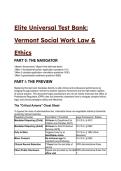
Elite Universal Test Bank:
Vermont Social Work Law &
Ethics
PART 0: THE NAVIGATOR
*(#part-i-the-preview) *(#part-ii-the-elite-test-bank)
*(#tier-1-foundational-syntax--application-questions-115)
*(#tier-2-complex-application--simulation-questions-1635)
*(#tier-3-grandmaster-synthesis-questions-3660)
PART I: THE PREVIEW
Mastering this test bank translates directly to elite clinical and professional performance by
bridging the gap between Vermont's abstract statutory framework and the high-stakes realities
of clinical practice. This document forges practitioners who do not merely memorize the Office of
Professional Regulation (OPR) rules but inherently understand how to navigate complex ethical,
legal, and clinical paradigms safely and effectively.
The "Critical Axioms" Cheat Sheet
To bypass the noise of administrative text, internalize these non-negotiable statutory thresholds
governing Vermont practice :
Regulatory Domain Core Metric / Threshold Legal Framework / Statute
Mandated Reporting (Child) 24 Hours to Department for 33 V.S.A. § 4913
Children and Families (DCF)
Mandated Reporting (Adult) 48 Hours to Adult Protective 33 V.S.A. § 6902
Services (APS)
Duty to Warn Triggered only by an 18 V.S.A. § 1882 (Peck
identifiable victim Standard)
Minor Consent No minimum age for 18 V.S.A. § 8350
outpatient psychotherapy
Clinical Record Retention 7 Years from the last date of OPR Administrative Rules
service
Client Public Disclosure Signed and provided by the 3rd OPR Administrative Rules Part
office visit 7
,Regulatory Domain Core Metric / Threshold Legal Framework / Statute
LICSW Supervised Hours 3,000 Hours (Min 2 years; 26 V.S.A. § 3205a
2,000 direct client hours)
CE Requirements (Biennial) LICSW = 20 Hrs / LMSW = 10 Act 117 & OPR Rules
Hrs (1.5 Ethics, 1 Act 117)
PART II: THE ELITE TEST BANK
Tier 1: Foundational Syntax & Application (Questions 1–15)
Q1: A Licensed Independent Clinical Social Worker (LICSW) in Vermont is preparing for their
biennial license renewal. Based on the rules of the Office of Professional Regulation (OPR),
what is the EXACT continuing education (CE) requirement? A) 10 total hours, including 1.5
hours of ethics and 1 hour of cultural competency. B) 20 total hours, including 3 hours of ethics
and 2 hours of cultural competency. C) 20 total hours, including 1.5 hours of ethics and 1 hour of
anti-oppressive practice. D) 40 total hours, including 4 hours of ethics.
● The Answer: C (20 total hours, including 1.5 hours of ethics and 1 hour of
anti-oppressive practice.)
● Distractor Analysis:
○ A is incorrect: This is the CE requirement for a Licensed Master's Social Worker
(LMSW), not an LICSW.
○ B is incorrect: This overstates the specific sub-requirements for ethics and cultural
competency established by Act 117.
○ D is incorrect: This aligns with other mental health professions (like psychologists)
but is legally inaccurate for Vermont social workers.
The Mentor's Analysis: License renewal requires adherence to strict, profession-specific
quantitative metrics. LICSWs are bound to 20 hours biennially. By utilizing Act 117
requirements, you bypass the common trap of relying on outdated legacy continuing education
standards. Professional/Academic Intuition: LMSW requires 10 hours; LICSW requires 20
hours. Both mandate exactly 1.5 ethics and 1.0 anti-oppressive practice hours.
Q2: An LMSW is accumulating hours toward LICSW licensure. They complete 3,000 supervised
hours in 18 months by working intense overtime. Based on Vermont administrative rules, which
conclusion is the MOST ACCURATE? A) The hours are fully valid because the 3,000-hour
threshold was mathematically met. B) The hours are invalid because supervised practice must
be completed in no less than two years. C) The hours are valid only if the supervisor holds an
active LICSW license. D) The hours are invalid because LMSWs cannot collect independent
clinical hours.
● The Answer: B (The hours are invalid because supervised practice must be completed in
no less than two years.)
● Distractor Analysis:
○ A is incorrect: The law strictly prohibits accruing the required hours in under 24
months, effectively capping creditable hours at 1,500 per year.
○ C is incorrect: While the supervisor must be qualified, this distractor misses the
critical chronological pacing violation.
○ D is incorrect: LMSWs engaged in supervised practice are explicitly authorized to
accumulate clinical hours.
The Mentor's Analysis: Time-in-practice cannot be artificially accelerated through overtime.
The Board requires chronological maturation alongside clinical exposure. By utilizing the
, two-year statutory minimum, you bypass the common trap of equating raw hours with regulatory
compliance. Professional/Academic Intuition: Clinical hours are governed by a speed
limit: a maximum of 1,500 creditable hours per year.
Q3: A social worker wishes to serve as a clinical supervisor for an LMSW pursuing their LICSW.
Under Vermont law, which prerequisite is MANDATORY for the supervisor? A) They must
possess an LICSW license and at least 3,000 hours of post-graduate experience. B) They must
hold an unencumbered license with 3 years and 4,500 hours of licensed practice. C) They must
hold an MSW and have completed a 3-credit graduate supervision course. D) They must be
approved directly by the ASWB to provide clinical oversight.
● The Answer: B (They must hold an unencumbered license with 3 years and 4,500 hours
of licensed practice.)
● Distractor Analysis:
○ A is incorrect: 3,000 hours is the requirement for obtaining the LICSW, not the
elevated standard for supervising others.
○ C is incorrect: Vermont does not mandate a 3-credit supervision course for basic
statutory qualification.
○ D is incorrect: The ASWB administers examinations; the Vermont OPR determines
supervisor eligibility and registry status.
The Mentor's Analysis: Supervision is a high-liability delegation of authority. The state
demands seasoned practitioners, defining "seasoned" as a specific mathematical threshold. By
utilizing the 4,500-hour mandate, you bypass the common trap of confusing licensure
requirements with supervisory requirements. Professional/Academic Intuition: The
supervisor must be 1,500 hours more experienced than the baseline licensure threshold
they are supervising.
Q4: Based on Vermont's Act 117, beginning with the 2026 renewal cycle, all social workers must
complete 1 hour of continuing education in which of the following SPECIFIC domains? A)
Telehealth Ethics and Interstate Practice. B) Systematic oppression and anti-oppressive practice
(Cultural Competency). C) Mandated Reporting and Domestic Violence Intervention. D)
DSM-5-TR Diagnostic Revisions.
● The Answer: B (Systematic oppression and anti-oppressive practice (Cultural
Competency).)
● Distractor Analysis:
○ A is incorrect: While highly relevant, telehealth is not a statutorily mandated,
standalone CE topic under Act 117.
○ C is incorrect: This is a common requirement in other jurisdictions, but not the
specific mandate added by Vermont's Act 117.
○ D is incorrect: Clinical knowledge updates are required broadly but are not carved
out as a specific, targeted mandate.
The Mentor's Analysis: Act 117 reflects a legislative prioritization of health equity within state
regulation. When renewing, the immediate priority is verifying exact categorical compliance. By
utilizing the anti-oppressive practice mandate, you bypass the common trap of confusing
general ethics with targeted cultural competency. Professional/Academic Intuition: Cultural
Humility is now a hard-deck statutory requirement, not merely an ethical ideal.
Q5: Under the Vermont OPR Administrative Rules Part 7, a social worker must provide a client
with a written public disclosure form. What is the LATEST acceptable point of treatment for this
disclosure to be provided? A) Prior to the initiation of the first clinical hour. B) Within 30 days of
the initial intake assessment. C) No later than the third office visit. D) Immediately upon the
client's formal request.
Vermont Social Work Law &
Ethics
PART 0: THE NAVIGATOR
*(#part-i-the-preview) *(#part-ii-the-elite-test-bank)
*(#tier-1-foundational-syntax--application-questions-115)
*(#tier-2-complex-application--simulation-questions-1635)
*(#tier-3-grandmaster-synthesis-questions-3660)
PART I: THE PREVIEW
Mastering this test bank translates directly to elite clinical and professional performance by
bridging the gap between Vermont's abstract statutory framework and the high-stakes realities
of clinical practice. This document forges practitioners who do not merely memorize the Office of
Professional Regulation (OPR) rules but inherently understand how to navigate complex ethical,
legal, and clinical paradigms safely and effectively.
The "Critical Axioms" Cheat Sheet
To bypass the noise of administrative text, internalize these non-negotiable statutory thresholds
governing Vermont practice :
Regulatory Domain Core Metric / Threshold Legal Framework / Statute
Mandated Reporting (Child) 24 Hours to Department for 33 V.S.A. § 4913
Children and Families (DCF)
Mandated Reporting (Adult) 48 Hours to Adult Protective 33 V.S.A. § 6902
Services (APS)
Duty to Warn Triggered only by an 18 V.S.A. § 1882 (Peck
identifiable victim Standard)
Minor Consent No minimum age for 18 V.S.A. § 8350
outpatient psychotherapy
Clinical Record Retention 7 Years from the last date of OPR Administrative Rules
service
Client Public Disclosure Signed and provided by the 3rd OPR Administrative Rules Part
office visit 7
,Regulatory Domain Core Metric / Threshold Legal Framework / Statute
LICSW Supervised Hours 3,000 Hours (Min 2 years; 26 V.S.A. § 3205a
2,000 direct client hours)
CE Requirements (Biennial) LICSW = 20 Hrs / LMSW = 10 Act 117 & OPR Rules
Hrs (1.5 Ethics, 1 Act 117)
PART II: THE ELITE TEST BANK
Tier 1: Foundational Syntax & Application (Questions 1–15)
Q1: A Licensed Independent Clinical Social Worker (LICSW) in Vermont is preparing for their
biennial license renewal. Based on the rules of the Office of Professional Regulation (OPR),
what is the EXACT continuing education (CE) requirement? A) 10 total hours, including 1.5
hours of ethics and 1 hour of cultural competency. B) 20 total hours, including 3 hours of ethics
and 2 hours of cultural competency. C) 20 total hours, including 1.5 hours of ethics and 1 hour of
anti-oppressive practice. D) 40 total hours, including 4 hours of ethics.
● The Answer: C (20 total hours, including 1.5 hours of ethics and 1 hour of
anti-oppressive practice.)
● Distractor Analysis:
○ A is incorrect: This is the CE requirement for a Licensed Master's Social Worker
(LMSW), not an LICSW.
○ B is incorrect: This overstates the specific sub-requirements for ethics and cultural
competency established by Act 117.
○ D is incorrect: This aligns with other mental health professions (like psychologists)
but is legally inaccurate for Vermont social workers.
The Mentor's Analysis: License renewal requires adherence to strict, profession-specific
quantitative metrics. LICSWs are bound to 20 hours biennially. By utilizing Act 117
requirements, you bypass the common trap of relying on outdated legacy continuing education
standards. Professional/Academic Intuition: LMSW requires 10 hours; LICSW requires 20
hours. Both mandate exactly 1.5 ethics and 1.0 anti-oppressive practice hours.
Q2: An LMSW is accumulating hours toward LICSW licensure. They complete 3,000 supervised
hours in 18 months by working intense overtime. Based on Vermont administrative rules, which
conclusion is the MOST ACCURATE? A) The hours are fully valid because the 3,000-hour
threshold was mathematically met. B) The hours are invalid because supervised practice must
be completed in no less than two years. C) The hours are valid only if the supervisor holds an
active LICSW license. D) The hours are invalid because LMSWs cannot collect independent
clinical hours.
● The Answer: B (The hours are invalid because supervised practice must be completed in
no less than two years.)
● Distractor Analysis:
○ A is incorrect: The law strictly prohibits accruing the required hours in under 24
months, effectively capping creditable hours at 1,500 per year.
○ C is incorrect: While the supervisor must be qualified, this distractor misses the
critical chronological pacing violation.
○ D is incorrect: LMSWs engaged in supervised practice are explicitly authorized to
accumulate clinical hours.
The Mentor's Analysis: Time-in-practice cannot be artificially accelerated through overtime.
The Board requires chronological maturation alongside clinical exposure. By utilizing the
, two-year statutory minimum, you bypass the common trap of equating raw hours with regulatory
compliance. Professional/Academic Intuition: Clinical hours are governed by a speed
limit: a maximum of 1,500 creditable hours per year.
Q3: A social worker wishes to serve as a clinical supervisor for an LMSW pursuing their LICSW.
Under Vermont law, which prerequisite is MANDATORY for the supervisor? A) They must
possess an LICSW license and at least 3,000 hours of post-graduate experience. B) They must
hold an unencumbered license with 3 years and 4,500 hours of licensed practice. C) They must
hold an MSW and have completed a 3-credit graduate supervision course. D) They must be
approved directly by the ASWB to provide clinical oversight.
● The Answer: B (They must hold an unencumbered license with 3 years and 4,500 hours
of licensed practice.)
● Distractor Analysis:
○ A is incorrect: 3,000 hours is the requirement for obtaining the LICSW, not the
elevated standard for supervising others.
○ C is incorrect: Vermont does not mandate a 3-credit supervision course for basic
statutory qualification.
○ D is incorrect: The ASWB administers examinations; the Vermont OPR determines
supervisor eligibility and registry status.
The Mentor's Analysis: Supervision is a high-liability delegation of authority. The state
demands seasoned practitioners, defining "seasoned" as a specific mathematical threshold. By
utilizing the 4,500-hour mandate, you bypass the common trap of confusing licensure
requirements with supervisory requirements. Professional/Academic Intuition: The
supervisor must be 1,500 hours more experienced than the baseline licensure threshold
they are supervising.
Q4: Based on Vermont's Act 117, beginning with the 2026 renewal cycle, all social workers must
complete 1 hour of continuing education in which of the following SPECIFIC domains? A)
Telehealth Ethics and Interstate Practice. B) Systematic oppression and anti-oppressive practice
(Cultural Competency). C) Mandated Reporting and Domestic Violence Intervention. D)
DSM-5-TR Diagnostic Revisions.
● The Answer: B (Systematic oppression and anti-oppressive practice (Cultural
Competency).)
● Distractor Analysis:
○ A is incorrect: While highly relevant, telehealth is not a statutorily mandated,
standalone CE topic under Act 117.
○ C is incorrect: This is a common requirement in other jurisdictions, but not the
specific mandate added by Vermont's Act 117.
○ D is incorrect: Clinical knowledge updates are required broadly but are not carved
out as a specific, targeted mandate.
The Mentor's Analysis: Act 117 reflects a legislative prioritization of health equity within state
regulation. When renewing, the immediate priority is verifying exact categorical compliance. By
utilizing the anti-oppressive practice mandate, you bypass the common trap of confusing
general ethics with targeted cultural competency. Professional/Academic Intuition: Cultural
Humility is now a hard-deck statutory requirement, not merely an ethical ideal.
Q5: Under the Vermont OPR Administrative Rules Part 7, a social worker must provide a client
with a written public disclosure form. What is the LATEST acceptable point of treatment for this
disclosure to be provided? A) Prior to the initiation of the first clinical hour. B) Within 30 days of
the initial intake assessment. C) No later than the third office visit. D) Immediately upon the
client's formal request.


