NURS 420 Exam 3 – Questions With A+ Solutions
Save Groups
Terms in this set (105)
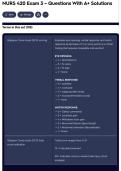
Glasgow Coma Scale (GCS) scoring Evaluates eye opening, verbal response, and motor
response (a decrease of 2 or more points is a critical
finding that requires immediate intervention)
EYE OPENING:
→ 4 = Spontaneous
→ 3 = To voice
→ 2 = To pain
→ 1 = None
VERBAL RESPONSE:
→ 5 = oriented
→ 4 = confused
→ 3 = inappropriate words
→ 2 = incomprehensible sounds
→ 1 = none
MOTOR RESPONSE:
→ 6 = Obeys commands
→ 5 = Localizes pain
→ 4 = Withdraws from pain
→ 3 = Abnormal flexion (decorticate)
→ 2 = Abnormal extension (decerebrate)
→ 1 = None
Glasgow Coma Scale (GCS) total Total score ranges from 3–15
score indication
15 = Fully alert/oriented
≤8 = Indicates coma or severe brain injury (must
intubate)
,Normal ICP 5–15 mmHg
>20 = critical
Signs of Increased Intracranial Occurs when pressure within the skull rises due to
Pressure (ICP) swelling, bleeding, or obstruction of CSF flow
EARLY SIGNS:
→ Change in level of consciousness
→ Headache
→ Nausea and vomiting (often projectile)
→ Restlessness, irritability
→ Decreased level of consciousness
→ Pupillary changes (sluggish or unequal)
→ Blurred vision or diplopia
LATE SIGNS (MEDICAL EMERGENCY):
→ Cushing’s Triad: increased systolic BP with
widened pulse pressure, bradycardia, irregular
respirations
→ Severe decrease in LOC or coma
→ Posturing (decorticate or decerebrate)
→ Loss of brainstem reflexes (gag, corneal)
Increased ICP interventions Maintain patent airway and elevate HOB 30°
Avoid neck flexion, coughing, or Valsalva
Administer mannitol, hypertonic saline, or
anticonvulsants as prescribed
→ Mannitol (gold standard) reduces cerebral edema
→ Hypertonic saline (3%) pulls fluid from brain tissue
→ Anticonvulsants control seizures
Keep environment quiet and minimize stimulation
Limit suctioning and stimulation
Monitor for Diabetes Insipidus (DI) or SIADH
(Syndrome of Inappropriate Antidiuretic Hormone)
,How ICP causes Diabetes Insipidus or Increased intracranial pressure can compress or
Syndrome of Inappropriate damage the hypothalamus or pituitary gland, which
Antidiuretic Hormone control the release of antidiuretic hormone (ADH)
If these areas are damaged or compressed, they may
stop releasing ADH → Diabetes Insipidus (DI)
If they become irritated or overstimulated, they may
release too much ADH → SIADH
Diabetes Insipidus vs Syndrome of Diabetes Insipidus (DI)
Inappropriate Antidiuretic Hormone ↓ ADH secretion → excessive urination, dehydration,
and ↑ serum sodium
SIADH (Syndrome of Inappropriate Antidiuretic
Hormone)
↑ ADH secretion → water retention, ↓ urine output,
and ↓ serum sodium (dilutional hyponatremia)
Syndrome of Inappropriate EARLY
Antidiuretic Hormone clinical → Headache
manifestations → Weakness
→ Muscle cramps
→ Weight gain (without edema)
PROGRESSIVE/LATE
→ Personality changes
→ Confusion
→ Hostility
→ N/V/D
→ Sluggish reflexes
→ Seizures
→ Coma
, Signs of fluid volume excess in SIADH Tachycardia
Bounding pulse
Possible HTN
Crackles
Distended neck veins
Taut skin
Decreased urine output
SIADH labs Hyponatremia (< 135 mEq/L)
Low blood osmolality (< 275 mOsm/kg)
High urine osmolality (> 100 mOsm/kg)
(Think “blood dilute, urine concentrated.”)
ICP monitoring devices Intraventricular catheter (ventriculostomy),
subarachnoid bolt, or EVD
→ Measures and drains CSF to control pressure
ICP measuring devices nursing care Maintain sterile system
Level transducer at tragus of ear
Keep HOB 30°
Avoid coughing, straining, or hip flexion
Save Groups
Terms in this set (105)
Glasgow Coma Scale (GCS) scoring Evaluates eye opening, verbal response, and motor
response (a decrease of 2 or more points is a critical
finding that requires immediate intervention)
EYE OPENING:
→ 4 = Spontaneous
→ 3 = To voice
→ 2 = To pain
→ 1 = None
VERBAL RESPONSE:
→ 5 = oriented
→ 4 = confused
→ 3 = inappropriate words
→ 2 = incomprehensible sounds
→ 1 = none
MOTOR RESPONSE:
→ 6 = Obeys commands
→ 5 = Localizes pain
→ 4 = Withdraws from pain
→ 3 = Abnormal flexion (decorticate)
→ 2 = Abnormal extension (decerebrate)
→ 1 = None
Glasgow Coma Scale (GCS) total Total score ranges from 3–15
score indication
15 = Fully alert/oriented
≤8 = Indicates coma or severe brain injury (must
intubate)
,Normal ICP 5–15 mmHg
>20 = critical
Signs of Increased Intracranial Occurs when pressure within the skull rises due to
Pressure (ICP) swelling, bleeding, or obstruction of CSF flow
EARLY SIGNS:
→ Change in level of consciousness
→ Headache
→ Nausea and vomiting (often projectile)
→ Restlessness, irritability
→ Decreased level of consciousness
→ Pupillary changes (sluggish or unequal)
→ Blurred vision or diplopia
LATE SIGNS (MEDICAL EMERGENCY):
→ Cushing’s Triad: increased systolic BP with
widened pulse pressure, bradycardia, irregular
respirations
→ Severe decrease in LOC or coma
→ Posturing (decorticate or decerebrate)
→ Loss of brainstem reflexes (gag, corneal)
Increased ICP interventions Maintain patent airway and elevate HOB 30°
Avoid neck flexion, coughing, or Valsalva
Administer mannitol, hypertonic saline, or
anticonvulsants as prescribed
→ Mannitol (gold standard) reduces cerebral edema
→ Hypertonic saline (3%) pulls fluid from brain tissue
→ Anticonvulsants control seizures
Keep environment quiet and minimize stimulation
Limit suctioning and stimulation
Monitor for Diabetes Insipidus (DI) or SIADH
(Syndrome of Inappropriate Antidiuretic Hormone)
,How ICP causes Diabetes Insipidus or Increased intracranial pressure can compress or
Syndrome of Inappropriate damage the hypothalamus or pituitary gland, which
Antidiuretic Hormone control the release of antidiuretic hormone (ADH)
If these areas are damaged or compressed, they may
stop releasing ADH → Diabetes Insipidus (DI)
If they become irritated or overstimulated, they may
release too much ADH → SIADH
Diabetes Insipidus vs Syndrome of Diabetes Insipidus (DI)
Inappropriate Antidiuretic Hormone ↓ ADH secretion → excessive urination, dehydration,
and ↑ serum sodium
SIADH (Syndrome of Inappropriate Antidiuretic
Hormone)
↑ ADH secretion → water retention, ↓ urine output,
and ↓ serum sodium (dilutional hyponatremia)
Syndrome of Inappropriate EARLY
Antidiuretic Hormone clinical → Headache
manifestations → Weakness
→ Muscle cramps
→ Weight gain (without edema)
PROGRESSIVE/LATE
→ Personality changes
→ Confusion
→ Hostility
→ N/V/D
→ Sluggish reflexes
→ Seizures
→ Coma
, Signs of fluid volume excess in SIADH Tachycardia
Bounding pulse
Possible HTN
Crackles
Distended neck veins
Taut skin
Decreased urine output
SIADH labs Hyponatremia (< 135 mEq/L)
Low blood osmolality (< 275 mOsm/kg)
High urine osmolality (> 100 mOsm/kg)
(Think “blood dilute, urine concentrated.”)
ICP monitoring devices Intraventricular catheter (ventriculostomy),
subarachnoid bolt, or EVD
→ Measures and drains CSF to control pressure
ICP measuring devices nursing care Maintain sterile system
Level transducer at tragus of ear
Keep HOB 30°
Avoid coughing, straining, or hip flexion