

1|Page
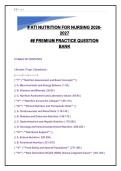
# ATI NUTRITION FOR NURSING 2026-
2027
## PREMIUM PRACTICE QUESTION
BANK
# TABLE OF CONTENTS
| Section | Topic | Questions |
|---------|-------|-----------|
| **I** | **Nutrition Assessment and Basic Concepts** | |
| | A. Macronutrients and Energy Balance | 1-35 |
| | B. Vitamins and Minerals | 36-65 |
| | C. Nutrition Assessment and Laboratory Values | 66-85 |
| **II** | **Nutrition Across the Lifespan** | 86-115 |
| **III** | **Clinical Nutrition and Therapeutic Diets** | |
| | A. Cardiovascular and Renal Diets | 116-145 |
| | B. Diabetes and Endocrine Nutrition | 146-175 |
| | C. Gastrointestinal and Hepatic Nutrition | 176-205 |
| | D. Oncology and Immunocompromised Nutrition | 206-225 |
| **IV** | **Nutritional Support** | |
| | A. Enteral Nutrition | 226-250 |
| | B. Parenteral Nutrition | 251-270 |
| **V** | **Food Safety and Special Populations** | 271-300 |
| **VI** | **Next Generation NCLEX (NGN) Clinical Judgment Cases** | 301-325 |
,2|Page
# SECTION I: NUTRITION ASSESSMENT AND BASIC CONCEPTS
## A. Macronutrients and Energy Balance (Questions 1-35)
**Question 1**
*Bloom's Level: Comprehension*
A nurse is providing teaching to a client about carbohydrates. Which of the
following statements by the client indicates an understanding of the teaching?
A. "Complex carbohydrates are broken down more slowly than simple
carbohydrates."
B. "All carbohydrates contain the same amount of fiber."
C. "Carbohydrates should be completely eliminated from my diet."
D. "Simple carbohydrates are a better choice for sustained energy."
**Correct Answer: A**
**Rationale:** Complex carbohydrates, such as starches and fiber, are broken
down more slowly than simple carbohydrates, providing sustained energy and
better glycemic control . This slower digestion helps prevent rapid spikes in blood
glucose.
**Incorrect Answer Explanations:**
- **B:** Not all carbohydrates contain fiber. Refined carbohydrates have had fiber
removed during processing.
,3|Page
- **C:** Carbohydrates are the body's preferred energy source and should not be
eliminated. They should comprise 45-65% of total daily calories.
- **D:** Simple carbohydrates are broken down quickly and cause rapid blood
glucose fluctuations. Complex carbohydrates are preferable for sustained energy.
---
**Question 2**
*Bloom's Level: Application*
A client's dietary intake includes 300 grams of carbohydrates per day. This amount
is above the Dietary Reference Intake (DRI) minimum of 130 grams per day .
**What percentage of a 2,000-calorie diet do these carbohydrates represent?**
A. 45%
B. 55%
C. 60%
D. 65%
**Correct Answer: C**
**Rationale:** To calculate the percentage: 300g × 4 kcal/g = 1,200 calories from
carbohydrates. 1,200 ÷ 2,000 = 0.60, or 60% of total calories. This falls within the
Acceptable Macronutrient Distribution Range (AMDR) of 45-65% for
carbohydrates .
, 4|Page
**Incorrect Answer Explanations:**
- **A:** 45% would equal 225 grams (900 calories). This miscalculates the
percentage.
- **B:** 55% would equal 275 grams (1,100 calories). This undercalculates the
percentage.
- **D:** 65% would equal 325 grams (1,300 calories). This slightly overcalculates
the percentage.
---
**Question 3**
*Bloom's Level: Analysis*
A nurse is calculating a client's protein needs. The client weighs 70 kg and is
recovering from surgery. Which of the following daily protein recommendations is
appropriate?
A. 40 g
B. 56 g
C. 70 g
D. 84 g
**Correct Answer: D**
# ATI NUTRITION FOR NURSING 2026-
2027
## PREMIUM PRACTICE QUESTION
BANK
# TABLE OF CONTENTS
| Section | Topic | Questions |
|---------|-------|-----------|
| **I** | **Nutrition Assessment and Basic Concepts** | |
| | A. Macronutrients and Energy Balance | 1-35 |
| | B. Vitamins and Minerals | 36-65 |
| | C. Nutrition Assessment and Laboratory Values | 66-85 |
| **II** | **Nutrition Across the Lifespan** | 86-115 |
| **III** | **Clinical Nutrition and Therapeutic Diets** | |
| | A. Cardiovascular and Renal Diets | 116-145 |
| | B. Diabetes and Endocrine Nutrition | 146-175 |
| | C. Gastrointestinal and Hepatic Nutrition | 176-205 |
| | D. Oncology and Immunocompromised Nutrition | 206-225 |
| **IV** | **Nutritional Support** | |
| | A. Enteral Nutrition | 226-250 |
| | B. Parenteral Nutrition | 251-270 |
| **V** | **Food Safety and Special Populations** | 271-300 |
| **VI** | **Next Generation NCLEX (NGN) Clinical Judgment Cases** | 301-325 |
,2|Page
# SECTION I: NUTRITION ASSESSMENT AND BASIC CONCEPTS
## A. Macronutrients and Energy Balance (Questions 1-35)
**Question 1**
*Bloom's Level: Comprehension*
A nurse is providing teaching to a client about carbohydrates. Which of the
following statements by the client indicates an understanding of the teaching?
A. "Complex carbohydrates are broken down more slowly than simple
carbohydrates."
B. "All carbohydrates contain the same amount of fiber."
C. "Carbohydrates should be completely eliminated from my diet."
D. "Simple carbohydrates are a better choice for sustained energy."
**Correct Answer: A**
**Rationale:** Complex carbohydrates, such as starches and fiber, are broken
down more slowly than simple carbohydrates, providing sustained energy and
better glycemic control . This slower digestion helps prevent rapid spikes in blood
glucose.
**Incorrect Answer Explanations:**
- **B:** Not all carbohydrates contain fiber. Refined carbohydrates have had fiber
removed during processing.
,3|Page
- **C:** Carbohydrates are the body's preferred energy source and should not be
eliminated. They should comprise 45-65% of total daily calories.
- **D:** Simple carbohydrates are broken down quickly and cause rapid blood
glucose fluctuations. Complex carbohydrates are preferable for sustained energy.
---
**Question 2**
*Bloom's Level: Application*
A client's dietary intake includes 300 grams of carbohydrates per day. This amount
is above the Dietary Reference Intake (DRI) minimum of 130 grams per day .
**What percentage of a 2,000-calorie diet do these carbohydrates represent?**
A. 45%
B. 55%
C. 60%
D. 65%
**Correct Answer: C**
**Rationale:** To calculate the percentage: 300g × 4 kcal/g = 1,200 calories from
carbohydrates. 1,200 ÷ 2,000 = 0.60, or 60% of total calories. This falls within the
Acceptable Macronutrient Distribution Range (AMDR) of 45-65% for
carbohydrates .
, 4|Page
**Incorrect Answer Explanations:**
- **A:** 45% would equal 225 grams (900 calories). This miscalculates the
percentage.
- **B:** 55% would equal 275 grams (1,100 calories). This undercalculates the
percentage.
- **D:** 65% would equal 325 grams (1,300 calories). This slightly overcalculates
the percentage.
---
**Question 3**
*Bloom's Level: Analysis*
A nurse is calculating a client's protein needs. The client weighs 70 kg and is
recovering from surgery. Which of the following daily protein recommendations is
appropriate?
A. 40 g
B. 56 g
C. 70 g
D. 84 g
**Correct Answer: D**


