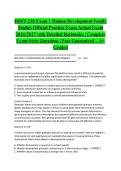
HDFS 210 Exam 1 Human Development Family
Studies Official Practice Exam Actual Exam
2026/2027 with Detailed Rationales | Complete
Exam-Style Questions | Pass Guaranteed – A+
Graded
══════════════════════════════════════
SECTION 1: FOUNDATIONS OF HUMAN DEVELOPMENT Q1 – Q10
══════════════════════════════════════
Question 1 of 50
A developmental psychologist observes that identical twins raised in different households
both excel at mathematics but differ significantly in their social confidence. This pattern best
illustrates which foundational principle of human development?
A. Nature and nurture interact in complex ways across developmental domains ✓ CORRECT
B. Genetic inheritance determines all cognitive outcomes uniformly
C. Environmental context has no influence on genetically influenced traits
D. Twin studies prove that personality is entirely environmentally driven
Correct Answer: A
Rationale: Nature and nurture interact across different developmental domains, meaning
genetic predispositions may express similarly in some areas while environmental contexts
shape divergence in others. The trap answer B incorrectly assumes genetic determinism,
ignoring that identical twins share genes but experience different environments that influence
socioemotional outcomes. Recognizing domain-specific gene-environment interactions is
essential for understanding why twins may be alike in some ways and different in others.
Question 2 of 50
A father notices his toddler gradually improves at walking over months, while his neighbor's
child seemed to start walking almost overnight after weeks of cruising furniture. These
observations reflect which debate in developmental science?
A. Whether development is universal or context-specific
B. Whether development proceeds continuously or in discontinuous stages ✓ CORRECT
C. Whether nature or nurture plays a stronger role in motor skills
,D. Whether early childhood experiences predict adult outcomes
Correct Answer: B
Rationale: The continuity-discontinuity debate centers on whether development is gradual and
cumulative or occurs in abrupt, qualitatively distinct stages. The trap answer A confuses this
with the universal versus context-specific debate, which addresses cultural variation rather
than the pace of change. Real developmental progress often involves both continuous
improvement and occasional stage-like shifts.
Question 3 of 50
A researcher studying adolescent identity formation finds that teenagers in collectivist
cultures prioritize family obligations over personal career dreams, while those in individualist
cultures emphasize self-discovery. This finding highlights which developmental issue?
A. The nature versus nurture debate
B. The continuity versus discontinuity question
C. Whether development is universal or context-specific ✓ CORRECT
D. Whether stages occur in fixed sequences across all cultures
Correct Answer: C
Rationale: The universal versus context-specific issue examines whether developmental
patterns are consistent across cultures or shaped by cultural contexts. The trap answer A
misidentifies the finding as nature versus nurture, when the study actually reveals cultural
variation in how identity develops. Developmental scientists must attend to cultural context
when applying theories formulated primarily in Western individualist societies.
Question 4 of 50
A pediatrician assesses a 4-year-old's height and weight, evaluates her ability to sort shapes
by color, and asks her parents about her play behaviors with peers. The doctor is examining
development across which three topical areas?
A. Genetic, environmental, and behavioral domains
B. Prenatal, natal, and postnatal periods
C. Nature, nurture, and interactionist perspectives
D. Physical, cognitive, and socioemotional processes ✓ CORRECT
Correct Answer: D
Rationale: Human development is traditionally organized into physical, cognitive, and
socioemotional processes, which together provide a comprehensive assessment of the
whole child. The trap answer B confuses topical areas with developmental periods, which
refer to age-related stages rather than domains of functioning. Pediatric and educational
assessments routinely evaluate all three domains to capture integrated development.
, Question 5 of 50
A child born with a temperamentally difficult disposition receives patient, responsive
parenting and gradually develops strong emotional regulation. This outcome demonstrates
which concept?
A. Differential susceptibility to environmental influences ✓ CORRECT
B. Genetic determinism of behavioral outcomes
C. Environmental irrelevance in temperament development
D. Fixed personality traits that resist all intervention
Correct Answer: A
Rationale: Differential susceptibility posits that some children, particularly those with difficult
temperaments, are more affected by parenting quality and can show especially positive
outcomes under supportive conditions. The trap answer B reflects genetic determinism, a
common misconception that ignores the powerful role of responsive caregiving in shaping
temperament outcomes. This principle underscores why early intervention programs target
high-risk infants with nurturing support.
Question 6 of 50
A grandmother insists that her grandson "changed overnight" when he turned two, suddenly
becoming more independent and defiant. Her son, a developmental scientist, explains that
this transformation actually reflects small, cumulative changes in brain maturation and
experience. Their disagreement centers on which issue?
A. Whether development is universal or culturally variable
B. Whether development is continuous or discontinuous ✓ CORRECT
C. Whether temperament is genetically inherited
D. Whether early childhood predicts later competence
Correct Answer: B
Rationale: The continuity-discontinuity issue distinguishes between gradual, quantitative
change and abrupt, qualitative transformation. The trap answer A confuses this debate with
the universal versus context-specific question, which concerns cultural consistency rather
than the pace of developmental change. Grandparents often perceive stage-like shifts where
parents see gradual evolution, illustrating how everyday observations filter through different
developmental assumptions.
Question 7 of 50
A preschool curriculum that emphasizes group harmony and cooperation is highly effective in
Japan but produces less engagement when implemented without adaptation in the United
States. This outcome best supports which position?
Studies Official Practice Exam Actual Exam
2026/2027 with Detailed Rationales | Complete
Exam-Style Questions | Pass Guaranteed – A+
Graded
══════════════════════════════════════
SECTION 1: FOUNDATIONS OF HUMAN DEVELOPMENT Q1 – Q10
══════════════════════════════════════
Question 1 of 50
A developmental psychologist observes that identical twins raised in different households
both excel at mathematics but differ significantly in their social confidence. This pattern best
illustrates which foundational principle of human development?
A. Nature and nurture interact in complex ways across developmental domains ✓ CORRECT
B. Genetic inheritance determines all cognitive outcomes uniformly
C. Environmental context has no influence on genetically influenced traits
D. Twin studies prove that personality is entirely environmentally driven
Correct Answer: A
Rationale: Nature and nurture interact across different developmental domains, meaning
genetic predispositions may express similarly in some areas while environmental contexts
shape divergence in others. The trap answer B incorrectly assumes genetic determinism,
ignoring that identical twins share genes but experience different environments that influence
socioemotional outcomes. Recognizing domain-specific gene-environment interactions is
essential for understanding why twins may be alike in some ways and different in others.
Question 2 of 50
A father notices his toddler gradually improves at walking over months, while his neighbor's
child seemed to start walking almost overnight after weeks of cruising furniture. These
observations reflect which debate in developmental science?
A. Whether development is universal or context-specific
B. Whether development proceeds continuously or in discontinuous stages ✓ CORRECT
C. Whether nature or nurture plays a stronger role in motor skills
,D. Whether early childhood experiences predict adult outcomes
Correct Answer: B
Rationale: The continuity-discontinuity debate centers on whether development is gradual and
cumulative or occurs in abrupt, qualitatively distinct stages. The trap answer A confuses this
with the universal versus context-specific debate, which addresses cultural variation rather
than the pace of change. Real developmental progress often involves both continuous
improvement and occasional stage-like shifts.
Question 3 of 50
A researcher studying adolescent identity formation finds that teenagers in collectivist
cultures prioritize family obligations over personal career dreams, while those in individualist
cultures emphasize self-discovery. This finding highlights which developmental issue?
A. The nature versus nurture debate
B. The continuity versus discontinuity question
C. Whether development is universal or context-specific ✓ CORRECT
D. Whether stages occur in fixed sequences across all cultures
Correct Answer: C
Rationale: The universal versus context-specific issue examines whether developmental
patterns are consistent across cultures or shaped by cultural contexts. The trap answer A
misidentifies the finding as nature versus nurture, when the study actually reveals cultural
variation in how identity develops. Developmental scientists must attend to cultural context
when applying theories formulated primarily in Western individualist societies.
Question 4 of 50
A pediatrician assesses a 4-year-old's height and weight, evaluates her ability to sort shapes
by color, and asks her parents about her play behaviors with peers. The doctor is examining
development across which three topical areas?
A. Genetic, environmental, and behavioral domains
B. Prenatal, natal, and postnatal periods
C. Nature, nurture, and interactionist perspectives
D. Physical, cognitive, and socioemotional processes ✓ CORRECT
Correct Answer: D
Rationale: Human development is traditionally organized into physical, cognitive, and
socioemotional processes, which together provide a comprehensive assessment of the
whole child. The trap answer B confuses topical areas with developmental periods, which
refer to age-related stages rather than domains of functioning. Pediatric and educational
assessments routinely evaluate all three domains to capture integrated development.
, Question 5 of 50
A child born with a temperamentally difficult disposition receives patient, responsive
parenting and gradually develops strong emotional regulation. This outcome demonstrates
which concept?
A. Differential susceptibility to environmental influences ✓ CORRECT
B. Genetic determinism of behavioral outcomes
C. Environmental irrelevance in temperament development
D. Fixed personality traits that resist all intervention
Correct Answer: A
Rationale: Differential susceptibility posits that some children, particularly those with difficult
temperaments, are more affected by parenting quality and can show especially positive
outcomes under supportive conditions. The trap answer B reflects genetic determinism, a
common misconception that ignores the powerful role of responsive caregiving in shaping
temperament outcomes. This principle underscores why early intervention programs target
high-risk infants with nurturing support.
Question 6 of 50
A grandmother insists that her grandson "changed overnight" when he turned two, suddenly
becoming more independent and defiant. Her son, a developmental scientist, explains that
this transformation actually reflects small, cumulative changes in brain maturation and
experience. Their disagreement centers on which issue?
A. Whether development is universal or culturally variable
B. Whether development is continuous or discontinuous ✓ CORRECT
C. Whether temperament is genetically inherited
D. Whether early childhood predicts later competence
Correct Answer: B
Rationale: The continuity-discontinuity issue distinguishes between gradual, quantitative
change and abrupt, qualitative transformation. The trap answer A confuses this debate with
the universal versus context-specific question, which concerns cultural consistency rather
than the pace of developmental change. Grandparents often perceive stage-like shifts where
parents see gradual evolution, illustrating how everyday observations filter through different
developmental assumptions.
Question 7 of 50
A preschool curriculum that emphasizes group harmony and cooperation is highly effective in
Japan but produces less engagement when implemented without adaptation in the United
States. This outcome best supports which position?