

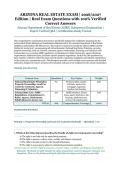
ARIZONA REAL ESTATE EXAM | 2026/2027
Edition | Real Exam Questions with 100% Verified
Correct Answers
Arizona Department of Real Estate (ADRE) Salesperson Examination |
Expert-Verified Q&A | Certification-Ready Format
This comprehensive examination document is specifically designed for candidates preparing for the
Arizona Real Estate Salesperson Examination administered by the Arizona Department of Real Estate
(ADRE) in partnership with PSI Services. The content is structured around the official ADRE Content
Outline for 2026/2027, encompassing all critical domains: National Real Estate Principles covering
property ownership, land use controls, contracts, agency relationships, financing, and valuation; and
Arizona State Law covering ADRE regulations, Commissioner's Rules, license law, agency disclosure
requirements, subdivision laws, and state-specific property regulations. Each of the 180 questions has
been expertly verified to reflect the most current statutes, regulatory standards, and industry standards as
of the 2026/2027 examination cycle. This document provides 100% verified correct answers with detailed
rationales, designed to ensure accurate self-evaluation and pass-level readiness for the actual examination.
Content Area Overview
_________________________________________________________________________
_______
Content Area Questions Key Topics Weight
National Real Estate Principles: 80 Property rights, estates, 44%
Property Ownership, Land Use contracts, agency law,
Controls, Contracts, Agency, mortgages, appraisal,
Financing & Valuation taxation, fair housing
Arizona State Law: ADRE 100 ADRE structure, license 56%
Regulations, Commissioner's types, agency disclosure, fair
Rules, Agency, Disclosures, housing, subdivision law,
Subdivisions & License Law escrow, CR requirements
TOTAL 180 Comprehensive Coverage 100%
Examination Questions
_________________________________________________________________________
_______
Domain: 1: Property Ownership and Land Use Controls (National) — Questions 1–20
_________________________________________________________________________
_______
1. Which of the following best describes the bundle of rights in real property ownership?
A) The right to use land only for agricultural purposes
B) The right to possess, control, enjoy, exclude, and dispose of property
C) The right to transfer property only through inheritance
D) The right to use property subject to unlimited government regulation
Correct Answer: B) The right to possess, control, enjoy, exclude, and dispose of property
Rationale: The bundle of rights includes the rights of possession, control, enjoyment, exclusion, and
disposition. These are the fundamental legal rights that accompany real property ownership.
,2. What type of estate is created when ownership is for an indefinite period and can be
inherited?
A) Life estate
B) Fee simple absolute
C) Leasehold estate
D) Fee simple defeasible
Correct Answer: B) Fee simple absolute
Rationale: Fee simple absolute is the highest form of ownership, providing indefinite duration and
full inheritability. It is not conditioned upon any specific event and conveys the complete bundle of
rights.
3. Under Arizona law, which of the following is considered real property?
A) A mobile home permanently affixed to a foundation
B) A stock certificate
C) A promissory note
D) A vehicle used for business purposes
Correct Answer: A) A mobile home permanently affixed to a foundation
Rationale: Real property includes land and anything permanently attached to it. A mobile home that
is permanently affixed to a foundation is considered a fixture and therefore real property under
Arizona law.
4. Which legal principle states that whoever owns the land owns everything above and
below the surface, subject to governmental limitations?
A) Littoral rights
B) Prior appropriation
C) Ad coelum doctrine
D) Emblements
Correct Answer: C) Ad coelum doctrine
Rationale: The ad coelum doctrine ('from the heavens to the center of the earth') provides that
landowners own the airspace above and the subsurface below their property, though modern law
limits this by government regulations such as zoning and air rights.
5. What is an easement in gross?
A) An easement benefiting a dominant tenement
B) An easement that benefits a person or entity, not a parcel of land
C) An easement created by prescription
D) An easement terminating upon the death of the holder
Correct Answer: B) An easement that benefits a person or entity, not a parcel of land
Rationale: An easement in gross benefits an individual or entity (such as a utility company) rather
than benefiting another parcel of land. It is a personal right that may be transferred.
6. Which form of co-ownership includes the right of survivorship and requires all owners
to hold equal shares?
A) Tenancy in common
B) Joint tenancy
C) Tenancy by the entirety
D) Community property with right of survivorship
Correct Answer: B) Joint tenancy
Rationale: Joint tenancy requires the four unities (time, title, interest, and possession) and includes
the right of survivorship. All joint tenants must have equal shares and acquire title at the same time
through the same instrument.
7. What does the term 'littoral rights' refer to?
, A) Rights to use water from underground aquifers
B) Rights of landowners whose property abuts navigable lakes and seas
C) Rights to appropriate water for agricultural use
D) Rights to mineral deposits beneath the surface
Correct Answer: B) Rights of landowners whose property abuts navigable lakes and seas
Rationale: Littoral rights pertain to landowners whose property borders navigable lakes, seas, or
oceans. These rights include access to the water and use of the shoreline, typically up to the ordinary
high-water mark.
8. What type of listing agreement gives the broker the exclusive right to earn a commission
regardless of who finds the buyer?
A) Open listing
B) Exclusive agency listing
C) Exclusive right-to-sell listing
D) Net listing
Correct Answer: C) Exclusive right-to-sell listing
Rationale: In an exclusive right-to-sell listing, the broker is entitled to a commission if the property is
sold during the listing period, regardless of whether the broker, the seller, or any other person
procures the buyer.
9. Which Arizona statute governs the recording of instruments affecting title to real
property?
A) A.R.S. Title 33, Chapter 4
B) A.R.S. Title 32, Chapter 20
C) A.R.S. Title 12, Chapter 6
D) A.R.S. Title 9, Chapter 2
Correct Answer: A) A.R.S. Title 33, Chapter 4
Rationale: Arizona Revised Statutes Title 33, Chapter 4 governs the recording of documents and
instruments affecting title to real property, including the requirements for recording and the priority
of recorded interests.
10. Which of the following would be considered a lien on real property?
A) A real estate purchase contract
B) A mortgage
C) A listing agreement
D) A lease agreement
Correct Answer: B) A mortgage
Rationale: A mortgage is a voluntary lien that encumbers real property as security for a debt. It
creates a claim against the property that must be satisfied upon sale or transfer.
11. What is the primary purpose of a homestead exemption under Arizona law?
A) To exempt property from all taxation
B) To protect a portion of the homeowner's equity from forced sale by creditors
C) To allow property to be conveyed without recording
D) To eliminate the need for title insurance
Correct Answer: B) To protect a portion of the homeowner's equity from forced sale by
creditors
Rationale: The Arizona homestead exemption protects up to $250,000 (or $400,000 for joint
owners) of equity in a primary residence from forced sale by most creditors. It does not eliminate tax
obligations or the need for title insurance.
12. Which of the following best defines 'police power' as it relates to real estate?
A) The power of the federal government to impose taxes
, B) The power of the state to regulate land use for the health, safety, and welfare of the public
C) The power of law enforcement to seize property
D) The power of local governments to purchase property through eminent domain
Correct Answer: B) The power of the state to regulate land use for the health, safety, and
welfare of the public
Rationale: Police power is the inherent authority of state and local governments to regulate private
property to protect public health, safety, morals, and general welfare. Zoning ordinances and
building codes are examples of police power.
13. A property owner grants a neighbor the right to use a pathway across their land. This is
an example of:
A) A license
B) An easement appurtenant
C) A lien
D) A leasehold interest
Correct Answer: B) An easement appurtenant
Rationale: An easement appurtenant benefits a dominant tenement (the benefited parcel) and runs
with the land. The servient tenement (the burdened parcel) must allow the specified use by the
dominant tenement owner.
14. What is the key distinction between a lien and an encumbrance?
A) All liens are encumbrances, but not all encumbrances are liens
B) Liens are always voluntary; encumbrances are always involuntary
C) Encumbrances only apply to commercial property
D) Liens cannot be recorded; encumbrances must be recorded
Correct Answer: A) All liens are encumbrances, but not all encumbrances are liens
Rationale: An encumbrance is any right or interest in property that diminishes its value, such as
easements, restrictions, or liens. A lien is a specific type of encumbrance representing a financial
claim against the property.
15. Under the Statute of Frauds, which of the following must be in writing to be
enforceable?
A) A month-to-month lease
B) A contract for the sale of real estate
C) An oral listing agreement
D) A verbal agreement to pay a commission
Correct Answer: B) A contract for the sale of real estate
Rationale: The Statute of Frauds requires that contracts for the sale of real estate must be in writing
and signed by the party to be charged to be enforceable. This includes real estate purchase
agreements and leases exceeding one year.
16. Which type of zoning regulates the height, bulk, and placement of buildings on a lot?
A) Use zoning
B) Density zoning
C) Bulk zoning
D) Aesthetic zoning
Correct Answer: C) Bulk zoning
Rationale: Bulk zoning (also called area zoning) regulates the physical dimensions of buildings,
including height, setback requirements, floor area ratios, and lot coverage. It controls the density and
mass of development.
17. What is a non-conforming use?
A) A use permitted only by variance
B) A use that was legal when established but does not comply with current zoning regulations
Edition | Real Exam Questions with 100% Verified
Correct Answers
Arizona Department of Real Estate (ADRE) Salesperson Examination |
Expert-Verified Q&A | Certification-Ready Format
This comprehensive examination document is specifically designed for candidates preparing for the
Arizona Real Estate Salesperson Examination administered by the Arizona Department of Real Estate
(ADRE) in partnership with PSI Services. The content is structured around the official ADRE Content
Outline for 2026/2027, encompassing all critical domains: National Real Estate Principles covering
property ownership, land use controls, contracts, agency relationships, financing, and valuation; and
Arizona State Law covering ADRE regulations, Commissioner's Rules, license law, agency disclosure
requirements, subdivision laws, and state-specific property regulations. Each of the 180 questions has
been expertly verified to reflect the most current statutes, regulatory standards, and industry standards as
of the 2026/2027 examination cycle. This document provides 100% verified correct answers with detailed
rationales, designed to ensure accurate self-evaluation and pass-level readiness for the actual examination.
Content Area Overview
_________________________________________________________________________
_______
Content Area Questions Key Topics Weight
National Real Estate Principles: 80 Property rights, estates, 44%
Property Ownership, Land Use contracts, agency law,
Controls, Contracts, Agency, mortgages, appraisal,
Financing & Valuation taxation, fair housing
Arizona State Law: ADRE 100 ADRE structure, license 56%
Regulations, Commissioner's types, agency disclosure, fair
Rules, Agency, Disclosures, housing, subdivision law,
Subdivisions & License Law escrow, CR requirements
TOTAL 180 Comprehensive Coverage 100%
Examination Questions
_________________________________________________________________________
_______
Domain: 1: Property Ownership and Land Use Controls (National) — Questions 1–20
_________________________________________________________________________
_______
1. Which of the following best describes the bundle of rights in real property ownership?
A) The right to use land only for agricultural purposes
B) The right to possess, control, enjoy, exclude, and dispose of property
C) The right to transfer property only through inheritance
D) The right to use property subject to unlimited government regulation
Correct Answer: B) The right to possess, control, enjoy, exclude, and dispose of property
Rationale: The bundle of rights includes the rights of possession, control, enjoyment, exclusion, and
disposition. These are the fundamental legal rights that accompany real property ownership.
,2. What type of estate is created when ownership is for an indefinite period and can be
inherited?
A) Life estate
B) Fee simple absolute
C) Leasehold estate
D) Fee simple defeasible
Correct Answer: B) Fee simple absolute
Rationale: Fee simple absolute is the highest form of ownership, providing indefinite duration and
full inheritability. It is not conditioned upon any specific event and conveys the complete bundle of
rights.
3. Under Arizona law, which of the following is considered real property?
A) A mobile home permanently affixed to a foundation
B) A stock certificate
C) A promissory note
D) A vehicle used for business purposes
Correct Answer: A) A mobile home permanently affixed to a foundation
Rationale: Real property includes land and anything permanently attached to it. A mobile home that
is permanently affixed to a foundation is considered a fixture and therefore real property under
Arizona law.
4. Which legal principle states that whoever owns the land owns everything above and
below the surface, subject to governmental limitations?
A) Littoral rights
B) Prior appropriation
C) Ad coelum doctrine
D) Emblements
Correct Answer: C) Ad coelum doctrine
Rationale: The ad coelum doctrine ('from the heavens to the center of the earth') provides that
landowners own the airspace above and the subsurface below their property, though modern law
limits this by government regulations such as zoning and air rights.
5. What is an easement in gross?
A) An easement benefiting a dominant tenement
B) An easement that benefits a person or entity, not a parcel of land
C) An easement created by prescription
D) An easement terminating upon the death of the holder
Correct Answer: B) An easement that benefits a person or entity, not a parcel of land
Rationale: An easement in gross benefits an individual or entity (such as a utility company) rather
than benefiting another parcel of land. It is a personal right that may be transferred.
6. Which form of co-ownership includes the right of survivorship and requires all owners
to hold equal shares?
A) Tenancy in common
B) Joint tenancy
C) Tenancy by the entirety
D) Community property with right of survivorship
Correct Answer: B) Joint tenancy
Rationale: Joint tenancy requires the four unities (time, title, interest, and possession) and includes
the right of survivorship. All joint tenants must have equal shares and acquire title at the same time
through the same instrument.
7. What does the term 'littoral rights' refer to?
, A) Rights to use water from underground aquifers
B) Rights of landowners whose property abuts navigable lakes and seas
C) Rights to appropriate water for agricultural use
D) Rights to mineral deposits beneath the surface
Correct Answer: B) Rights of landowners whose property abuts navigable lakes and seas
Rationale: Littoral rights pertain to landowners whose property borders navigable lakes, seas, or
oceans. These rights include access to the water and use of the shoreline, typically up to the ordinary
high-water mark.
8. What type of listing agreement gives the broker the exclusive right to earn a commission
regardless of who finds the buyer?
A) Open listing
B) Exclusive agency listing
C) Exclusive right-to-sell listing
D) Net listing
Correct Answer: C) Exclusive right-to-sell listing
Rationale: In an exclusive right-to-sell listing, the broker is entitled to a commission if the property is
sold during the listing period, regardless of whether the broker, the seller, or any other person
procures the buyer.
9. Which Arizona statute governs the recording of instruments affecting title to real
property?
A) A.R.S. Title 33, Chapter 4
B) A.R.S. Title 32, Chapter 20
C) A.R.S. Title 12, Chapter 6
D) A.R.S. Title 9, Chapter 2
Correct Answer: A) A.R.S. Title 33, Chapter 4
Rationale: Arizona Revised Statutes Title 33, Chapter 4 governs the recording of documents and
instruments affecting title to real property, including the requirements for recording and the priority
of recorded interests.
10. Which of the following would be considered a lien on real property?
A) A real estate purchase contract
B) A mortgage
C) A listing agreement
D) A lease agreement
Correct Answer: B) A mortgage
Rationale: A mortgage is a voluntary lien that encumbers real property as security for a debt. It
creates a claim against the property that must be satisfied upon sale or transfer.
11. What is the primary purpose of a homestead exemption under Arizona law?
A) To exempt property from all taxation
B) To protect a portion of the homeowner's equity from forced sale by creditors
C) To allow property to be conveyed without recording
D) To eliminate the need for title insurance
Correct Answer: B) To protect a portion of the homeowner's equity from forced sale by
creditors
Rationale: The Arizona homestead exemption protects up to $250,000 (or $400,000 for joint
owners) of equity in a primary residence from forced sale by most creditors. It does not eliminate tax
obligations or the need for title insurance.
12. Which of the following best defines 'police power' as it relates to real estate?
A) The power of the federal government to impose taxes
, B) The power of the state to regulate land use for the health, safety, and welfare of the public
C) The power of law enforcement to seize property
D) The power of local governments to purchase property through eminent domain
Correct Answer: B) The power of the state to regulate land use for the health, safety, and
welfare of the public
Rationale: Police power is the inherent authority of state and local governments to regulate private
property to protect public health, safety, morals, and general welfare. Zoning ordinances and
building codes are examples of police power.
13. A property owner grants a neighbor the right to use a pathway across their land. This is
an example of:
A) A license
B) An easement appurtenant
C) A lien
D) A leasehold interest
Correct Answer: B) An easement appurtenant
Rationale: An easement appurtenant benefits a dominant tenement (the benefited parcel) and runs
with the land. The servient tenement (the burdened parcel) must allow the specified use by the
dominant tenement owner.
14. What is the key distinction between a lien and an encumbrance?
A) All liens are encumbrances, but not all encumbrances are liens
B) Liens are always voluntary; encumbrances are always involuntary
C) Encumbrances only apply to commercial property
D) Liens cannot be recorded; encumbrances must be recorded
Correct Answer: A) All liens are encumbrances, but not all encumbrances are liens
Rationale: An encumbrance is any right or interest in property that diminishes its value, such as
easements, restrictions, or liens. A lien is a specific type of encumbrance representing a financial
claim against the property.
15. Under the Statute of Frauds, which of the following must be in writing to be
enforceable?
A) A month-to-month lease
B) A contract for the sale of real estate
C) An oral listing agreement
D) A verbal agreement to pay a commission
Correct Answer: B) A contract for the sale of real estate
Rationale: The Statute of Frauds requires that contracts for the sale of real estate must be in writing
and signed by the party to be charged to be enforceable. This includes real estate purchase
agreements and leases exceeding one year.
16. Which type of zoning regulates the height, bulk, and placement of buildings on a lot?
A) Use zoning
B) Density zoning
C) Bulk zoning
D) Aesthetic zoning
Correct Answer: C) Bulk zoning
Rationale: Bulk zoning (also called area zoning) regulates the physical dimensions of buildings,
including height, setback requirements, floor area ratios, and lot coverage. It controls the density and
mass of development.
17. What is a non-conforming use?
A) A use permitted only by variance
B) A use that was legal when established but does not comply with current zoning regulations


