
Lab #3: Pressure within Fluids, Pascals’ Law and the Bernoulli
Principle
Your Name Here:
Theory: In class we found that the pressure within a fluid rises based on the depth within the
fluid.
P = P 0 + ρgy
As we probe deeper within a fluid the pressure we find there will depend on any surrounding
pressure plus a pressure resulting from a need to support the overlying weight of the fluid.
The simulation we will be using will allow for changing the overlying pressure, the density of
the fluid and the gravitational constant of the planet, allowing us to probe the relationship.
Pascals Law tells us that, for the same depth within a single fluid, the pressure will be the
same and that, if the pressure is raised within the fluid, it will be transmitted to all parts of the
fluid: P1 = P2 (given same elevation).
Continuity of Flow tells us that the volume of fluid passing a point per unit time is the same
everywhere, provided the fluid is incompressible. A1v1 = A2v2.
Bernoulli’s principle tells us about the behavior of an incompressible, nonviscous fluid.
Specifically,
P + ρgy + 12 ρv2 = constant
Most of the time our focus in the classroom is on what happens within a moving fluid –
namely that the pressure drops as the speed increases (given same elevation).
In fact, the Bernoulli equation contains the other two (pressure with depth and Pascals law).
In this lab we will be using a PhET simulation to probe the relationships we have learned
about in class. If you are comfortable downloading and running a .jar file on your computer
then you may use the version found here:
https://phet.colorado.edu/en/simulation/legacy/fluid-pressure-and-flow
If you would prefer not to run an unfamiliar jar file OR your device cannot run a jar file then
you may use the Cheerpj online version, just be warned: it runs SLOW.
https://phet.colorado.edu/sims/cheerpj/fluid-pressure-and-flow/latest/fluid-pressure-an
d-flow.html
Pressure tab:
Exercise 1: The first two exercises can be either of the first two tank types. Use the pressure
tool to place a pressure meter near the bottom of the tank. Measure the pressure at the
, bottom of the square pool as you raise and lower the fluid level inside. Use the ruler to
measure the depth.
Click and drag the pressure tool to a few locations both inside and outside the liquid and
observe the readings.
Q1: Is the pressure reported gauge pressure or absolute pressure? What is your evidence?
Ans: Absolute pressure at a point inside the liquid is the sum of the atmospheric pressure and
the pressure due to the liquid column over that point. Gauge pressure does not consider the
atmospheric pressure. Gauge pressure is the difference between the absolute pressure at that
point and the atmospheric pressure.
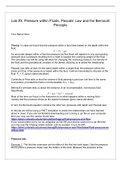
Here as can be observed from the above picture of the pressure measuring instrument,
its zero reading is set at atmospheric pressure of 101.300 kPa. Hence this instrument will
show the absolute pressure at any point within the liquid.
Principle
Your Name Here:
Theory: In class we found that the pressure within a fluid rises based on the depth within the
fluid.
P = P 0 + ρgy
As we probe deeper within a fluid the pressure we find there will depend on any surrounding
pressure plus a pressure resulting from a need to support the overlying weight of the fluid.
The simulation we will be using will allow for changing the overlying pressure, the density of
the fluid and the gravitational constant of the planet, allowing us to probe the relationship.
Pascals Law tells us that, for the same depth within a single fluid, the pressure will be the
same and that, if the pressure is raised within the fluid, it will be transmitted to all parts of the
fluid: P1 = P2 (given same elevation).
Continuity of Flow tells us that the volume of fluid passing a point per unit time is the same
everywhere, provided the fluid is incompressible. A1v1 = A2v2.
Bernoulli’s principle tells us about the behavior of an incompressible, nonviscous fluid.
Specifically,
P + ρgy + 12 ρv2 = constant
Most of the time our focus in the classroom is on what happens within a moving fluid –
namely that the pressure drops as the speed increases (given same elevation).
In fact, the Bernoulli equation contains the other two (pressure with depth and Pascals law).
In this lab we will be using a PhET simulation to probe the relationships we have learned
about in class. If you are comfortable downloading and running a .jar file on your computer
then you may use the version found here:
https://phet.colorado.edu/en/simulation/legacy/fluid-pressure-and-flow
If you would prefer not to run an unfamiliar jar file OR your device cannot run a jar file then
you may use the Cheerpj online version, just be warned: it runs SLOW.
https://phet.colorado.edu/sims/cheerpj/fluid-pressure-and-flow/latest/fluid-pressure-an
d-flow.html
Pressure tab:
Exercise 1: The first two exercises can be either of the first two tank types. Use the pressure
tool to place a pressure meter near the bottom of the tank. Measure the pressure at the
, bottom of the square pool as you raise and lower the fluid level inside. Use the ruler to
measure the depth.
Click and drag the pressure tool to a few locations both inside and outside the liquid and
observe the readings.
Q1: Is the pressure reported gauge pressure or absolute pressure? What is your evidence?
Ans: Absolute pressure at a point inside the liquid is the sum of the atmospheric pressure and
the pressure due to the liquid column over that point. Gauge pressure does not consider the
atmospheric pressure. Gauge pressure is the difference between the absolute pressure at that
point and the atmospheric pressure.
Here as can be observed from the above picture of the pressure measuring instrument,
its zero reading is set at atmospheric pressure of 101.300 kPa. Hence this instrument will
show the absolute pressure at any point within the liquid.


