

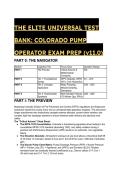
THE ELITE UNIVERSAL TEST
BANK: COLORADO PUMP
OPERATOR EXAM PREP (v11.0)
PART 0: THE NAVIGATOR
Section Cognitive Tier Focus Area Question Range
PART I The Preview Critical Axioms & N/A
Mathematical
Constants
PART II Tier 1: Foundational DFPC Statutes, NFPA Q1 – Q15
Syntax 1010, Core Hydraulics
PART II Tier 2: Complex Relay Pumping, Q16 – Q35
Application Altitude Derating,
Standpipes
PART II Tier 3: Grandmaster Multi-Variable Failures, Q36 – Q60
Synthesis I-70 Winter Ops, PRVs
PART I: THE PREVIEW
Mastering Colorado Division of Fire Prevention and Control (DFPC) regulations and fireground
hydraulics transforms a basic driver into an unimpeachable apparatus engineer. This document
forges practitioners who instinctively navigate extreme altitudes, severe winter weather, and
complex high-rise standpipe systems to ensure flawless water delivery and absolute crew
safety.
The "Critical Axioms" Cheat Sheet:
● The NFPA 1010 Consolidation: Colorado is transitioning apparatus driver testing to the
consolidated NFPA 1010 standard (absorbing 1002). Any safety violation during a
practical Job Performance Requirement (JPR) results in an automatic, non-negotiable
failure.
● The Elevation Absolute: Atmospheric pressure at sea level allows a theoretical draft lift
of 33.9 feet. In Colorado, deduct 0.5 psi and 1 foot of lift for every 1,000 feet of elevation
gain.
● The Denver Pump Chart Matrix: Pump Discharge Pressure (PDP) = Nozzle Pressure
(NP) + Friction Loss (FL) + Appliance Loss (APPL) \pm Elevation (ELEV). Modern
extruded hose has drastically lowered coefficients (e.g., Denver utilizes C=7.3 for 1
3/4-inch hose and C=1.7 for 2 1/2-inch hose).
, ● The Governor Mandate: During relay pumping operations, the Attack Engine MUST
operate in PSI (Pressure) mode, while the Supply Engine MUST operate in RPM
(Volume) mode to prevent electronic governor oscillation.
● The Winter Traction Imperative: Under Colorado SB25-069, apparatus on restricted
winter corridors must utilize Alternate Traction Devices (ATDs) or physical chains. Engine
brakes/retarders must never be used on icy downgrades.
● The High-Rise Standpipe Hard-Deck: If a building fire pump fails and Pressure
Reducing Valves (PRVs) are present, you MUST pump to the roof elevation. If no PRVs
are present, pump to the fire floor.
PART II: THE ELITE TEST BANK
Tier 1: Foundational Syntax & Application (Questions 1–15)
Q1: A candidate is undergoing the Colorado DFPC Driver Operator Pumper certification. During
the practical evaluation, the candidate successfully completes all pumping JPRs but fails to
properly secure a compartment door before driving. Based on DFPC testing standards, which
action/conclusion is the MOST ACCURATE? A) The candidate loses 5 points but passes if the
overall score remains above 80%. B) The candidate is allowed an immediate retest of the
specific driving JPR without penalty. C) The candidate automatically fails the practical
examination due to a safety violation. D) The proctor must issue a verbal warning and deduct 10
points from the driving module.
● The Answer: C (The candidate automatically fails the practical examination due to a
safety violation.)
● Distractor Analysis:
○ A is incorrect: Practical exams do not use a cumulative point system for passing;
they require 100% completion of all JPR steps.
○ B is incorrect: Immediate retests for safety violations are strictly prohibited by DFPC
policy.
○ D is incorrect: Proctors do not issue verbal warnings for safety violations; it is an
automatic failure.
The Mentor's Analysis: DFPC evaluates practical skills on a strict pass/fail binary. When
evaluating apparatus operation, the immediate priority is absolute safety compliance. By utilizing
the 100% JPR completion rule, you bypass the common trap of assuming a minor oversight is
acceptable. Professional/Academic Intuition: Any safety violation during a DFPC practical
JPR results in an immediate, automatic failure.
Q2: Under the newly consolidated NFPA standards slated for adoption in Colorado, professional
qualifications for Firefighters, Airport Firefighters, and Apparatus Driver/Operators have been
merged. Based on current regulatory updates, which standard replaces the legacy NFPA 1002?
A) NFPA 1001 B) NFPA 1500 C) NFPA 1010 D) NFPA 1901
● The Answer: C (NFPA 1010)
● Distractor Analysis:
○ A is incorrect: NFPA 1001 is the legacy standard for Firefighter Professional
Qualifications, which is also absorbed into the new standard.
○ B is incorrect: NFPA 1500 governs Fire Department Occupational Safety, Health,
and Wellness.
○ D is incorrect: NFPA 1901 is the standard for Automotive Fire Apparatus design and
, manufacturing.
The Mentor's Analysis: Regulatory frameworks evolve to streamline training and testing. When
referencing current professional qualifications, the immediate priority is utilizing the most
up-to-date codes. By utilizing NFPA 1010, you bypass the common trap of relying on outdated
legacy standard numbers. Professional/Academic Intuition: NFPA 1010 is the universal
umbrella standard for all fire service responder qualifications, replacing 1001, 1002, and
1003.
Q3: A pump operator is calculating friction loss for a 150-foot preconnect of 1 3/4-inch hose
flowing 180 GPM. Using the Denver Fire Department updated friction loss coefficient (C = 7.3),
what is the approximate friction loss? A) 35 psi B) 50 psi C) 75 psi D) 90 psi
● The Answer: A (35 psi)
● Distractor Analysis:
○ B is incorrect: This calculation uses an incorrect multiplier for the hose length.
○ C is incorrect: This is the result of using the outdated legacy coefficient (C=15.5),
which grossly over-pressurizes modern hoses.
○ D is incorrect: This is the result of failing to divide the flow rate by 100 before
squaring it.
The Mentor's Analysis: Modern extruded hose severely reduces internal hydraulic drag
compared to legacy woven-jacket hose. When calculating friction loss, the immediate priority is
using the manufacturer or AHJ-updated coefficient. By utilizing the C=7.3 parameter, you
bypass the common trap of applying 75 psi to the line, which would cause an unmanageable
nozzle reaction. Professional/Academic Intuition: Modern hose technology mandates
lower friction loss coefficients; legacy math (C=15.5) will exhaust your nozzle firefighters.
Q4: You are operating a pumper at an elevation of 10,000 feet in Leadville, Colorado. Based on
the principles of drafting, which physical limitation is the MOST ACCURATE compared to
operating at sea level? A) The pump will require a lower RPM to achieve prime due to the
thinner air. B) The atmospheric pressure pushing water into the intake is reduced by
approximately 5 psi. C) The water will boil at a higher temperature, increasing the risk of pump
overheating. D) The maximum theoretical lift will remain 33.9 feet, but the practical lift will
decrease.
● The Answer: B (The atmospheric pressure pushing water into the intake is reduced by
approximately 5 psi.)
● Distractor Analysis:
○ A is incorrect: Thinner air requires the engine to work harder, and primer operation
relies on creating a vacuum regardless of air density.
○ C is incorrect: Water boils at a lower temperature at high altitudes, accelerating
cavitation.
○ D is incorrect: Theoretical lift directly depends on atmospheric pressure; it
decreases by 1 foot for every 1,000 feet of elevation.
The Mentor's Analysis: Drafting is entirely dependent on the weight of the atmosphere pushing
down on the static water source. When operating in the high country, the immediate priority is
minimizing lift height. By utilizing the 0.5 psi drop per 1,000 ft rule, you bypass the common trap
of expecting sea-level performance from high-altitude drafts. Professional/Academic Intuition:
Altitude kills draft capacity. Deduct 1 foot of theoretical lift for every 1,000 feet of
elevation above sea level.
Q5: A driver/operator is navigating a steep downgrade on the I-70 corridor during a severe
winter storm. The apparatus hits a patch of black ice. Based on the principles of heavy vehicle
handling, which action is the MOST ACCURATE? A) Immediately apply the auxiliary engine
BANK: COLORADO PUMP
OPERATOR EXAM PREP (v11.0)
PART 0: THE NAVIGATOR
Section Cognitive Tier Focus Area Question Range
PART I The Preview Critical Axioms & N/A
Mathematical
Constants
PART II Tier 1: Foundational DFPC Statutes, NFPA Q1 – Q15
Syntax 1010, Core Hydraulics
PART II Tier 2: Complex Relay Pumping, Q16 – Q35
Application Altitude Derating,
Standpipes
PART II Tier 3: Grandmaster Multi-Variable Failures, Q36 – Q60
Synthesis I-70 Winter Ops, PRVs
PART I: THE PREVIEW
Mastering Colorado Division of Fire Prevention and Control (DFPC) regulations and fireground
hydraulics transforms a basic driver into an unimpeachable apparatus engineer. This document
forges practitioners who instinctively navigate extreme altitudes, severe winter weather, and
complex high-rise standpipe systems to ensure flawless water delivery and absolute crew
safety.
The "Critical Axioms" Cheat Sheet:
● The NFPA 1010 Consolidation: Colorado is transitioning apparatus driver testing to the
consolidated NFPA 1010 standard (absorbing 1002). Any safety violation during a
practical Job Performance Requirement (JPR) results in an automatic, non-negotiable
failure.
● The Elevation Absolute: Atmospheric pressure at sea level allows a theoretical draft lift
of 33.9 feet. In Colorado, deduct 0.5 psi and 1 foot of lift for every 1,000 feet of elevation
gain.
● The Denver Pump Chart Matrix: Pump Discharge Pressure (PDP) = Nozzle Pressure
(NP) + Friction Loss (FL) + Appliance Loss (APPL) \pm Elevation (ELEV). Modern
extruded hose has drastically lowered coefficients (e.g., Denver utilizes C=7.3 for 1
3/4-inch hose and C=1.7 for 2 1/2-inch hose).
, ● The Governor Mandate: During relay pumping operations, the Attack Engine MUST
operate in PSI (Pressure) mode, while the Supply Engine MUST operate in RPM
(Volume) mode to prevent electronic governor oscillation.
● The Winter Traction Imperative: Under Colorado SB25-069, apparatus on restricted
winter corridors must utilize Alternate Traction Devices (ATDs) or physical chains. Engine
brakes/retarders must never be used on icy downgrades.
● The High-Rise Standpipe Hard-Deck: If a building fire pump fails and Pressure
Reducing Valves (PRVs) are present, you MUST pump to the roof elevation. If no PRVs
are present, pump to the fire floor.
PART II: THE ELITE TEST BANK
Tier 1: Foundational Syntax & Application (Questions 1–15)
Q1: A candidate is undergoing the Colorado DFPC Driver Operator Pumper certification. During
the practical evaluation, the candidate successfully completes all pumping JPRs but fails to
properly secure a compartment door before driving. Based on DFPC testing standards, which
action/conclusion is the MOST ACCURATE? A) The candidate loses 5 points but passes if the
overall score remains above 80%. B) The candidate is allowed an immediate retest of the
specific driving JPR without penalty. C) The candidate automatically fails the practical
examination due to a safety violation. D) The proctor must issue a verbal warning and deduct 10
points from the driving module.
● The Answer: C (The candidate automatically fails the practical examination due to a
safety violation.)
● Distractor Analysis:
○ A is incorrect: Practical exams do not use a cumulative point system for passing;
they require 100% completion of all JPR steps.
○ B is incorrect: Immediate retests for safety violations are strictly prohibited by DFPC
policy.
○ D is incorrect: Proctors do not issue verbal warnings for safety violations; it is an
automatic failure.
The Mentor's Analysis: DFPC evaluates practical skills on a strict pass/fail binary. When
evaluating apparatus operation, the immediate priority is absolute safety compliance. By utilizing
the 100% JPR completion rule, you bypass the common trap of assuming a minor oversight is
acceptable. Professional/Academic Intuition: Any safety violation during a DFPC practical
JPR results in an immediate, automatic failure.
Q2: Under the newly consolidated NFPA standards slated for adoption in Colorado, professional
qualifications for Firefighters, Airport Firefighters, and Apparatus Driver/Operators have been
merged. Based on current regulatory updates, which standard replaces the legacy NFPA 1002?
A) NFPA 1001 B) NFPA 1500 C) NFPA 1010 D) NFPA 1901
● The Answer: C (NFPA 1010)
● Distractor Analysis:
○ A is incorrect: NFPA 1001 is the legacy standard for Firefighter Professional
Qualifications, which is also absorbed into the new standard.
○ B is incorrect: NFPA 1500 governs Fire Department Occupational Safety, Health,
and Wellness.
○ D is incorrect: NFPA 1901 is the standard for Automotive Fire Apparatus design and
, manufacturing.
The Mentor's Analysis: Regulatory frameworks evolve to streamline training and testing. When
referencing current professional qualifications, the immediate priority is utilizing the most
up-to-date codes. By utilizing NFPA 1010, you bypass the common trap of relying on outdated
legacy standard numbers. Professional/Academic Intuition: NFPA 1010 is the universal
umbrella standard for all fire service responder qualifications, replacing 1001, 1002, and
1003.
Q3: A pump operator is calculating friction loss for a 150-foot preconnect of 1 3/4-inch hose
flowing 180 GPM. Using the Denver Fire Department updated friction loss coefficient (C = 7.3),
what is the approximate friction loss? A) 35 psi B) 50 psi C) 75 psi D) 90 psi
● The Answer: A (35 psi)
● Distractor Analysis:
○ B is incorrect: This calculation uses an incorrect multiplier for the hose length.
○ C is incorrect: This is the result of using the outdated legacy coefficient (C=15.5),
which grossly over-pressurizes modern hoses.
○ D is incorrect: This is the result of failing to divide the flow rate by 100 before
squaring it.
The Mentor's Analysis: Modern extruded hose severely reduces internal hydraulic drag
compared to legacy woven-jacket hose. When calculating friction loss, the immediate priority is
using the manufacturer or AHJ-updated coefficient. By utilizing the C=7.3 parameter, you
bypass the common trap of applying 75 psi to the line, which would cause an unmanageable
nozzle reaction. Professional/Academic Intuition: Modern hose technology mandates
lower friction loss coefficients; legacy math (C=15.5) will exhaust your nozzle firefighters.
Q4: You are operating a pumper at an elevation of 10,000 feet in Leadville, Colorado. Based on
the principles of drafting, which physical limitation is the MOST ACCURATE compared to
operating at sea level? A) The pump will require a lower RPM to achieve prime due to the
thinner air. B) The atmospheric pressure pushing water into the intake is reduced by
approximately 5 psi. C) The water will boil at a higher temperature, increasing the risk of pump
overheating. D) The maximum theoretical lift will remain 33.9 feet, but the practical lift will
decrease.
● The Answer: B (The atmospheric pressure pushing water into the intake is reduced by
approximately 5 psi.)
● Distractor Analysis:
○ A is incorrect: Thinner air requires the engine to work harder, and primer operation
relies on creating a vacuum regardless of air density.
○ C is incorrect: Water boils at a lower temperature at high altitudes, accelerating
cavitation.
○ D is incorrect: Theoretical lift directly depends on atmospheric pressure; it
decreases by 1 foot for every 1,000 feet of elevation.
The Mentor's Analysis: Drafting is entirely dependent on the weight of the atmosphere pushing
down on the static water source. When operating in the high country, the immediate priority is
minimizing lift height. By utilizing the 0.5 psi drop per 1,000 ft rule, you bypass the common trap
of expecting sea-level performance from high-altitude drafts. Professional/Academic Intuition:
Altitude kills draft capacity. Deduct 1 foot of theoretical lift for every 1,000 feet of
elevation above sea level.
Q5: A driver/operator is navigating a steep downgrade on the I-70 corridor during a severe
winter storm. The apparatus hits a patch of black ice. Based on the principles of heavy vehicle
handling, which action is the MOST ACCURATE? A) Immediately apply the auxiliary engine


