

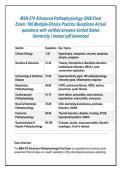
MSN 570 Advanced Pathophysiology 2026 Final
Exam: 100 Multiple-Choice Practice Questions Actual
questions with verified answers United States
University | instant pdf download
Section Questions Key Topics
Cellular Biology 1-20 Hypertrophy, metaplasia, necrosis, apoptosis,
atrophy, anaplasia
Genetics & Genomics 21-30 Trisomy, Hemophilia A, Mendelian disorders,
multifactorial disorders, BRCA1, semi-
conservative replication
Immunology & Infectious 31-45 Hypersensitivity types, HIV pathophysiology,
Disease immunity types, inflammatory response
Respiratory 46-60 COPD, pulmonary fibrosis, ARDS, asthma,
Pathophysiology pneumonia, cystic fibrosis
Cardiovascular 61-75 Heart failure, pericarditis, aortic stenosis,
Pathophysiology hypertension, endocarditis, aneurysms
Renal & Electrolyte 76-85 CKD, electrolyte disturbances, acid-base
Pathophysiology disorders, SIADH
Endocrine 86-95 Thyroid disorders, diabetes, Cushing, PCOS,
Pathophysiology hyperparathyroidism, SIADH
Gastrointestinal & 96-100 Cirrhosis, ascites, acute pancreatitis, Barrett's
Hepatic Pathophysiology esophagus, Crohn's disease
Exam Overview
The MSN 570 Advanced Pathophysiology Final Exam is a graduate-level nursing course
assessment that provides an in-depth exploration of the physiological processes underlying
,disease development. The course emphasizes the mechanisms of cellular injury, genetic
and developmental disorders, immune and inflammatory responses, and alterations in major
body systems including cardiovascular, respiratory, renal, endocrine, gastrointestinal, and
neurological systems.
Section 1: Cellular Biology, Adaptation & Injury (Questions 1-20)
1. A 62-year-old male with a 30-year history of poorly controlled hypertension
presents with echocardiographic evidence of left ventricular wall thickening. What is
the primary cellular mechanism driving this adaptive change in his cardiac muscle
cells?
A) Hyperplasia due to increased cell division
B) Hypertrophy due to increased protein synthesis
C) Metaplasia due to cellular reprogramming
D) Dysplasia due to abnormal cell maturation
Rationale: Myocardial cells are permanent cells and cannot undergo mitosis, ruling out
hyperplasia. When faced with a chronic increase in afterload from hypertension, the
myocytes adapt via hypertrophy, which involves an increase in cell size driven by enhanced
protein synthesis and the addition of sarcomeres .
2. A 45-year-old female with chronic gastroesophageal reflux disease undergoes an
upper endoscopy that reveals replacement of the normal squamous epithelium of the
lower esophagus with columnar epithelium. This cellular adaptation is best described
as which of the following processes?
A) Hypertrophy
B) Hyperplasia
C) Metaplasia
D) Anaplasia
Rationale: Metaplasia is the reversible replacement of one differentiated cell type with
another. In Barrett's esophagus, chronic acid exposure causes the squamous epithelium to
,be replaced by columnar epithelium, which is better suited to the acidic environment but
increases the risk of adenocarcinoma .
3. A 50-year-old female presents with a Pap smear showing dysplastic cells.
Dysplasia is best characterized by which of the following descriptions?
A) An increase in the size of individual cells
B) An increase in the number of cells
C) Abnormal changes in cell size, shape, and organization
D) Replacement of one cell type with another
Rationale: Dysplasia is characterized by abnormal changes in cell size, shape, and
organization. It is often a precursor to malignancy and is commonly detected in cervical Pap
smears .
4. A patient experiences a myocardial infarction resulting in cell death due to
prolonged ischemia. The type of necrosis most likely seen in this patient's heart
tissue is which of the following?
A) Liquefactive necrosis
B) Coagulative necrosis
C) Caseous necrosis
D) Fat necrosis
Rationale: Coagulative necrosis is the most common type of necrosis and occurs in solid
organs such as the heart, kidney, and liver following ischemia. The cell architecture is
preserved but the cells are dead .
5. A patient experiences reperfusion injury following restoration of blood flow to an
ischemic area of the heart. This injury occurs primarily due to which of the following
mechanisms?
A) Increased calcium influx into cells
B) Activation of the complement system
, C) Generation of reactive oxygen species (free radicals)
D) Release of inflammatory cytokines
Rationale: Reperfusion injury occurs when blood flow is restored to ischemic tissue, leading
to the generation of reactive oxygen species (free radicals) that cause additional cellular
damage .
6. A patient with chronic hypoxia develops increased production of red blood cells.
This is an example of which type of cellular adaptation?
A) Physiologic hyperplasia
B) Compensatory hyperplasia
C) Pathologic hyperplasia
D) Compensatory hypertrophy
Rationale: Compensatory hyperplasia occurs when the body increases cell production to
compensate for a deficiency. In chronic hypoxia, the kidneys release erythropoietin, which
stimulates the bone marrow to produce more red blood cells to increase oxygen-carrying
capacity .
7. A 55-year-old female with long-standing immobility due to a stroke develops
muscle wasting in her affected leg. This decrease in cell size is best described by
which term?
A) Hypoplasia
B) Atrophy
C) Dystrophy
D) Aplasia
Rationale: Atrophy results from a decrease in cell size due to decreased protein synthesis,
increased protein degradation, or both. This occurs in response to decreased workload, loss
of innervation, diminished blood supply, or inadequate nutrition .
Exam: 100 Multiple-Choice Practice Questions Actual
questions with verified answers United States
University | instant pdf download
Section Questions Key Topics
Cellular Biology 1-20 Hypertrophy, metaplasia, necrosis, apoptosis,
atrophy, anaplasia
Genetics & Genomics 21-30 Trisomy, Hemophilia A, Mendelian disorders,
multifactorial disorders, BRCA1, semi-
conservative replication
Immunology & Infectious 31-45 Hypersensitivity types, HIV pathophysiology,
Disease immunity types, inflammatory response
Respiratory 46-60 COPD, pulmonary fibrosis, ARDS, asthma,
Pathophysiology pneumonia, cystic fibrosis
Cardiovascular 61-75 Heart failure, pericarditis, aortic stenosis,
Pathophysiology hypertension, endocarditis, aneurysms
Renal & Electrolyte 76-85 CKD, electrolyte disturbances, acid-base
Pathophysiology disorders, SIADH
Endocrine 86-95 Thyroid disorders, diabetes, Cushing, PCOS,
Pathophysiology hyperparathyroidism, SIADH
Gastrointestinal & 96-100 Cirrhosis, ascites, acute pancreatitis, Barrett's
Hepatic Pathophysiology esophagus, Crohn's disease
Exam Overview
The MSN 570 Advanced Pathophysiology Final Exam is a graduate-level nursing course
assessment that provides an in-depth exploration of the physiological processes underlying
,disease development. The course emphasizes the mechanisms of cellular injury, genetic
and developmental disorders, immune and inflammatory responses, and alterations in major
body systems including cardiovascular, respiratory, renal, endocrine, gastrointestinal, and
neurological systems.
Section 1: Cellular Biology, Adaptation & Injury (Questions 1-20)
1. A 62-year-old male with a 30-year history of poorly controlled hypertension
presents with echocardiographic evidence of left ventricular wall thickening. What is
the primary cellular mechanism driving this adaptive change in his cardiac muscle
cells?
A) Hyperplasia due to increased cell division
B) Hypertrophy due to increased protein synthesis
C) Metaplasia due to cellular reprogramming
D) Dysplasia due to abnormal cell maturation
Rationale: Myocardial cells are permanent cells and cannot undergo mitosis, ruling out
hyperplasia. When faced with a chronic increase in afterload from hypertension, the
myocytes adapt via hypertrophy, which involves an increase in cell size driven by enhanced
protein synthesis and the addition of sarcomeres .
2. A 45-year-old female with chronic gastroesophageal reflux disease undergoes an
upper endoscopy that reveals replacement of the normal squamous epithelium of the
lower esophagus with columnar epithelium. This cellular adaptation is best described
as which of the following processes?
A) Hypertrophy
B) Hyperplasia
C) Metaplasia
D) Anaplasia
Rationale: Metaplasia is the reversible replacement of one differentiated cell type with
another. In Barrett's esophagus, chronic acid exposure causes the squamous epithelium to
,be replaced by columnar epithelium, which is better suited to the acidic environment but
increases the risk of adenocarcinoma .
3. A 50-year-old female presents with a Pap smear showing dysplastic cells.
Dysplasia is best characterized by which of the following descriptions?
A) An increase in the size of individual cells
B) An increase in the number of cells
C) Abnormal changes in cell size, shape, and organization
D) Replacement of one cell type with another
Rationale: Dysplasia is characterized by abnormal changes in cell size, shape, and
organization. It is often a precursor to malignancy and is commonly detected in cervical Pap
smears .
4. A patient experiences a myocardial infarction resulting in cell death due to
prolonged ischemia. The type of necrosis most likely seen in this patient's heart
tissue is which of the following?
A) Liquefactive necrosis
B) Coagulative necrosis
C) Caseous necrosis
D) Fat necrosis
Rationale: Coagulative necrosis is the most common type of necrosis and occurs in solid
organs such as the heart, kidney, and liver following ischemia. The cell architecture is
preserved but the cells are dead .
5. A patient experiences reperfusion injury following restoration of blood flow to an
ischemic area of the heart. This injury occurs primarily due to which of the following
mechanisms?
A) Increased calcium influx into cells
B) Activation of the complement system
, C) Generation of reactive oxygen species (free radicals)
D) Release of inflammatory cytokines
Rationale: Reperfusion injury occurs when blood flow is restored to ischemic tissue, leading
to the generation of reactive oxygen species (free radicals) that cause additional cellular
damage .
6. A patient with chronic hypoxia develops increased production of red blood cells.
This is an example of which type of cellular adaptation?
A) Physiologic hyperplasia
B) Compensatory hyperplasia
C) Pathologic hyperplasia
D) Compensatory hypertrophy
Rationale: Compensatory hyperplasia occurs when the body increases cell production to
compensate for a deficiency. In chronic hypoxia, the kidneys release erythropoietin, which
stimulates the bone marrow to produce more red blood cells to increase oxygen-carrying
capacity .
7. A 55-year-old female with long-standing immobility due to a stroke develops
muscle wasting in her affected leg. This decrease in cell size is best described by
which term?
A) Hypoplasia
B) Atrophy
C) Dystrophy
D) Aplasia
Rationale: Atrophy results from a decrease in cell size due to decreased protein synthesis,
increased protein degradation, or both. This occurs in response to decreased workload, loss
of innervation, diminished blood supply, or inadequate nutrition .


