

Video’s: https://www.odoo.com/nl_NL/slides
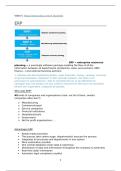
ERP
ERP = enterprise resources
planning = a one/single software package enabling the flow of all the
information between all departments (production, sales, procurement, HRM,
finance…) and external business partners.
= software die alle bedrijfsactiviteiten, zoals financiën, inkoop, verkoop, voorraad
en personeelszaken, integreert in één centraal systeem. Het doel is om
processen te automatiseren, data te centraliseren en zo de efficiëntie te
verhogen door het bieden van een uniform overzicht en één bron van waarheid
binnen een organisatie, ongeacht de grootte.
Who uses ERP?
All kinds of companies and organizations (note: not all of them, smaller
companies often don’t)
o Manufacturing
o Commercial/retail
o Service companies
o Financial institutions
o Hospitals/schools
o Government
o Not for profit organisations, …
Advantages ERP
Ready-made processes
The process take centre stage, department(s) execute the process.
Integrates all processes and departments in one system
More automation possible
One central database (clean data & reporting)
Distribution of data and information throughout the company & externally
Real-time data/ information
Automatic legal compliance (audits)
1
,Disadvantages ERP
Cost
- License
- Implementations
- Upgrades
Often not recommended to model the software to your processes but
rather change your processes to the software.
Training
Where does your ERP live?
On-premise & in the cloud
Silo mentality
Vb:
“I’m not in sales/marketing. Why are you asking this to me?”
“I’ve got 15 minutes to talk to you. I’m very busy with important things.”
“I’ve been here for 20 years and I don’t see why we should change now.”
“This is the way it’s always been done and it’s worked well up to now.”
“I am willing to support the project 100% as long as it does not affect me.”
Inhibits customer centricity (= verhindert klantgerichtheid)
Werken in silo's betekent dat teams of afdelingen binnen een organisatie
los van elkaar opereren met weinig communicatie en samenwerking,
waardoor ze zich richten op hun eigen doelen in plaats van het grotere
organisatiedoel. Dit leidt tot inefficiëntie, miscommunicatie, gemiste
kansen, dubbel werk en een belemmering van innovatie en effectiviteit.
Evolving from a functional to process organisation
Functional organisation:
- Short term goals of departments central
- Interface between departments non-transparent
- End customers not visible to all departments
2
, Process organisation:
- Relationship towards customers central
- Organisation based on complete processes
- Importance of internal customer-supplier relation
Data integration
CRM
= customer relationship management
“Know your customer”
Capture customer data and purchase
behaviour
Processes for interactions with your
customers
Nowadays, often part of an ERP
CRM vs. ERP
CRM (Customer Relationship Management) draait om klanten en verkoop,
ERP (Enterprise Resource Planning) om interne processen en middelen.
3
ERP
ERP = enterprise resources
planning = a one/single software package enabling the flow of all the
information between all departments (production, sales, procurement, HRM,
finance…) and external business partners.
= software die alle bedrijfsactiviteiten, zoals financiën, inkoop, verkoop, voorraad
en personeelszaken, integreert in één centraal systeem. Het doel is om
processen te automatiseren, data te centraliseren en zo de efficiëntie te
verhogen door het bieden van een uniform overzicht en één bron van waarheid
binnen een organisatie, ongeacht de grootte.
Who uses ERP?
All kinds of companies and organizations (note: not all of them, smaller
companies often don’t)
o Manufacturing
o Commercial/retail
o Service companies
o Financial institutions
o Hospitals/schools
o Government
o Not for profit organisations, …
Advantages ERP
Ready-made processes
The process take centre stage, department(s) execute the process.
Integrates all processes and departments in one system
More automation possible
One central database (clean data & reporting)
Distribution of data and information throughout the company & externally
Real-time data/ information
Automatic legal compliance (audits)
1
,Disadvantages ERP
Cost
- License
- Implementations
- Upgrades
Often not recommended to model the software to your processes but
rather change your processes to the software.
Training
Where does your ERP live?
On-premise & in the cloud
Silo mentality
Vb:
“I’m not in sales/marketing. Why are you asking this to me?”
“I’ve got 15 minutes to talk to you. I’m very busy with important things.”
“I’ve been here for 20 years and I don’t see why we should change now.”
“This is the way it’s always been done and it’s worked well up to now.”
“I am willing to support the project 100% as long as it does not affect me.”
Inhibits customer centricity (= verhindert klantgerichtheid)
Werken in silo's betekent dat teams of afdelingen binnen een organisatie
los van elkaar opereren met weinig communicatie en samenwerking,
waardoor ze zich richten op hun eigen doelen in plaats van het grotere
organisatiedoel. Dit leidt tot inefficiëntie, miscommunicatie, gemiste
kansen, dubbel werk en een belemmering van innovatie en effectiviteit.
Evolving from a functional to process organisation
Functional organisation:
- Short term goals of departments central
- Interface between departments non-transparent
- End customers not visible to all departments
2
, Process organisation:
- Relationship towards customers central
- Organisation based on complete processes
- Importance of internal customer-supplier relation
Data integration
CRM
= customer relationship management
“Know your customer”
Capture customer data and purchase
behaviour
Processes for interactions with your
customers
Nowadays, often part of an ERP
CRM vs. ERP
CRM (Customer Relationship Management) draait om klanten en verkoop,
ERP (Enterprise Resource Planning) om interne processen en middelen.
3


