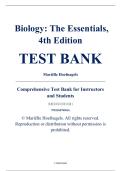
TEST BANK
Biology: The Essentials, 4th Edition
By Mariëlle Hoefnagels
SC
O
R
EG
U
ID
ES
, Table of Content
UNIT 1 Science, Chemistry, and Cells
1 The Scientific Study of Life
2 The Chemistry of Life
3 Cells
4 The Energy of Life
5 Photosynthesis
6 Respiration and Fermentation
UNIT 2 DNA, Inheritance, and Biotechnology
7 DNA Structure and Gene Function
SC
8 DNA Replication, Binary Fission, and Mitosis
9 Sexual Reproduction and Meiosis
10 Patterns of Inheritance
11 DNA Technology
UNIT 3 Evolution and Diversity
12 Forces of Evolutionary Change
O
13 Evidence of Evolution
14 Speciation and Extinction
15 Evolution and Diversity of Microbial Life
16 Evolution and Diversity of Plants
R
17 Evolution and Diversity of Animals
UNIT 4 Ecology
18 Populations
EG
19 Communities and Ecosystems
20 Preserving Biodiversity
UNIT 5 Plant Anatomy and Physiology
21 Plant Form and Function
22 Reproduction and Development of Flowering Plants
UNIT 6 Animal Anatomy and Physiology
23 Animal Tissues and Organ Systems
U
24 The Nervous System and the Senses
25 The Endocrine System
26 The Skeletal and Muscular Systems
ID
27 The Circulatory and Respiratory Systems
28 The Digestive and Urinary Systems
29 The Immune System
30 Animal Reproduction and Development
ES
,Chapter 1
TRUE/FALSE - Write 'T' if the statement is true and 'F' if the statement is false.
1) If you found an organism that was single-celled and had a nucleus, you would classify it
as a member of the Archaea.
⊚ true
⊚ false
2) The "kingdom" is the most all-inclusive taxonomic category.
SC
⊚ true
⊚ false
3) The scientific method cannot be used to answer questions about immaterial and
O
philosophical issues.
⊚ true
R
⊚ false
EG
MULTIPLE CHOICE - Choose the one alternative that best completes the statement or
answers the question.
4) Which is the correct sequence for levels of biological organization within amulticellular
organism?
U
A) atom - molecule - organelle - cell - tissue
B) molecule - atom - organelle - tissue - cell
C) cell - organelle - atom - tissue - molecule
ID
D) organelle - molecule - atom - tissue - cell
E) atom - organelle - molecule - cell - tissue
ES
5) Which is the correct sequence for levels of biological organization occurring beyond an
organism?
, A) population - ecosystem - community - biosphere
B) community - population - ecosystem - biosphere
C) community - population - biosphere - ecosystem
D) population - community - ecosystem - biosphere
E) ecosystem - population - biosphere - community
6) All living organisms
SC
A) are prokaryotes.
B) are either unicellular or multicellular.
C) are eukaryotes.
D) are multicellular.
E) are unicellular.
O
R
7) Organisms that extract energy from nonliving environmental resources are called
EG
A) heterotrophs.
B) decomposers.
C) parasites.
D) consumers.
E) producers.
U
8) You are sorting cards with pictures of organisms and their descriptions into groups. You
would place the card with an osprey and the description "organisms that obtain energy by
ID
consuming other organisms" with cards for other
A) autotrophs.
ES
B) plants.
C) heterotrophs.
D) producers.
E) photosynthesizers.
Biology: The Essentials, 4th Edition
By Mariëlle Hoefnagels
SC
O
R
EG
U
ID
ES
, Table of Content
UNIT 1 Science, Chemistry, and Cells
1 The Scientific Study of Life
2 The Chemistry of Life
3 Cells
4 The Energy of Life
5 Photosynthesis
6 Respiration and Fermentation
UNIT 2 DNA, Inheritance, and Biotechnology
7 DNA Structure and Gene Function
SC
8 DNA Replication, Binary Fission, and Mitosis
9 Sexual Reproduction and Meiosis
10 Patterns of Inheritance
11 DNA Technology
UNIT 3 Evolution and Diversity
12 Forces of Evolutionary Change
O
13 Evidence of Evolution
14 Speciation and Extinction
15 Evolution and Diversity of Microbial Life
16 Evolution and Diversity of Plants
R
17 Evolution and Diversity of Animals
UNIT 4 Ecology
18 Populations
EG
19 Communities and Ecosystems
20 Preserving Biodiversity
UNIT 5 Plant Anatomy and Physiology
21 Plant Form and Function
22 Reproduction and Development of Flowering Plants
UNIT 6 Animal Anatomy and Physiology
23 Animal Tissues and Organ Systems
U
24 The Nervous System and the Senses
25 The Endocrine System
26 The Skeletal and Muscular Systems
ID
27 The Circulatory and Respiratory Systems
28 The Digestive and Urinary Systems
29 The Immune System
30 Animal Reproduction and Development
ES
,Chapter 1
TRUE/FALSE - Write 'T' if the statement is true and 'F' if the statement is false.
1) If you found an organism that was single-celled and had a nucleus, you would classify it
as a member of the Archaea.
⊚ true
⊚ false
2) The "kingdom" is the most all-inclusive taxonomic category.
SC
⊚ true
⊚ false
3) The scientific method cannot be used to answer questions about immaterial and
O
philosophical issues.
⊚ true
R
⊚ false
EG
MULTIPLE CHOICE - Choose the one alternative that best completes the statement or
answers the question.
4) Which is the correct sequence for levels of biological organization within amulticellular
organism?
U
A) atom - molecule - organelle - cell - tissue
B) molecule - atom - organelle - tissue - cell
C) cell - organelle - atom - tissue - molecule
ID
D) organelle - molecule - atom - tissue - cell
E) atom - organelle - molecule - cell - tissue
ES
5) Which is the correct sequence for levels of biological organization occurring beyond an
organism?
, A) population - ecosystem - community - biosphere
B) community - population - ecosystem - biosphere
C) community - population - biosphere - ecosystem
D) population - community - ecosystem - biosphere
E) ecosystem - population - biosphere - community
6) All living organisms
SC
A) are prokaryotes.
B) are either unicellular or multicellular.
C) are eukaryotes.
D) are multicellular.
E) are unicellular.
O
R
7) Organisms that extract energy from nonliving environmental resources are called
EG
A) heterotrophs.
B) decomposers.
C) parasites.
D) consumers.
E) producers.
U
8) You are sorting cards with pictures of organisms and their descriptions into groups. You
would place the card with an osprey and the description "organisms that obtain energy by
ID
consuming other organisms" with cards for other
A) autotrophs.
ES
B) plants.
C) heterotrophs.
D) producers.
E) photosynthesizers.