

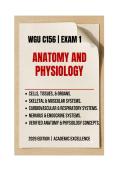
,WGU C156 Anatomy and Physiology Exam 1 |
Q & A | 2026 Edition | Western Governors
University
1. Which of the following represents the correct order of structural organization in the human body,
from simplest to most complex?**
A) Tissue, cellular, organ, chemical, organ system, organism
B) Chemical, cellular, tissue, organ, organ system, organism
C) Cellular, chemical, tissue, organ system, organ, organism
D) Chemical, tissue, cellular, organ, organ system, organism
Correct Answer: B) Chemical, cellular, tissue, organ, organ system, organism
Rationale: The levels of structural organization progress from atoms and molecules (chemical level) to
cells, tissues, organs, organ systems, and finally the organism. This hierarchical arrangement reflects
increasing complexity, where each level builds upon the previous one. The chemical level is the simplest,
and the organism is the most complex.
**2. Which level of structural organization consists of groups of similar cells that work together to
perform a common function?**
A) Chemical level
B) Cellular level
C) Tissue level
D) Organ level
Correct Answer: C) Tissue level
Rationale: The tissue level is composed of groups of similar cells that perform a common function. There
are four primary tissue types: epithelial, connective, muscle, and nervous tissue. The cellular level
consists of individual cells, while the organ level consists of multiple tissue types working together.
,**3. The study of the structure of the human body is known as:**
A) Physiology
B) Histology
C) Anatomy
D) Cytology
Correct Answer: C) Anatomy
Rationale: Anatomy is the study of the structure of the body and the relationships between its parts.
Physiology is the study of function. Histology is the study of tissues, and cytology is the study of cells.
**4. The study of the functions of the human body is known as:**
A) Anatomy
B) Physiology
C) Pathology
D) Embryology
Correct Answer: B) Physiology
Rationale: Physiology focuses on how the body parts work and carry out their life-sustaining functions.
Anatomy provides the structural framework, while physiology explains the dynamic processes that occur
within that structure.
**5. Which of the following is an example of a negative feedback mechanism?**
A) Uterine contractions during childbirth
B) Blood clotting cascade
C) Regulation of blood glucose by insulin
D) Depolarization of neurons during action potential
Correct Answer: C) Regulation of blood glucose by insulin
, Rationale: Negative feedback mechanisms work to maintain homeostasis by opposing a change in a
controlled variable. When blood glucose rises, insulin is released to lower it, returning the variable to its
set point. Childbirth and blood clotting are positive feedback loops that amplify the initial stimulus.
**6. In the anatomical position, the palms of the hands are facing:**
A) Posteriorly
B) Anteriorly
C) Medially
D) Laterally
Correct Answer: B) Anteriorly
Rationale: In the standard anatomical position, the body is upright, facing forward, with arms at the
sides and palms facing forward (anteriorly). This position provides a consistent reference point for
describing body structures and directions.
**7. Which directional term means "toward the head" or "above"?**
A) Caudal
B) Cephalic
C) Ventral
D) Distal
Correct Answer: B) Cephalic
Rationale: Cephalic (or superior) means toward the head or upper part of the body. Caudal (or inferior)
means toward the tail or lower part. Ventral (or anterior) means toward the belly, and distal means
farther from the point of origin or trunk.
**8. Which term refers to a structure that is closer to the midline of the body?**
A) Lateral
Q & A | 2026 Edition | Western Governors
University
1. Which of the following represents the correct order of structural organization in the human body,
from simplest to most complex?**
A) Tissue, cellular, organ, chemical, organ system, organism
B) Chemical, cellular, tissue, organ, organ system, organism
C) Cellular, chemical, tissue, organ system, organ, organism
D) Chemical, tissue, cellular, organ, organ system, organism
Correct Answer: B) Chemical, cellular, tissue, organ, organ system, organism
Rationale: The levels of structural organization progress from atoms and molecules (chemical level) to
cells, tissues, organs, organ systems, and finally the organism. This hierarchical arrangement reflects
increasing complexity, where each level builds upon the previous one. The chemical level is the simplest,
and the organism is the most complex.
**2. Which level of structural organization consists of groups of similar cells that work together to
perform a common function?**
A) Chemical level
B) Cellular level
C) Tissue level
D) Organ level
Correct Answer: C) Tissue level
Rationale: The tissue level is composed of groups of similar cells that perform a common function. There
are four primary tissue types: epithelial, connective, muscle, and nervous tissue. The cellular level
consists of individual cells, while the organ level consists of multiple tissue types working together.
,**3. The study of the structure of the human body is known as:**
A) Physiology
B) Histology
C) Anatomy
D) Cytology
Correct Answer: C) Anatomy
Rationale: Anatomy is the study of the structure of the body and the relationships between its parts.
Physiology is the study of function. Histology is the study of tissues, and cytology is the study of cells.
**4. The study of the functions of the human body is known as:**
A) Anatomy
B) Physiology
C) Pathology
D) Embryology
Correct Answer: B) Physiology
Rationale: Physiology focuses on how the body parts work and carry out their life-sustaining functions.
Anatomy provides the structural framework, while physiology explains the dynamic processes that occur
within that structure.
**5. Which of the following is an example of a negative feedback mechanism?**
A) Uterine contractions during childbirth
B) Blood clotting cascade
C) Regulation of blood glucose by insulin
D) Depolarization of neurons during action potential
Correct Answer: C) Regulation of blood glucose by insulin
, Rationale: Negative feedback mechanisms work to maintain homeostasis by opposing a change in a
controlled variable. When blood glucose rises, insulin is released to lower it, returning the variable to its
set point. Childbirth and blood clotting are positive feedback loops that amplify the initial stimulus.
**6. In the anatomical position, the palms of the hands are facing:**
A) Posteriorly
B) Anteriorly
C) Medially
D) Laterally
Correct Answer: B) Anteriorly
Rationale: In the standard anatomical position, the body is upright, facing forward, with arms at the
sides and palms facing forward (anteriorly). This position provides a consistent reference point for
describing body structures and directions.
**7. Which directional term means "toward the head" or "above"?**
A) Caudal
B) Cephalic
C) Ventral
D) Distal
Correct Answer: B) Cephalic
Rationale: Cephalic (or superior) means toward the head or upper part of the body. Caudal (or inferior)
means toward the tail or lower part. Ventral (or anterior) means toward the belly, and distal means
farther from the point of origin or trunk.
**8. Which term refers to a structure that is closer to the midline of the body?**
A) Lateral


