

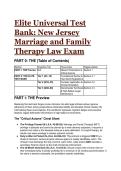
Elite Universal Test
Bank: New Jersey
Marriage and Family
Therapy Law Exam
PART 0: THE (Table of Contents)
Section Cognitive Tier Focus Area Page/Location
PART I: THE Preview N/A Mission Parameters & Section 1
Critical Axioms
PART II: THE ELITE Tier 1 (Q1–15) Foundational Syntax & Section 2.1
TEST BANK Hard Deck Regulations
Tier 2 (Q16–35) Complex Application & Section 2.2
Clinical Simulation
Tier 3 (Q36–60) Grandmaster Synthesis Section 2.3
& High-Stakes Legal
Intersections
PART I: THE Preview
Mastering this test bank forges novice clinicians into elite legal scholars whose rigorous
adherence to New Jersey jurisprudence eliminates liability and elevates clinical mastery. By
internalizing these exact statutes, the practitioner bypasses cognitive fatigue and executes
flawless, legally defensible interventions in high-stakes environments.
The "Critical Axioms" Cheat Sheet
● The Privilege Firewall (N.J.S.A. 45:8B-29): Marriage and Family Therapist (MFT)
privilege is absolute and cannot be pierced by a mere attorney subpoena; it requires a
judicial court order or the therapist acting as a party defendant. In conjoint therapy, all
adults must waive privilege to release systemic records.
● Duty to Warn & Protect (N.J.S.A. 2A:62A-16): This protocol is triggered ONLY by a
threat of imminent, serious physical violence against a readily identifiable victim. The
clinician must discharge the duty (commit, warn victim, notify police) AND mandate a
secondary firearms check via the chief of local law enforcement.
● The 24-Month Hard Deck (N.J.A.C. 13:34-6.4): Sexual contact with a former client or
their immediate family is strictly prohibited for a minimum of 24 months post-termination. If
the client is deemed vulnerable, the prohibition extends indefinitely.
, ● The Cullen Act Mandate (P.L.2005, c.83): Health care entities must report professional
impairment or misconduct adversely affecting patient safety within 7 calendar days.
Individual professionals MUST report peers if their incompetence presents an imminent
danger to the public.
Statutory Timelines & Jurisdictions
Regulatory Action Statutory Timeframe / Agency Citation Reference
Routing
Board Communication 30 Days (from date of mailing) N.J.A.C. 13:34-7.1
Response
Address/Name Change 30 Days N.J.A.C. 13:34-1.8
Notification
Child Abuse Reporting Immediate (State Central N.J.S.A. 9:6-8.10
Registry / SCR)
Community Elder Abuse Immediate (Adult Protective N.J.S.A. 52:27D-409
Reporting Services / APS)
Record Retention (Adults) 7 Years from the date of the N.J.A.C. 13:34-8.1
last entry
PART II: THE ELITE TEST BANK
Tier 1: Foundational Syntax & Application
Q1: A Licensed Marriage and Family Therapist (LMFT) is submitting their biennial license
renewal. They have accumulated 45 Continuing Education (CE) contact hours, including 25 via
distance learning and 20 face-to-face. Based on the principles of N.J.A.C. 13:34-5.2, which
conclusion regarding their CE compliance is the MOST ACCURATE? A) The licensee is
compliant because they exceeded the 40-hour requirement, and distance learning can comprise
up to 30 hours. B) The licensee is non-compliant because face-to-face instruction must account
for at least 30 of the 40 required hours. C) The licensee is compliant, provided the 40 hours
include 5 hours of ethics, 3 hours of cultural competence, and 1 hour regarding prescription
opioids. D) The licensee is non-compliant because the opioid education requirement is only
mandated for the initial licensure period.
● The Answer: C (The licensee is compliant, provided the 40 hours include 5 hours of
ethics, 3 hours of cultural competence, and 1 hour regarding prescription opioids.)
● Distractor Analysis:
○ A is incorrect: While the raw numbers are technically acceptable, this option omits
the mandatory specific content areas required for legal compliance.
○ B is incorrect: New Jersey law dictates that at least 20 of the 40 hours must be
obtained through face-to-face instruction, not 30.
○ D is incorrect: The 1-hour prescription opioid education requirement is mandatory
for every biennial renewal period, not just the initial one.
The Mentor's Analysis: Regulatory compliance requires exact granular alignment with state
mandates. When calculating CEUs, the clinician must prioritize the mandatory sub-categories
(ethics, cultural competence, opioids) before confirming the delivery method.
Professional/Academic Intuition: Validate the mandatory micro-requirements before verifying
the macro-hour count.
, Q2: A practitioner changes their primary practice location to a new municipality. According to
N.J.A.C. 13:34-1.8, what is the FIRST administrative action the clinician must execute regarding
their address of record? A) Notify the Board in writing within 60 days to avoid a lapse in
licensure status. B) Update their malpractice insurance carrier and forward the confirmation to
the Board. C) Notify the Board in writing within 30 days, specifying if it is a residence or
employment address. D) Publish a notice of practice relocation in a local newspaper of general
circulation.
● The Answer: C (Notify the Board in writing within 30 days, specifying if it is a residence or
employment address.)
● Distractor Analysis:
○ A is incorrect: The statutory window is 30 days, not 60 days.
○ B is incorrect: While updating insurance is a sound practice, it is not the statutory
mandate for updating the Board.
○ D is incorrect: Newspaper publication is required for the cessation of practice
(anticipating being out of practice for >3 months), not a simple relocation.
The Mentor's Analysis: The address of record is the legal anchor for service of process and
disciplinary notification. Failing to update it within the 30-day window defaults any Board
communication to "adequate notice," resulting in automatic defaults in disciplinary actions.
Professional/Academic Intuition: The 30-day administrative window is absolute for both
address changes and disciplinary notifications.
Q3: An LMFT is drafting a new advertisement for a local wellness magazine. Under N.J.A.C.
13:34-9.3, which combination of elements is ABSOLUTELY REQUIRED? A) Name, "LMFT",
highest degree earned, and practice telephone number. B) Name, "LMFT", the 12-digit license
number, and the street address and telephone number of the practice location. C) Name,
"Licensed Marriage and Family Therapist", NPI number, and email address. D) Name, license
status, clinical specialties, and a disclaimer regarding insurance.
● The Answer: B (Name, "LMFT", the 12-digit license number, and the street address and
telephone number of the practice location.)
● Distractor Analysis:
○ A is incorrect: It omits the 12-digit license number and the street address, which are
explicitly mandated.
○ C is incorrect: NPI numbers and email addresses are not statutory requirements for
advertising.
○ D is incorrect: Clinical specialties and insurance disclaimers are optional, whereas
the license number and street address are mandatory.
The Mentor's Analysis: Advertising statutes exist to protect the consumer from fraudulent or
untraceable practitioners. The 12-digit license number and physical street address provide
immediate, verifiable accountability. Professional/Academic Intuition: Every public
representation of the practice must prominently display the 12-digit license number.
Q4: A client explicitly communicates to an LMFT an intent to murder their former spouse at their
workplace the following morning. The therapist believes the threat is credible. Under N.J.S.A.
2A:62A-16, which secondary action is MANDATORY in addition to discharging the duty via
hospitalization or warning the victim? A) Filing a formal report with the Division of Child
Protection and Permanency. B) Requesting the client's consent to contact their primary care
physician. C) Notifying the chief law enforcement officer of the municipality where the patient
resides. D) Notifying the Health Care Professional Information Clearing House Coordinator.
● The Answer: C (Notifying the chief law enforcement officer of the municipality where the
patient resides.)
Bank: New Jersey
Marriage and Family
Therapy Law Exam
PART 0: THE (Table of Contents)
Section Cognitive Tier Focus Area Page/Location
PART I: THE Preview N/A Mission Parameters & Section 1
Critical Axioms
PART II: THE ELITE Tier 1 (Q1–15) Foundational Syntax & Section 2.1
TEST BANK Hard Deck Regulations
Tier 2 (Q16–35) Complex Application & Section 2.2
Clinical Simulation
Tier 3 (Q36–60) Grandmaster Synthesis Section 2.3
& High-Stakes Legal
Intersections
PART I: THE Preview
Mastering this test bank forges novice clinicians into elite legal scholars whose rigorous
adherence to New Jersey jurisprudence eliminates liability and elevates clinical mastery. By
internalizing these exact statutes, the practitioner bypasses cognitive fatigue and executes
flawless, legally defensible interventions in high-stakes environments.
The "Critical Axioms" Cheat Sheet
● The Privilege Firewall (N.J.S.A. 45:8B-29): Marriage and Family Therapist (MFT)
privilege is absolute and cannot be pierced by a mere attorney subpoena; it requires a
judicial court order or the therapist acting as a party defendant. In conjoint therapy, all
adults must waive privilege to release systemic records.
● Duty to Warn & Protect (N.J.S.A. 2A:62A-16): This protocol is triggered ONLY by a
threat of imminent, serious physical violence against a readily identifiable victim. The
clinician must discharge the duty (commit, warn victim, notify police) AND mandate a
secondary firearms check via the chief of local law enforcement.
● The 24-Month Hard Deck (N.J.A.C. 13:34-6.4): Sexual contact with a former client or
their immediate family is strictly prohibited for a minimum of 24 months post-termination. If
the client is deemed vulnerable, the prohibition extends indefinitely.
, ● The Cullen Act Mandate (P.L.2005, c.83): Health care entities must report professional
impairment or misconduct adversely affecting patient safety within 7 calendar days.
Individual professionals MUST report peers if their incompetence presents an imminent
danger to the public.
Statutory Timelines & Jurisdictions
Regulatory Action Statutory Timeframe / Agency Citation Reference
Routing
Board Communication 30 Days (from date of mailing) N.J.A.C. 13:34-7.1
Response
Address/Name Change 30 Days N.J.A.C. 13:34-1.8
Notification
Child Abuse Reporting Immediate (State Central N.J.S.A. 9:6-8.10
Registry / SCR)
Community Elder Abuse Immediate (Adult Protective N.J.S.A. 52:27D-409
Reporting Services / APS)
Record Retention (Adults) 7 Years from the date of the N.J.A.C. 13:34-8.1
last entry
PART II: THE ELITE TEST BANK
Tier 1: Foundational Syntax & Application
Q1: A Licensed Marriage and Family Therapist (LMFT) is submitting their biennial license
renewal. They have accumulated 45 Continuing Education (CE) contact hours, including 25 via
distance learning and 20 face-to-face. Based on the principles of N.J.A.C. 13:34-5.2, which
conclusion regarding their CE compliance is the MOST ACCURATE? A) The licensee is
compliant because they exceeded the 40-hour requirement, and distance learning can comprise
up to 30 hours. B) The licensee is non-compliant because face-to-face instruction must account
for at least 30 of the 40 required hours. C) The licensee is compliant, provided the 40 hours
include 5 hours of ethics, 3 hours of cultural competence, and 1 hour regarding prescription
opioids. D) The licensee is non-compliant because the opioid education requirement is only
mandated for the initial licensure period.
● The Answer: C (The licensee is compliant, provided the 40 hours include 5 hours of
ethics, 3 hours of cultural competence, and 1 hour regarding prescription opioids.)
● Distractor Analysis:
○ A is incorrect: While the raw numbers are technically acceptable, this option omits
the mandatory specific content areas required for legal compliance.
○ B is incorrect: New Jersey law dictates that at least 20 of the 40 hours must be
obtained through face-to-face instruction, not 30.
○ D is incorrect: The 1-hour prescription opioid education requirement is mandatory
for every biennial renewal period, not just the initial one.
The Mentor's Analysis: Regulatory compliance requires exact granular alignment with state
mandates. When calculating CEUs, the clinician must prioritize the mandatory sub-categories
(ethics, cultural competence, opioids) before confirming the delivery method.
Professional/Academic Intuition: Validate the mandatory micro-requirements before verifying
the macro-hour count.
, Q2: A practitioner changes their primary practice location to a new municipality. According to
N.J.A.C. 13:34-1.8, what is the FIRST administrative action the clinician must execute regarding
their address of record? A) Notify the Board in writing within 60 days to avoid a lapse in
licensure status. B) Update their malpractice insurance carrier and forward the confirmation to
the Board. C) Notify the Board in writing within 30 days, specifying if it is a residence or
employment address. D) Publish a notice of practice relocation in a local newspaper of general
circulation.
● The Answer: C (Notify the Board in writing within 30 days, specifying if it is a residence or
employment address.)
● Distractor Analysis:
○ A is incorrect: The statutory window is 30 days, not 60 days.
○ B is incorrect: While updating insurance is a sound practice, it is not the statutory
mandate for updating the Board.
○ D is incorrect: Newspaper publication is required for the cessation of practice
(anticipating being out of practice for >3 months), not a simple relocation.
The Mentor's Analysis: The address of record is the legal anchor for service of process and
disciplinary notification. Failing to update it within the 30-day window defaults any Board
communication to "adequate notice," resulting in automatic defaults in disciplinary actions.
Professional/Academic Intuition: The 30-day administrative window is absolute for both
address changes and disciplinary notifications.
Q3: An LMFT is drafting a new advertisement for a local wellness magazine. Under N.J.A.C.
13:34-9.3, which combination of elements is ABSOLUTELY REQUIRED? A) Name, "LMFT",
highest degree earned, and practice telephone number. B) Name, "LMFT", the 12-digit license
number, and the street address and telephone number of the practice location. C) Name,
"Licensed Marriage and Family Therapist", NPI number, and email address. D) Name, license
status, clinical specialties, and a disclaimer regarding insurance.
● The Answer: B (Name, "LMFT", the 12-digit license number, and the street address and
telephone number of the practice location.)
● Distractor Analysis:
○ A is incorrect: It omits the 12-digit license number and the street address, which are
explicitly mandated.
○ C is incorrect: NPI numbers and email addresses are not statutory requirements for
advertising.
○ D is incorrect: Clinical specialties and insurance disclaimers are optional, whereas
the license number and street address are mandatory.
The Mentor's Analysis: Advertising statutes exist to protect the consumer from fraudulent or
untraceable practitioners. The 12-digit license number and physical street address provide
immediate, verifiable accountability. Professional/Academic Intuition: Every public
representation of the practice must prominently display the 12-digit license number.
Q4: A client explicitly communicates to an LMFT an intent to murder their former spouse at their
workplace the following morning. The therapist believes the threat is credible. Under N.J.S.A.
2A:62A-16, which secondary action is MANDATORY in addition to discharging the duty via
hospitalization or warning the victim? A) Filing a formal report with the Division of Child
Protection and Permanency. B) Requesting the client's consent to contact their primary care
physician. C) Notifying the chief law enforcement officer of the municipality where the patient
resides. D) Notifying the Health Care Professional Information Clearing House Coordinator.
● The Answer: C (Notifying the chief law enforcement officer of the municipality where the
patient resides.)


