

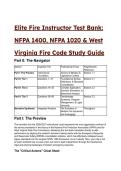
Elite Fire Instructor Test Bank:
NFPA 1400, NFPA 1020 & West
Virginia Fire Code Study Guide
Part 0: The Navigator
Section Cognitive Tier Professional Focus Page/Section
Reference
Part I: The Preview Instructional Axioms of Mastery & Section 1.1
Foundation Legislative Context
Part II: Tier 1 Questions 1–15 Foundational Syntax, Section 2.1
Definitions, & Standard
Consolidation
Part II: Tier 2 Questions 16–35 Complex Application, Section 2.2
Scenario Simulation, &
Behavioral Analysis
Part II: Tier 3 Questions 36–60 Grandmaster Section 2.3
Synthesis, Program
Management, & Legal
Immunity
Narrative Synthesis Integrated Analysis The Evolution of Throughout
Modern Fire Dynamics
and Andragogy
Part I: The Preview
The transition into the 2026/2027 instructional cycle represents the most aggressive overhaul of
fire service standards in the history of the National Fire Protection Association (NFPA) and the
West Virginia State Fire Commission. Mastering this test bank translates directly to elite
performance by aligning the student's decision-making matrix with the Emergency Response
and Responder Safety (ERRS) consolidation initiative, which has effectively collapsed seven
legacy standards into the singular NFPA 1400 framework. As an Industry Titan, your role is not
to teach students how to pass a test, but how to lead a department through the treacherous
legal and physical landscape of modern emergency response.
The "Critical Axioms" Cheat Sheet
, ● The Single Source Mandate: NFPA 1400 (2026 Edition) now integrates legacy
standards 1402, 1403, 1404, 1407, 1408, 1410, and 1451. Failure to cross-reference
these chapters during training plan development is considered an administrative failure.
● The Uncoupling Principle: NFPA 1020 (2025) has explicitly removed firefighting
prerequisites for EMS Officer tracks, allowing for clinical leadership specialized in
paramedicine without the burden of fire suppression certification.
● The WV Legislative Shield: Under W. Va. Code § 29-12A-5, qualified immunity for
instructors is nearly absolute unless the act is performed with "malicious purpose, in bad
faith, or in a wanton or reckless manner".
● The Thermodynamic Pivot: The term "Fire Behavior" is formally deprecated in favor of
"Fire Dynamics" to reflect the predictable, physical relationship between fuel, heat, and
ventilation.
● The Five-Year Structural Integrity Rule: All training structures must undergo a
documented structural integrity assessment by a qualified engineer every 60 months (5
years).
Part II: The Elite Test Bank
Section 2.1: Tier 1 - Foundational Syntax & Application (Questions
1–15)
In the era of high-performance fire service academics, the "Hard Deck" of knowledge refers to
the non-negotiable definitions and standards that form the bedrock of safety. This section
focuses on the structural consolidation of NFPA standards and the specific legislative rules of
West Virginia (Title 87 and Title 103). The following 15 questions test the candidate's ability to
navigate the new comprehensive environment where disparate standards have been unified into
a single lifecycle of training.
Q1: A Fire Instructor II is updating a department's standard operating guidelines (SOGs) for
training facility maintenance. In the 2026 edition of NFPA 1400, which legacy standard has been
primarily absorbed into the chapters governing the design and construction of live fire training
structures? A) NFPA 1403 B) NFPA 1010 C) NFPA 1402 D) NFPA 1021
● The Answer: C (NFPA 1402)
● Distractor Analysis:
○ A is incorrect: NFPA 1403 was the legacy standard for live fire evolutions (the
action), whereas 1402 governed the facility (the structure).
○ B is incorrect: NFPA 1010 is the newly consolidated standard for Professional
Qualifications for Firefighters (formerly 1001), not facilities.
○ D is incorrect: NFPA 1021 was the legacy standard for Fire Officers, now
consolidated into NFPA 1020.
The Mentor's Analysis: The consolidation of NFPA 1402 into NFPA 1400 marks a structural
shift that eliminates the "silo" between the building's engineering and the drill's operations.
When designing a training curriculum, the instructor must now view the facility’s maintenance
logs as part of the safety briefing. Professional/Academic Intuition: The building is the most
dangerous prop in your inventory; treat its engineering requirements with the same rigor
as you treat the fire itself.
Q2: Under West Virginia Legislative Rule Title 87, Series 13, a newly appointed Fire Chief must
provide specific documentation to the State Fire Commission to receive certification. Which
, combination of certifications is MANDATORY for this individual? A) Firefighter I and II only B)
Fire Officer I and II (NFPA 1021 or equivalent) C) Fire Instructor I and II D) Hazardous Materials
Technician and EVOC
● The Answer: B (Fire Officer I and II)
● Distractor Analysis:
○ A is incorrect: Firefighter I and II are entry-level recruit requirements and do not
meet the command-level standards for the Chief’s affidavit.
○ C is incorrect: While valuable, Instructor certifications are not the specific
prerequisite for the Chief's role under Series 13.
○ D is incorrect: These are specialty technical certifications and do not satisfy the
administrative leadership requirements for chief officers.
The Mentor's Analysis: West Virginia law ensures that command-level leadership is not merely
based on seniority but on the successful completion of the Fire Officer management tracks. This
prevents "legacy leadership" from bypassing modern administrative safety requirements.
Professional/Academic Intuition: In West Virginia, your "Chief" status is a legal
certification from the State Fire Commission, not just a title given by your local board.
Q3: The National Fire Protection Association has globally mandated the transition from the term
"Fire Behavior" to "Fire Dynamics" in all 2026/2027 curricula. What is the PRIMARY
pedagogical reason for this change? A) To simplify the language for volunteer recruits with lower
reading levels. B) To align fire service terminology with International Building Codes (IBC). C) To
emphasize that fire is influenced by the dynamic relationship between fuel, heat, ventilation, and
compartmentation rather than having an independent "behavior." D) To reduce the number of
scientific concepts instructors are required to teach.
● The Answer: C (To emphasize that fire is influenced by the dynamic relationship between
fuel, heat, ventilation, and compartmentation rather than having an independent
"behavior.")
● Distractor Analysis:
○ A is incorrect: The change actually increases the scientific complexity of the content
by demanding an understanding of physics and fluid dynamics.
○ B is incorrect: While alignment with engineering is a secondary benefit, the primary
driver is the accuracy of responder training.
○ D is incorrect: This shift expands the curriculum to include concepts from NFPA
1700 (Guide for Structural Fire Fighting).
The Mentor's Analysis: "Behavior" is a biological term that implies choice; "Dynamics" is a
physical term that implies predictable outcomes. By adopting this language, the instructor trains
the student to view the fire as a math problem rather than a monster. Professional/Academic
Intuition: If you don't control the ventilation, the dynamics of the fire will eventually
control you.
Q4: A West Virginia Fire Instructor is preparing a certification exam for a specialized group of
students. According to Title 103, Series 1, which specific trade is governed by this legislative
rule regarding certification by the State Fire Marshal? A) Fire Service Instructors B) Electrical
Inspectors C) Home Inspectors D) Fire Protection Worker (Sprinklers)
● The Answer: B (Electrical Inspectors)
● Distractor Analysis:
○ A is incorrect: Fire Service Instructor qualifications are typically governed by Title 87
Series 8 or WVDE Policy 5202.
○ C is incorrect: Home Inspectors are governed by Title 103, Series 7.
○ D is incorrect: Fire Protection Workers (e.g., sprinkler technicians) are governed by
NFPA 1400, NFPA 1020 & West
Virginia Fire Code Study Guide
Part 0: The Navigator
Section Cognitive Tier Professional Focus Page/Section
Reference
Part I: The Preview Instructional Axioms of Mastery & Section 1.1
Foundation Legislative Context
Part II: Tier 1 Questions 1–15 Foundational Syntax, Section 2.1
Definitions, & Standard
Consolidation
Part II: Tier 2 Questions 16–35 Complex Application, Section 2.2
Scenario Simulation, &
Behavioral Analysis
Part II: Tier 3 Questions 36–60 Grandmaster Section 2.3
Synthesis, Program
Management, & Legal
Immunity
Narrative Synthesis Integrated Analysis The Evolution of Throughout
Modern Fire Dynamics
and Andragogy
Part I: The Preview
The transition into the 2026/2027 instructional cycle represents the most aggressive overhaul of
fire service standards in the history of the National Fire Protection Association (NFPA) and the
West Virginia State Fire Commission. Mastering this test bank translates directly to elite
performance by aligning the student's decision-making matrix with the Emergency Response
and Responder Safety (ERRS) consolidation initiative, which has effectively collapsed seven
legacy standards into the singular NFPA 1400 framework. As an Industry Titan, your role is not
to teach students how to pass a test, but how to lead a department through the treacherous
legal and physical landscape of modern emergency response.
The "Critical Axioms" Cheat Sheet
, ● The Single Source Mandate: NFPA 1400 (2026 Edition) now integrates legacy
standards 1402, 1403, 1404, 1407, 1408, 1410, and 1451. Failure to cross-reference
these chapters during training plan development is considered an administrative failure.
● The Uncoupling Principle: NFPA 1020 (2025) has explicitly removed firefighting
prerequisites for EMS Officer tracks, allowing for clinical leadership specialized in
paramedicine without the burden of fire suppression certification.
● The WV Legislative Shield: Under W. Va. Code § 29-12A-5, qualified immunity for
instructors is nearly absolute unless the act is performed with "malicious purpose, in bad
faith, or in a wanton or reckless manner".
● The Thermodynamic Pivot: The term "Fire Behavior" is formally deprecated in favor of
"Fire Dynamics" to reflect the predictable, physical relationship between fuel, heat, and
ventilation.
● The Five-Year Structural Integrity Rule: All training structures must undergo a
documented structural integrity assessment by a qualified engineer every 60 months (5
years).
Part II: The Elite Test Bank
Section 2.1: Tier 1 - Foundational Syntax & Application (Questions
1–15)
In the era of high-performance fire service academics, the "Hard Deck" of knowledge refers to
the non-negotiable definitions and standards that form the bedrock of safety. This section
focuses on the structural consolidation of NFPA standards and the specific legislative rules of
West Virginia (Title 87 and Title 103). The following 15 questions test the candidate's ability to
navigate the new comprehensive environment where disparate standards have been unified into
a single lifecycle of training.
Q1: A Fire Instructor II is updating a department's standard operating guidelines (SOGs) for
training facility maintenance. In the 2026 edition of NFPA 1400, which legacy standard has been
primarily absorbed into the chapters governing the design and construction of live fire training
structures? A) NFPA 1403 B) NFPA 1010 C) NFPA 1402 D) NFPA 1021
● The Answer: C (NFPA 1402)
● Distractor Analysis:
○ A is incorrect: NFPA 1403 was the legacy standard for live fire evolutions (the
action), whereas 1402 governed the facility (the structure).
○ B is incorrect: NFPA 1010 is the newly consolidated standard for Professional
Qualifications for Firefighters (formerly 1001), not facilities.
○ D is incorrect: NFPA 1021 was the legacy standard for Fire Officers, now
consolidated into NFPA 1020.
The Mentor's Analysis: The consolidation of NFPA 1402 into NFPA 1400 marks a structural
shift that eliminates the "silo" between the building's engineering and the drill's operations.
When designing a training curriculum, the instructor must now view the facility’s maintenance
logs as part of the safety briefing. Professional/Academic Intuition: The building is the most
dangerous prop in your inventory; treat its engineering requirements with the same rigor
as you treat the fire itself.
Q2: Under West Virginia Legislative Rule Title 87, Series 13, a newly appointed Fire Chief must
provide specific documentation to the State Fire Commission to receive certification. Which
, combination of certifications is MANDATORY for this individual? A) Firefighter I and II only B)
Fire Officer I and II (NFPA 1021 or equivalent) C) Fire Instructor I and II D) Hazardous Materials
Technician and EVOC
● The Answer: B (Fire Officer I and II)
● Distractor Analysis:
○ A is incorrect: Firefighter I and II are entry-level recruit requirements and do not
meet the command-level standards for the Chief’s affidavit.
○ C is incorrect: While valuable, Instructor certifications are not the specific
prerequisite for the Chief's role under Series 13.
○ D is incorrect: These are specialty technical certifications and do not satisfy the
administrative leadership requirements for chief officers.
The Mentor's Analysis: West Virginia law ensures that command-level leadership is not merely
based on seniority but on the successful completion of the Fire Officer management tracks. This
prevents "legacy leadership" from bypassing modern administrative safety requirements.
Professional/Academic Intuition: In West Virginia, your "Chief" status is a legal
certification from the State Fire Commission, not just a title given by your local board.
Q3: The National Fire Protection Association has globally mandated the transition from the term
"Fire Behavior" to "Fire Dynamics" in all 2026/2027 curricula. What is the PRIMARY
pedagogical reason for this change? A) To simplify the language for volunteer recruits with lower
reading levels. B) To align fire service terminology with International Building Codes (IBC). C) To
emphasize that fire is influenced by the dynamic relationship between fuel, heat, ventilation, and
compartmentation rather than having an independent "behavior." D) To reduce the number of
scientific concepts instructors are required to teach.
● The Answer: C (To emphasize that fire is influenced by the dynamic relationship between
fuel, heat, ventilation, and compartmentation rather than having an independent
"behavior.")
● Distractor Analysis:
○ A is incorrect: The change actually increases the scientific complexity of the content
by demanding an understanding of physics and fluid dynamics.
○ B is incorrect: While alignment with engineering is a secondary benefit, the primary
driver is the accuracy of responder training.
○ D is incorrect: This shift expands the curriculum to include concepts from NFPA
1700 (Guide for Structural Fire Fighting).
The Mentor's Analysis: "Behavior" is a biological term that implies choice; "Dynamics" is a
physical term that implies predictable outcomes. By adopting this language, the instructor trains
the student to view the fire as a math problem rather than a monster. Professional/Academic
Intuition: If you don't control the ventilation, the dynamics of the fire will eventually
control you.
Q4: A West Virginia Fire Instructor is preparing a certification exam for a specialized group of
students. According to Title 103, Series 1, which specific trade is governed by this legislative
rule regarding certification by the State Fire Marshal? A) Fire Service Instructors B) Electrical
Inspectors C) Home Inspectors D) Fire Protection Worker (Sprinklers)
● The Answer: B (Electrical Inspectors)
● Distractor Analysis:
○ A is incorrect: Fire Service Instructor qualifications are typically governed by Title 87
Series 8 or WVDE Policy 5202.
○ C is incorrect: Home Inspectors are governed by Title 103, Series 7.
○ D is incorrect: Fire Protection Workers (e.g., sprinkler technicians) are governed by


