

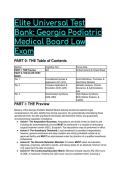
Elite Universal Test
Bank: Georgia Podiatric
Medical Board Law
Exam
PART 0: THE Table of Contents
Section Cognitive Tier Focus Area
PART I: THE Preview N/A Critical Axioms & Cheat Sheet
PART II: THE ELITE TEST
BANK
Tier 1 Foundational Syntax & Core Definitions, Formulas, &
Application (Q1–Q15) Hard Deck Statutes
Tier 2 Complex Application & Variable Analysis, Clinical
Simulation (Q16–Q35) Scenarios, & Administrative
Law
Tier 3 Grandmaster Synthesis High-Stakes Synthesis,
(Q36–Q60) Multi-Statute Failures, &
Liability
PART I: THE Preview
Mastery of the Georgia Podiatric Medical Board statutes transforms baseline legal
comprehension into elite, liability-free clinical execution. By systematically internalizing these
operational limits, the elite practitioner eliminates administrative friction and guarantees
uncompromising regulatory compliance.
● Axiom I: The Amputation Boundary: Amputations are strictly limited to distal to and
including the tarsometatarsal joint and MUST be performed in a hospital or ambulatory
surgical treatment center (ASC). Exception: Toe amputations may be performed in-office.
● Axiom II: The Anesthesia Threshold: Local anesthesia is permitted independently;
however, general anesthesia and deep sedation are strictly prohibited outside of an
approved facility and MUST be administered under the direction of a qualified anesthesia
professional.
● Axiom III: The Records Retention Mandate: Providers MUST retain all evaluation,
diagnosis, prognosis, laboratory reports, and biopsy slides for an absolute minimum of ten
(10) years from the date of creation.
● Axiom IV: The Continuing Education Matrix: Biennial renewal requires fifty (50) hours
of CME. A maximum of twenty-five (25) hours may be completed online, ensuring a
, minimum of thirty (30) hours are live and approved by the Council of Podiatric Medical
Education (CPME) or the Georgia Podiatric Medical Association (GPMA).
● Axiom V: The Delegation Doctrine: Podiatrists may organize professional corporations
with Doctors of Medicine (MD) or Doctors of Osteopathy (DO). Clinical delegation to a
Physician Assistant (PA) requires Medical Board approval , while delegating injections to
a Medical Assistant (MA) requires the podiatrist to be physically on-site.
PART II: THE ELITE TEST BANK
Tier 1: Foundational Syntax & Application
Q1: A licensed Georgia podiatrist is calculating their continuing medical education (CME) hours
for the upcoming biennial renewal. They have completed 45 hours of CPME-approved online
modules and 5 hours of live lectures. Based on the principles of Georgia Podiatry Rule
500-5-.01, which conclusion is the MOST ACCURATE? A) The practitioner is compliant
because all 50 hours are CPME-approved. B) The practitioner is non-compliant because the
minimum requirement is 60 hours per biennium. C) The practitioner is non-compliant because
the absolute maximum for online coursework is 25 hours. D) The practitioner is compliant under
the telehealth digital education exemption.
● The Answer: C (The practitioner is non-compliant because the absolute maximum for
online coursework is 25 hours.)
● Distractor Analysis:
○ A is incorrect: Approval by the CPME does not override the statutory cap on the
delivery method.
○ B is incorrect: The Georgia statutory requirement is exactly 50 hours, not 60.
○ D is incorrect: There is no universal telehealth exemption that overrides the hard
limit on digital CME hours.
The Mentor's Analysis: The foundational principle of continuing education balances
accessibility with interactive rigor. When auditing a renewal cycle, the immediate priority is
isolating the digital-to-live ratio. By utilizing the 25-hour cap, the practitioner bypasses the
common trap of invalidating an entire licensing cycle through over-reliance on online modules.
Professional/Academic Intuition: The state demands digital limits; online courses cannot
exceed fifty percent of the biennial mandate.
Q2: A patient requests a complete copy of their medical chart. According to O.C.G.A. § 31-33-2,
what is the EXACT minimum timeframe the podiatrist is legally mandated to retain evaluation
notes and biopsy slides from the date of creation? A) Three years. B) Five years. C) Seven
years. D) Ten years.
● The Answer: D (Ten years.)
● Distractor Analysis:
○ A is incorrect: Three years is a common standard for state financial audits, not
health records.
○ B is incorrect: Five years falls short of Georgia's general statute for medical
artifacts.
○ C is incorrect: Seven years is a legacy metric for IRS tax documents, representing a
frequent novice misconception.
The Mentor's Analysis: Medical artifacts form the definitive legal timeline of patient care. When
establishing an archiving protocol, the immediate priority is guaranteeing long-term data
,survival. By utilizing the 10-year retention rule, the practitioner bypasses severe administrative
penalties associated with premature data destruction. Professional/Academic Intuition: A
closed file remains legally active for a full decade.
Q3: A podiatrist intends to perform an amputation of the great toe in their private, unaccredited
clinical office under local anesthesia. Based on O.C.G.A. § 43-35-3, is this action legally
permissible? A) Yes, because amputations of the toe are explicitly permitted within the standard
scope of practice. B) No, because all amputations, regardless of location, must be performed in
a hospital or ambulatory surgical treatment center. C) Yes, provided the podiatrist holds a
separate, specialized surgical permit issued by the state. D) No, because podiatrists are strictly
forbidden from performing any form of amputation in Georgia.
● The Answer: A (Yes, because amputations of the toe are explicitly permitted within the
standard scope of practice.)
● Distractor Analysis:
○ B is incorrect: The facility restriction (hospital/ASC) specifically applies to
amputations distal to and including the tarsometatarsal joint, not simple toe
amputations.
○ C is incorrect: Standard licensure covers toe amputations without requiring a
specialized secondary permit.
○ D is incorrect: This is a legacy misconception; Georgia law explicitly grants
podiatrists the authority to perform toe amputations.
The Mentor's Analysis: The scope of surgical practice scales with anatomical complexity and
facility capabilities. When scheduling an amputation, the immediate priority is identifying the
exact anatomical joint line. By utilizing the toe-exemption clause, the practitioner bypasses the
administrative burden of securing hospital operating time for minor extremity procedures.
Professional/Academic Intuition: Toes may be amputated in the clinic; the tarsometatarsal
joint demands a hospital.
Q4: A newly licensed podiatrist receives their active Georgia license in May of an
even-numbered year. The biennial renewal period ends in August of the following
odd-numbered year. Based on Rule 500-5-.01, how many CME hours MUST this practitioner
complete prior to their first renewal? A) 0 hours. B) 25 hours. C) 30 hours. D) 50 hours.
● The Answer: C (30 hours.)
● Distractor Analysis:
○ A is incorrect: A complete exemption (0 hours) only applies if the license is issued
during the last six months of the cycle.
○ B is incorrect: 25 hours is a mathematical half-measure not recognized by the
statute.
○ D is incorrect: The full 50 hours are only required if licensed during the first six
months of the biennial cycle.
The Mentor's Analysis: Pro-rated requirements protect new licensees from mathematically
impossible continuing education burdens. When calculating initial CME requirements, the
immediate priority is charting the exact month of licensure against the biennial timeline. By
utilizing the 30-hour intermediate tier, the practitioner bypasses the trap of unnecessary
over-education during their critical first year of practice. Professional/Academic Intuition: A
mid-cycle license triggers a mid-cycle continuing education requirement.
Q5: An applicant applies for a Georgia Podiatry license and must take the Georgia
Jurisprudence Assessment Module (GA JAM). According to the board standards, what is the
defined passing score baseline for this specific ethics and law exam? A) 70% B) 75% C) 80%
D) 85%
, ● The Answer: C (80%)
● Distractor Analysis:
○ A is incorrect: 70% is a standard undergraduate academic baseline, insufficient for
terminal medical jurisprudence.
○ B is incorrect: 75% is the standard for certain adjoining states, but fails to meet
Georgia's specific metric.
○ D is incorrect: 85% represents an unnecessary mastery tier not statutorily
demanded for entry-level practice.
The Mentor's Analysis: Standardized metrics ensure a universal baseline of foundational legal
knowledge. When processing applications, the immediate priority is verifying the absolute
minimum threshold of regulatory safety. By utilizing the 80-point standard, the board bypasses
the risk of admitting administratively deficient practitioners. Professional/Academic Intuition:
An eighty percent jurisprudence score unlocks the gateway to Georgia practice.
Q6: A podiatrist maintains an active DEA certificate. Under Georgia Rule 500-5-.01, what
specific, targeted continuing education MUST they complete at least once in their career? A) A
1-hour course on identifying drug-seeking behavior annually. B) A 3-hour course specifically
designed to address controlled substance prescribing practices. C) A 5-hour CPME-approved
module on the pharmacology of synthetic opioids. D) A 10-hour live seminar on addiction
medicine every renewal cycle.
● The Answer: B (A 3-hour course specifically designed to address controlled substance
prescribing practices.)
● Distractor Analysis:
○ A is incorrect: A one-hour annual requirement is technically insufficient and
incorrect in frequency.
○ C is incorrect: The requirement is exactly three hours, not five.
○ D is incorrect: The mandate is a one-time, three-hour requirement, not a recurring
ten-hour seminar.
The Mentor's Analysis: The legislative response to the opioid crisis demands targeted, specific
pharmacological education. When maintaining a DEA permit, the immediate priority is securing
the mandatory controlled substance module. By utilizing this targeted 3-hour CME, the
practitioner bypasses the trap of losing their prescribing privileges during a random board audit.
Professional/Academic Intuition: Three hours of controlled substance education is the
one-time tax for holding a DEA permit.
Q7: Under O.C.G.A. § 14-7-4 regarding professional corporations, a Doctor of Podiatric
Medicine (DPM) wishes to jointly own a corporate practice. With which specific licensed
professional is the podiatrist EXPLICITLY permitted to form a joint professional corporation? A)
A licensed Doctor of Chiropractic (DC). B) A licensed Doctor of Medicine (MD). C) A licensed
Physical Therapist (DPT). D) A licensed Doctor of Dental Surgery (DDS).
● The Answer: B (A licensed Doctor of Medicine (MD).)
● Distractor Analysis:
○ A is incorrect: Chiropractors do not share the explicit statutory crossover for
professional medical corporations in this section.
○ C is incorrect: Physical therapists operate under a different corporate structure and
cannot jointly own a PC with a physician in this context.
○ D is incorrect: Dentistry maintains a highly isolated corporate structure separate
from podiatry and allopathic medicine.
The Mentor's Analysis: Corporate integration laws dictate how medical risk and profit can be
legally shared. When organizing a multidisciplinary clinic, the immediate priority is ensuring
Bank: Georgia Podiatric
Medical Board Law
Exam
PART 0: THE Table of Contents
Section Cognitive Tier Focus Area
PART I: THE Preview N/A Critical Axioms & Cheat Sheet
PART II: THE ELITE TEST
BANK
Tier 1 Foundational Syntax & Core Definitions, Formulas, &
Application (Q1–Q15) Hard Deck Statutes
Tier 2 Complex Application & Variable Analysis, Clinical
Simulation (Q16–Q35) Scenarios, & Administrative
Law
Tier 3 Grandmaster Synthesis High-Stakes Synthesis,
(Q36–Q60) Multi-Statute Failures, &
Liability
PART I: THE Preview
Mastery of the Georgia Podiatric Medical Board statutes transforms baseline legal
comprehension into elite, liability-free clinical execution. By systematically internalizing these
operational limits, the elite practitioner eliminates administrative friction and guarantees
uncompromising regulatory compliance.
● Axiom I: The Amputation Boundary: Amputations are strictly limited to distal to and
including the tarsometatarsal joint and MUST be performed in a hospital or ambulatory
surgical treatment center (ASC). Exception: Toe amputations may be performed in-office.
● Axiom II: The Anesthesia Threshold: Local anesthesia is permitted independently;
however, general anesthesia and deep sedation are strictly prohibited outside of an
approved facility and MUST be administered under the direction of a qualified anesthesia
professional.
● Axiom III: The Records Retention Mandate: Providers MUST retain all evaluation,
diagnosis, prognosis, laboratory reports, and biopsy slides for an absolute minimum of ten
(10) years from the date of creation.
● Axiom IV: The Continuing Education Matrix: Biennial renewal requires fifty (50) hours
of CME. A maximum of twenty-five (25) hours may be completed online, ensuring a
, minimum of thirty (30) hours are live and approved by the Council of Podiatric Medical
Education (CPME) or the Georgia Podiatric Medical Association (GPMA).
● Axiom V: The Delegation Doctrine: Podiatrists may organize professional corporations
with Doctors of Medicine (MD) or Doctors of Osteopathy (DO). Clinical delegation to a
Physician Assistant (PA) requires Medical Board approval , while delegating injections to
a Medical Assistant (MA) requires the podiatrist to be physically on-site.
PART II: THE ELITE TEST BANK
Tier 1: Foundational Syntax & Application
Q1: A licensed Georgia podiatrist is calculating their continuing medical education (CME) hours
for the upcoming biennial renewal. They have completed 45 hours of CPME-approved online
modules and 5 hours of live lectures. Based on the principles of Georgia Podiatry Rule
500-5-.01, which conclusion is the MOST ACCURATE? A) The practitioner is compliant
because all 50 hours are CPME-approved. B) The practitioner is non-compliant because the
minimum requirement is 60 hours per biennium. C) The practitioner is non-compliant because
the absolute maximum for online coursework is 25 hours. D) The practitioner is compliant under
the telehealth digital education exemption.
● The Answer: C (The practitioner is non-compliant because the absolute maximum for
online coursework is 25 hours.)
● Distractor Analysis:
○ A is incorrect: Approval by the CPME does not override the statutory cap on the
delivery method.
○ B is incorrect: The Georgia statutory requirement is exactly 50 hours, not 60.
○ D is incorrect: There is no universal telehealth exemption that overrides the hard
limit on digital CME hours.
The Mentor's Analysis: The foundational principle of continuing education balances
accessibility with interactive rigor. When auditing a renewal cycle, the immediate priority is
isolating the digital-to-live ratio. By utilizing the 25-hour cap, the practitioner bypasses the
common trap of invalidating an entire licensing cycle through over-reliance on online modules.
Professional/Academic Intuition: The state demands digital limits; online courses cannot
exceed fifty percent of the biennial mandate.
Q2: A patient requests a complete copy of their medical chart. According to O.C.G.A. § 31-33-2,
what is the EXACT minimum timeframe the podiatrist is legally mandated to retain evaluation
notes and biopsy slides from the date of creation? A) Three years. B) Five years. C) Seven
years. D) Ten years.
● The Answer: D (Ten years.)
● Distractor Analysis:
○ A is incorrect: Three years is a common standard for state financial audits, not
health records.
○ B is incorrect: Five years falls short of Georgia's general statute for medical
artifacts.
○ C is incorrect: Seven years is a legacy metric for IRS tax documents, representing a
frequent novice misconception.
The Mentor's Analysis: Medical artifacts form the definitive legal timeline of patient care. When
establishing an archiving protocol, the immediate priority is guaranteeing long-term data
,survival. By utilizing the 10-year retention rule, the practitioner bypasses severe administrative
penalties associated with premature data destruction. Professional/Academic Intuition: A
closed file remains legally active for a full decade.
Q3: A podiatrist intends to perform an amputation of the great toe in their private, unaccredited
clinical office under local anesthesia. Based on O.C.G.A. § 43-35-3, is this action legally
permissible? A) Yes, because amputations of the toe are explicitly permitted within the standard
scope of practice. B) No, because all amputations, regardless of location, must be performed in
a hospital or ambulatory surgical treatment center. C) Yes, provided the podiatrist holds a
separate, specialized surgical permit issued by the state. D) No, because podiatrists are strictly
forbidden from performing any form of amputation in Georgia.
● The Answer: A (Yes, because amputations of the toe are explicitly permitted within the
standard scope of practice.)
● Distractor Analysis:
○ B is incorrect: The facility restriction (hospital/ASC) specifically applies to
amputations distal to and including the tarsometatarsal joint, not simple toe
amputations.
○ C is incorrect: Standard licensure covers toe amputations without requiring a
specialized secondary permit.
○ D is incorrect: This is a legacy misconception; Georgia law explicitly grants
podiatrists the authority to perform toe amputations.
The Mentor's Analysis: The scope of surgical practice scales with anatomical complexity and
facility capabilities. When scheduling an amputation, the immediate priority is identifying the
exact anatomical joint line. By utilizing the toe-exemption clause, the practitioner bypasses the
administrative burden of securing hospital operating time for minor extremity procedures.
Professional/Academic Intuition: Toes may be amputated in the clinic; the tarsometatarsal
joint demands a hospital.
Q4: A newly licensed podiatrist receives their active Georgia license in May of an
even-numbered year. The biennial renewal period ends in August of the following
odd-numbered year. Based on Rule 500-5-.01, how many CME hours MUST this practitioner
complete prior to their first renewal? A) 0 hours. B) 25 hours. C) 30 hours. D) 50 hours.
● The Answer: C (30 hours.)
● Distractor Analysis:
○ A is incorrect: A complete exemption (0 hours) only applies if the license is issued
during the last six months of the cycle.
○ B is incorrect: 25 hours is a mathematical half-measure not recognized by the
statute.
○ D is incorrect: The full 50 hours are only required if licensed during the first six
months of the biennial cycle.
The Mentor's Analysis: Pro-rated requirements protect new licensees from mathematically
impossible continuing education burdens. When calculating initial CME requirements, the
immediate priority is charting the exact month of licensure against the biennial timeline. By
utilizing the 30-hour intermediate tier, the practitioner bypasses the trap of unnecessary
over-education during their critical first year of practice. Professional/Academic Intuition: A
mid-cycle license triggers a mid-cycle continuing education requirement.
Q5: An applicant applies for a Georgia Podiatry license and must take the Georgia
Jurisprudence Assessment Module (GA JAM). According to the board standards, what is the
defined passing score baseline for this specific ethics and law exam? A) 70% B) 75% C) 80%
D) 85%
, ● The Answer: C (80%)
● Distractor Analysis:
○ A is incorrect: 70% is a standard undergraduate academic baseline, insufficient for
terminal medical jurisprudence.
○ B is incorrect: 75% is the standard for certain adjoining states, but fails to meet
Georgia's specific metric.
○ D is incorrect: 85% represents an unnecessary mastery tier not statutorily
demanded for entry-level practice.
The Mentor's Analysis: Standardized metrics ensure a universal baseline of foundational legal
knowledge. When processing applications, the immediate priority is verifying the absolute
minimum threshold of regulatory safety. By utilizing the 80-point standard, the board bypasses
the risk of admitting administratively deficient practitioners. Professional/Academic Intuition:
An eighty percent jurisprudence score unlocks the gateway to Georgia practice.
Q6: A podiatrist maintains an active DEA certificate. Under Georgia Rule 500-5-.01, what
specific, targeted continuing education MUST they complete at least once in their career? A) A
1-hour course on identifying drug-seeking behavior annually. B) A 3-hour course specifically
designed to address controlled substance prescribing practices. C) A 5-hour CPME-approved
module on the pharmacology of synthetic opioids. D) A 10-hour live seminar on addiction
medicine every renewal cycle.
● The Answer: B (A 3-hour course specifically designed to address controlled substance
prescribing practices.)
● Distractor Analysis:
○ A is incorrect: A one-hour annual requirement is technically insufficient and
incorrect in frequency.
○ C is incorrect: The requirement is exactly three hours, not five.
○ D is incorrect: The mandate is a one-time, three-hour requirement, not a recurring
ten-hour seminar.
The Mentor's Analysis: The legislative response to the opioid crisis demands targeted, specific
pharmacological education. When maintaining a DEA permit, the immediate priority is securing
the mandatory controlled substance module. By utilizing this targeted 3-hour CME, the
practitioner bypasses the trap of losing their prescribing privileges during a random board audit.
Professional/Academic Intuition: Three hours of controlled substance education is the
one-time tax for holding a DEA permit.
Q7: Under O.C.G.A. § 14-7-4 regarding professional corporations, a Doctor of Podiatric
Medicine (DPM) wishes to jointly own a corporate practice. With which specific licensed
professional is the podiatrist EXPLICITLY permitted to form a joint professional corporation? A)
A licensed Doctor of Chiropractic (DC). B) A licensed Doctor of Medicine (MD). C) A licensed
Physical Therapist (DPT). D) A licensed Doctor of Dental Surgery (DDS).
● The Answer: B (A licensed Doctor of Medicine (MD).)
● Distractor Analysis:
○ A is incorrect: Chiropractors do not share the explicit statutory crossover for
professional medical corporations in this section.
○ C is incorrect: Physical therapists operate under a different corporate structure and
cannot jointly own a PC with a physician in this context.
○ D is incorrect: Dentistry maintains a highly isolated corporate structure separate
from podiatry and allopathic medicine.
The Mentor's Analysis: Corporate integration laws dictate how medical risk and profit can be
legally shared. When organizing a multidisciplinary clinic, the immediate priority is ensuring


