

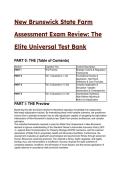
New Brunswick State Farm
Assessment Exam Review: The
Elite Universal Test Bank
PART 0: THE (Table of Contents)
Section Cognitive Tier Content Description
PART I The Preview Strategic Axioms & Regulatory
Frameworks
PART II Tier 1 (Questions 1–10) Foundational Syntax &
Application: Hard Deck
Definitions & Core Formulas
PART II Tier 2 (Questions 11–20) Complex Application &
Simulation: Variable
Intersections & Contingencies
PART II Tier 3 (Questions 21–30) Grandmaster Synthesis:
High-Stakes Adjusting &
Multi-Line Adjudication
PART I: THE Preview
Mastering this elite test bank transforms theoretical regulatory knowledge into weaponized,
field-ready adjudication intuition. By internalizing these multi-variable scenarios, the practitioner
evolves from a standard evaluator into an elite adjudicator capable of navigating the high-stakes
intersections of New Brunswick's statutory law, State Farm product architecture, and complex
estimatics.
The analytical frameworks required to pass the State Farm Assessment in New Brunswick
demand a rigorous understanding of the Standard Owner's Automobile Insurance Policy (SPF
1), regional Direct Compensation for Property Damage (DCPD) mechanics, and the nuanced
parameters of State Farm's proprietary health and life product portfolios. Furthermore, the
assessment evaluates an applicant's psychological and psychomotor fitness through advanced
Human Resources screening protocols. The material is dense, highly regulated, and legally
binding; thus, rote memorization is insufficient. Success requires the rapid synthesis of
competing statutory conditions, the elimination of moral hazard, and the precise application of
capital reserves in accordance with provincial mandates.
,The "Critical Axioms" Cheat Sheet
Core Discipline Critical Regulatory / Product Source Authority
Framework
Automobile: Section B Medical and rehabilitation
(Medical) expenses are strictly capped at
a maximum of $50,000 or 4
years from the date of the
accident, whichever occurs
first.
Automobile: Section B Loss of income benefits
(Income) guarantee 80% of gross income
up to a hard cap of $250 per
week. Principal unpaid
housekeepers receive $100 per
week (52-week max).
Automobile: Section B The death benefit for a Head of
(Death) Household is $50,000. Spouses
receive $25,000, and
dependents receive $5,000.
Funeral expenses are capped
at $2,500.
Property: Statutory Unilateral insurer cancellation
Termination mandates 15 days' notice via
registered mail (pro rata refund)
or 5 days' written notice
delivered personally.
Health: Short-Term Disability State Farm short-term disability
insurance utilizes streamlined
underwriting and explicitly
contains NO policy riders or
coordination of benefits.
Corporate: HR Assessments The State Farm hiring protocol
isolates metrics: Data Entry is
untimed (absolute accuracy);
Typing is 2 minutes per
paragraph (speed under
pressure); SLCP measures 13
behavioral traits.
PART II: THE ELITE TEST BANK
Q1: An insured driver in New Brunswick sustains severe bodily injuries following a collision and
requires immediate surgical intervention followed by long-term physiotherapy. Based on the
principles of the New Brunswick SPF 1 Section B (Accident Benefits) framework, which
action/conclusion regarding their medical allowance is the MOST ACCURATE? A) The insurer
must provide unlimited medical coverage until the third-party liability limit of the at-fault driver is
entirely exhausted. B) The policy limits medical and rehabilitation expenses to a strict maximum
, of $25,000 or two years from the date of the loss, whichever occurs first. C) The coverage
provides a maximum of $50,000 or four years from the date of the accident, whichever comes
first, to cover medical and rehabilitation expenses. D) The insured receives a lifetime maximum
of $50,000, provided they utilize provincial healthcare facilities exclusively without relying on
private clinics.
● The Answer: C (The coverage provides a maximum of $50,000 or four years from the
date of the accident, whichever comes first, to cover medical and rehabilitation expenses.)
● Distractor Analysis:
○ A is incorrect: This option improperly blends Section B (no-fault accident benefits)
with Section A (third-party liability). Section B medical limits are hard-coded into the
policy independently of fault or third-party limits.
○ B is incorrect: This distractor cites outdated or incorrect regional data. While
Newfoundland and Labrador utilize an optional $25,000 limit, it does not apply to
New Brunswick's mandatory $50,000 baseline.
○ D is incorrect: The statutory four-year temporal limit is completely omitted, and the
restriction forcing the exclusive use of provincial healthcare is entirely fabricated
and absent from the SPF 1 wording.
The Mentor's Analysis: Establishing the hard-deck limits of an insurance contract dictates the
entire trajectory of the claim's reserving process. When facing standard bodily injury
adjudication, the immediate priority is locking down the $50,000/4-year statutory ceiling. By
utilizing native Section B parameters, the adjudicator bypasses the common trap of confusing
native no-fault limits with tort-based recovery avenues. Professional/Academic Intuition: The
SPF 1 Section B operates as a primary, fault-blind reservoir of capital; its limits are
non-negotiable statutory baselines, operating irrespective of the insured's ultimate litigation
success.
Q2: A State Farm underwriter is evaluating an applicant's request for disability coverage. The
applicant specifies a need for a policy that offers an automated, streamlined underwriting
process without complex coordination of benefits. Based on the principles of State Farm Health
Product Portfolios, which action/conclusion is the MOST ACCURATE? A) The underwriter
should assign a long-term disability policy, as it excludes coordination of benefits and offers
streamlined online processing for immediate activation. B) The underwriter must issue a hospital
income policy, as disability policies legally mandate the inclusion of complex coordination
protocols to prevent double recovery. C) The underwriter must issue a short-term disability
policy, as it operates definitively without policy riders or coordination of benefits. D) The
underwriter should deny coverage, as all State Farm disability products require mandatory
medical examinations and comprehensive underwriting riders.
● The Answer: C (The underwriter must issue a short-term disability policy, as it operates
definitively without policy riders or coordination of benefits.)
● Distractor Analysis:
○ A is incorrect: Long-term disability products explicitly allow customers to continue or
customize coverage through a variety of complex policy riders, contradicting the
applicant's request for an uncomplicated, rider-free structure.
○ B is incorrect: While hospital income and supplemental health products provide
24-hour protection, they are distinct from direct disability income replacement.
Furthermore, short-term disability fundamentally does not require coordination
protocols.
○ D is incorrect: This is a legacy misconception. Short-term disability utilizes an
automated electronic application with limited screening questions, bypassing
Assessment Exam Review: The
Elite Universal Test Bank
PART 0: THE (Table of Contents)
Section Cognitive Tier Content Description
PART I The Preview Strategic Axioms & Regulatory
Frameworks
PART II Tier 1 (Questions 1–10) Foundational Syntax &
Application: Hard Deck
Definitions & Core Formulas
PART II Tier 2 (Questions 11–20) Complex Application &
Simulation: Variable
Intersections & Contingencies
PART II Tier 3 (Questions 21–30) Grandmaster Synthesis:
High-Stakes Adjusting &
Multi-Line Adjudication
PART I: THE Preview
Mastering this elite test bank transforms theoretical regulatory knowledge into weaponized,
field-ready adjudication intuition. By internalizing these multi-variable scenarios, the practitioner
evolves from a standard evaluator into an elite adjudicator capable of navigating the high-stakes
intersections of New Brunswick's statutory law, State Farm product architecture, and complex
estimatics.
The analytical frameworks required to pass the State Farm Assessment in New Brunswick
demand a rigorous understanding of the Standard Owner's Automobile Insurance Policy (SPF
1), regional Direct Compensation for Property Damage (DCPD) mechanics, and the nuanced
parameters of State Farm's proprietary health and life product portfolios. Furthermore, the
assessment evaluates an applicant's psychological and psychomotor fitness through advanced
Human Resources screening protocols. The material is dense, highly regulated, and legally
binding; thus, rote memorization is insufficient. Success requires the rapid synthesis of
competing statutory conditions, the elimination of moral hazard, and the precise application of
capital reserves in accordance with provincial mandates.
,The "Critical Axioms" Cheat Sheet
Core Discipline Critical Regulatory / Product Source Authority
Framework
Automobile: Section B Medical and rehabilitation
(Medical) expenses are strictly capped at
a maximum of $50,000 or 4
years from the date of the
accident, whichever occurs
first.
Automobile: Section B Loss of income benefits
(Income) guarantee 80% of gross income
up to a hard cap of $250 per
week. Principal unpaid
housekeepers receive $100 per
week (52-week max).
Automobile: Section B The death benefit for a Head of
(Death) Household is $50,000. Spouses
receive $25,000, and
dependents receive $5,000.
Funeral expenses are capped
at $2,500.
Property: Statutory Unilateral insurer cancellation
Termination mandates 15 days' notice via
registered mail (pro rata refund)
or 5 days' written notice
delivered personally.
Health: Short-Term Disability State Farm short-term disability
insurance utilizes streamlined
underwriting and explicitly
contains NO policy riders or
coordination of benefits.
Corporate: HR Assessments The State Farm hiring protocol
isolates metrics: Data Entry is
untimed (absolute accuracy);
Typing is 2 minutes per
paragraph (speed under
pressure); SLCP measures 13
behavioral traits.
PART II: THE ELITE TEST BANK
Q1: An insured driver in New Brunswick sustains severe bodily injuries following a collision and
requires immediate surgical intervention followed by long-term physiotherapy. Based on the
principles of the New Brunswick SPF 1 Section B (Accident Benefits) framework, which
action/conclusion regarding their medical allowance is the MOST ACCURATE? A) The insurer
must provide unlimited medical coverage until the third-party liability limit of the at-fault driver is
entirely exhausted. B) The policy limits medical and rehabilitation expenses to a strict maximum
, of $25,000 or two years from the date of the loss, whichever occurs first. C) The coverage
provides a maximum of $50,000 or four years from the date of the accident, whichever comes
first, to cover medical and rehabilitation expenses. D) The insured receives a lifetime maximum
of $50,000, provided they utilize provincial healthcare facilities exclusively without relying on
private clinics.
● The Answer: C (The coverage provides a maximum of $50,000 or four years from the
date of the accident, whichever comes first, to cover medical and rehabilitation expenses.)
● Distractor Analysis:
○ A is incorrect: This option improperly blends Section B (no-fault accident benefits)
with Section A (third-party liability). Section B medical limits are hard-coded into the
policy independently of fault or third-party limits.
○ B is incorrect: This distractor cites outdated or incorrect regional data. While
Newfoundland and Labrador utilize an optional $25,000 limit, it does not apply to
New Brunswick's mandatory $50,000 baseline.
○ D is incorrect: The statutory four-year temporal limit is completely omitted, and the
restriction forcing the exclusive use of provincial healthcare is entirely fabricated
and absent from the SPF 1 wording.
The Mentor's Analysis: Establishing the hard-deck limits of an insurance contract dictates the
entire trajectory of the claim's reserving process. When facing standard bodily injury
adjudication, the immediate priority is locking down the $50,000/4-year statutory ceiling. By
utilizing native Section B parameters, the adjudicator bypasses the common trap of confusing
native no-fault limits with tort-based recovery avenues. Professional/Academic Intuition: The
SPF 1 Section B operates as a primary, fault-blind reservoir of capital; its limits are
non-negotiable statutory baselines, operating irrespective of the insured's ultimate litigation
success.
Q2: A State Farm underwriter is evaluating an applicant's request for disability coverage. The
applicant specifies a need for a policy that offers an automated, streamlined underwriting
process without complex coordination of benefits. Based on the principles of State Farm Health
Product Portfolios, which action/conclusion is the MOST ACCURATE? A) The underwriter
should assign a long-term disability policy, as it excludes coordination of benefits and offers
streamlined online processing for immediate activation. B) The underwriter must issue a hospital
income policy, as disability policies legally mandate the inclusion of complex coordination
protocols to prevent double recovery. C) The underwriter must issue a short-term disability
policy, as it operates definitively without policy riders or coordination of benefits. D) The
underwriter should deny coverage, as all State Farm disability products require mandatory
medical examinations and comprehensive underwriting riders.
● The Answer: C (The underwriter must issue a short-term disability policy, as it operates
definitively without policy riders or coordination of benefits.)
● Distractor Analysis:
○ A is incorrect: Long-term disability products explicitly allow customers to continue or
customize coverage through a variety of complex policy riders, contradicting the
applicant's request for an uncomplicated, rider-free structure.
○ B is incorrect: While hospital income and supplemental health products provide
24-hour protection, they are distinct from direct disability income replacement.
Furthermore, short-term disability fundamentally does not require coordination
protocols.
○ D is incorrect: This is a legacy misconception. Short-term disability utilizes an
automated electronic application with limited screening questions, bypassing


