

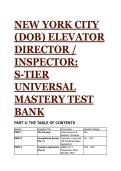
NEW YORK CITY
(DOB) ELEVATOR
DIRECTOR /
INSPECTOR:
S-TIER
UNIVERSAL
MASTERY TEST
BANK
PART 0: THE TABLE OF CONTENTS
Section Cognitive Tier Focus Area Question Range
PART I The Preview Critical Axioms & N/A
Statutory Timelines
PART II Foundational Syntax Licensure, Local Law Q1 – Q15
(Tier 1) 126 Timelines, Basic
Appendix K
PART II Complex Application ASME A17.1 Q16 – Q35
(Tier 2) Clearances, DLM
Retrofits, FEO
,Section Cognitive Tier Focus Area Question Range
Protocols
PART II Grandmaster Multi-System Failure Q36 – Q60
Synthesis (Tier 3) Triage, Overlapping
Retroactive Statutes
PART I: THE PREVIEW
Mastering this exact operational syntax separates compliant New York City Department of
Buildings (DOB) Elevator Directors from those exposing their agencies to catastrophic liability
and decertification. By internalizing these statutory timelines, retroactive code mandates
(Appendix K), and applied mechanical thresholds (ASME A17.1), you forge an operational
intuition that translates directly into elite regulatory dominance.
The "Critical Axioms" Cheat Sheet
● The Local Law 126 Paradigm: For Category 1, 3, and 5 tests, DOB notification is
required 5 days prior. Test reports must be filed within 21 days. Defects must be corrected
within 90 days (with two 45-day extensions permitted), and an Affirmation of Correction
(AOC) must be filed exactly within 14 days of the correction.
● The Appendix K Retroactive Mandate: All automatic passenger and freight elevators
must feature Door Lock Monitoring (DLM) to prevent operation with faulty door contacts
(Deadline: Jan 1, 2020). All existing traction elevators with single plunger brakes must
retrofit to dual-plunger or implement Unintended Car Movement (UCM) protection by Jan
1, 2027.
● The Pit & Clearance Imperative: A second pit stop switch is strictly required when pit
depth exceeds 67 inches. A pit ladder is required for depths exceeding 35 inches.
Governor ropes must maintain a minimum safety factor of 5.
● The "Failure to File" Penalty Scaling: Missing an AOC or periodic report filing deadline
triggers an immediate major violation. The penalty for failure to file a Category 1 or AOC
is $3,000 per elevator. Failure to file Category 3 or 5 is $5,000. Late filings accrue at $150
per month, capping at $1,800.
PART II: THE ELITE TEST BANK
Tier 1: Foundational Syntax & Application
Q1: An applicant is seeking licensure as a NYC DOB Elevator Agency Director. They hold a
valid New York State Professional Engineer (P.E.) license and have supervised elevator
installations for 6 years within the last 8 years. Based on NYC Administrative Code Section
28-421, which conclusion regarding their eligibility is the MOST ACCURATE? A) The applicant
is ineligible because all Directors must possess a minimum of 10 years of satisfactory
experience regardless of academic or professional licensure. B) The applicant is ineligible
because they have not completed the mandatory OSHA 10-Hour General Industry Standards
course required for Directors. C) The applicant is eligible, as a licensed P.E. requires only 5
years of satisfactory experience within the 7 years immediately preceding the application. D)
The applicant is eligible, provided they register as an Elevator Agency Inspector first for a
, minimum of 3 years.
● The Answer: C (The applicant is eligible, as a licensed P.E. requires only 5 years of
satisfactory experience within the 7 years immediately preceding the application.)
● Distractor Analysis:
○ A is incorrect: While standard applicants require 10 years within the last 15,
NYS-licensed P.E.s and R.A.s have a legally reduced threshold of 5 years within the
last 7.
○ B is incorrect: Elevator Agency Directors require the OSHA 30-Hour course, not
OSHA 10. (Inspectors require OSHA 10).
○ D is incorrect: There is no statutory prerequisite in Title 28 requiring a P.E. to hold
an Inspector license prior to becoming a Director.
The Mentor's Analysis: Professional licensure legally abbreviates the experiential gauntlet.
When evaluating Director qualifications, the immediate priority is identifying the applicant's base
credential (Standard vs. P.E./R.A.). By utilizing Administrative Code 28-421 parameters, you
bypass the common trap of applying blanket 10-year experience rules to registered design
professionals. Professional/Academic Intuition: Design Professionals (P.E./R.A.) cut
experiential requirements in half (5 in 7 years), but escalate the liability.
Q2: A third-party witnessing agency is contracted to oversee a Category 1 no-load safety test.
Under the updated filing rules of Local Law 126 of 2021, what is the MAXIMUM timeframe
allowed to submit the Category Test Report to the DOB after the test date? A) 60 days from the
date of the inspection. B) 21 days from the date of the test. C) 14 days from the date of the test.
D) 90 days from the date of the test.
● The Answer: B (21 days from the date of the test.)
● Distractor Analysis:
○ A is incorrect: 60 days is the legacy requirement prior to the January 1, 2022
implementation of LL 126.
○ C is incorrect: 14 days is the filing window for the Affirmation of Correction (AOC)
after a defect has been corrected, not the initial test report.
○ D is incorrect: 90 days is the timeframe allotted to correct the defects identified in
the test report, not to file the report itself.
The Mentor's Analysis: Local Law 126 drastically compressed administrative latency. When
processing Category 1, 3, or 5 test results, the immediate priority is initiating the 21-day filing
countdown. By utilizing current 1 RCNY 103-02 syntax, you bypass the common trap of relying
on outdated 60-day grace periods. Professional/Academic Intuition: The test report is 21
days. The defect correction is 90 days. The AOC is 14 days. Memorize this sequence to avoid
automatic civil penalties.
Q3: A Category 1 inspection reveals defective door restrictors on a passenger elevator. The
elevator agency corrects the defect exactly 80 days after the test date. What is the LATEST
permissible date to file the Affirmation of Correction (AOC) without incurring a late penalty? A)
14 days after the test date. B) 60 days after the defect was corrected. C) 14 days after the
defect was corrected. D) 120 days after the test date.
● The Answer: C (14 days after the defect was corrected.)
● Distractor Analysis:
○ A is incorrect: The 14-day window begins upon the date of correction, not the date
of the original Category 1 test.
○ B is incorrect: 60 days post-correction is the legacy LL 10/81 standard that was
superseded by LL 126.
○ D is incorrect: 120 days was the legacy maximum timeframe to correct defects,
(DOB) ELEVATOR
DIRECTOR /
INSPECTOR:
S-TIER
UNIVERSAL
MASTERY TEST
BANK
PART 0: THE TABLE OF CONTENTS
Section Cognitive Tier Focus Area Question Range
PART I The Preview Critical Axioms & N/A
Statutory Timelines
PART II Foundational Syntax Licensure, Local Law Q1 – Q15
(Tier 1) 126 Timelines, Basic
Appendix K
PART II Complex Application ASME A17.1 Q16 – Q35
(Tier 2) Clearances, DLM
Retrofits, FEO
,Section Cognitive Tier Focus Area Question Range
Protocols
PART II Grandmaster Multi-System Failure Q36 – Q60
Synthesis (Tier 3) Triage, Overlapping
Retroactive Statutes
PART I: THE PREVIEW
Mastering this exact operational syntax separates compliant New York City Department of
Buildings (DOB) Elevator Directors from those exposing their agencies to catastrophic liability
and decertification. By internalizing these statutory timelines, retroactive code mandates
(Appendix K), and applied mechanical thresholds (ASME A17.1), you forge an operational
intuition that translates directly into elite regulatory dominance.
The "Critical Axioms" Cheat Sheet
● The Local Law 126 Paradigm: For Category 1, 3, and 5 tests, DOB notification is
required 5 days prior. Test reports must be filed within 21 days. Defects must be corrected
within 90 days (with two 45-day extensions permitted), and an Affirmation of Correction
(AOC) must be filed exactly within 14 days of the correction.
● The Appendix K Retroactive Mandate: All automatic passenger and freight elevators
must feature Door Lock Monitoring (DLM) to prevent operation with faulty door contacts
(Deadline: Jan 1, 2020). All existing traction elevators with single plunger brakes must
retrofit to dual-plunger or implement Unintended Car Movement (UCM) protection by Jan
1, 2027.
● The Pit & Clearance Imperative: A second pit stop switch is strictly required when pit
depth exceeds 67 inches. A pit ladder is required for depths exceeding 35 inches.
Governor ropes must maintain a minimum safety factor of 5.
● The "Failure to File" Penalty Scaling: Missing an AOC or periodic report filing deadline
triggers an immediate major violation. The penalty for failure to file a Category 1 or AOC
is $3,000 per elevator. Failure to file Category 3 or 5 is $5,000. Late filings accrue at $150
per month, capping at $1,800.
PART II: THE ELITE TEST BANK
Tier 1: Foundational Syntax & Application
Q1: An applicant is seeking licensure as a NYC DOB Elevator Agency Director. They hold a
valid New York State Professional Engineer (P.E.) license and have supervised elevator
installations for 6 years within the last 8 years. Based on NYC Administrative Code Section
28-421, which conclusion regarding their eligibility is the MOST ACCURATE? A) The applicant
is ineligible because all Directors must possess a minimum of 10 years of satisfactory
experience regardless of academic or professional licensure. B) The applicant is ineligible
because they have not completed the mandatory OSHA 10-Hour General Industry Standards
course required for Directors. C) The applicant is eligible, as a licensed P.E. requires only 5
years of satisfactory experience within the 7 years immediately preceding the application. D)
The applicant is eligible, provided they register as an Elevator Agency Inspector first for a
, minimum of 3 years.
● The Answer: C (The applicant is eligible, as a licensed P.E. requires only 5 years of
satisfactory experience within the 7 years immediately preceding the application.)
● Distractor Analysis:
○ A is incorrect: While standard applicants require 10 years within the last 15,
NYS-licensed P.E.s and R.A.s have a legally reduced threshold of 5 years within the
last 7.
○ B is incorrect: Elevator Agency Directors require the OSHA 30-Hour course, not
OSHA 10. (Inspectors require OSHA 10).
○ D is incorrect: There is no statutory prerequisite in Title 28 requiring a P.E. to hold
an Inspector license prior to becoming a Director.
The Mentor's Analysis: Professional licensure legally abbreviates the experiential gauntlet.
When evaluating Director qualifications, the immediate priority is identifying the applicant's base
credential (Standard vs. P.E./R.A.). By utilizing Administrative Code 28-421 parameters, you
bypass the common trap of applying blanket 10-year experience rules to registered design
professionals. Professional/Academic Intuition: Design Professionals (P.E./R.A.) cut
experiential requirements in half (5 in 7 years), but escalate the liability.
Q2: A third-party witnessing agency is contracted to oversee a Category 1 no-load safety test.
Under the updated filing rules of Local Law 126 of 2021, what is the MAXIMUM timeframe
allowed to submit the Category Test Report to the DOB after the test date? A) 60 days from the
date of the inspection. B) 21 days from the date of the test. C) 14 days from the date of the test.
D) 90 days from the date of the test.
● The Answer: B (21 days from the date of the test.)
● Distractor Analysis:
○ A is incorrect: 60 days is the legacy requirement prior to the January 1, 2022
implementation of LL 126.
○ C is incorrect: 14 days is the filing window for the Affirmation of Correction (AOC)
after a defect has been corrected, not the initial test report.
○ D is incorrect: 90 days is the timeframe allotted to correct the defects identified in
the test report, not to file the report itself.
The Mentor's Analysis: Local Law 126 drastically compressed administrative latency. When
processing Category 1, 3, or 5 test results, the immediate priority is initiating the 21-day filing
countdown. By utilizing current 1 RCNY 103-02 syntax, you bypass the common trap of relying
on outdated 60-day grace periods. Professional/Academic Intuition: The test report is 21
days. The defect correction is 90 days. The AOC is 14 days. Memorize this sequence to avoid
automatic civil penalties.
Q3: A Category 1 inspection reveals defective door restrictors on a passenger elevator. The
elevator agency corrects the defect exactly 80 days after the test date. What is the LATEST
permissible date to file the Affirmation of Correction (AOC) without incurring a late penalty? A)
14 days after the test date. B) 60 days after the defect was corrected. C) 14 days after the
defect was corrected. D) 120 days after the test date.
● The Answer: C (14 days after the defect was corrected.)
● Distractor Analysis:
○ A is incorrect: The 14-day window begins upon the date of correction, not the date
of the original Category 1 test.
○ B is incorrect: 60 days post-correction is the legacy LL 10/81 standard that was
superseded by LL 126.
○ D is incorrect: 120 days was the legacy maximum timeframe to correct defects,


