

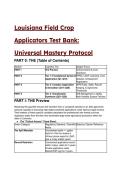
Louisiana Field Crop
Applicators Test Bank:
Universal Mastery Protocol
PART 0: THE (Table of Contents)
Section Cognitive Tier Subject Focus
PART I The Preview Critical Axioms & Core
Directives
PART II Tier 1: Foundational Syntax & FIFRA, LDAF Licensing, Core
Application (Q1–Q10) Statutes, & Equipment
Registration
PART II Tier 2: Complex Application WPS Rules, Spills, Record
& Simulation (Q11–Q20) Keeping, & Agronomic
Thresholds
PART II Tier 3: Grandmaster Drift Management, Liability,
Synthesis (Q21–Q30) Multi-Variable System Failures
PART I: THE Preview
Mastering this gauntlet ensures the transition from a compliant operator to an elite agronomic
authority capable of executing high-stakes pesticide applications under rigorous legal scrutiny.
Total mastery of these specific variables separates the professional who merely survives
regulatory audits from the titan who dominates large-scale agricultural production within the
state of Louisiana.
● The "Critical Axioms" Cheat Sheet:
Axiom Category Regulatory Standard / Scientific Statutory Citation Reference
Metric
The Spill Mandate Uncontained spills > 1 gallon
liquid or 4 lbs dry require a
24-hour phone report to LDAF,
plus a 3-day written report.
Record Retention Commercial applicators record
within 3 days, retain for 3 years.
Private applicators retain
federal RUP logs for 2 years.
,Axiom Category Regulatory Standard / Scientific Statutory Citation Reference
Metric
Wind Speed Ceilings Propanil, Paraquat,
Glyphosate, or Glufosinate
applications are strictly
prohibited at wind speeds \ge
10 mph.
Application Heights Maximum discharge height is
18 feet (aerial) or 3 feet
(ground) above the target field
crop canopy.
Agronomic Thresholds Redbanded stink bugs: 4
bugs/25 sweeps. Southern
green/brown stink bugs: 9
bugs/25 sweeps.
WPS Eyewash Emergency systems must
deliver 1.5 liters (0.4 gallons)
per minute continuously for 15
minutes.
PART II: THE ELITE TEST BANK
Tier 1 - Foundational Syntax & Application
Q1: A grower owns 5,000 acres of Louisiana soybean fields and routinely purchases Restricted
Use Pesticides (RUPs) to apply on this property. The grower occasionally sprays a neighboring
farm for a predetermined contractual fee. Based on the principles of Louisiana Pesticide
Applicator Certification, which credentialing pathway is the MOST ACCURATE requirement for
this operator? A) A Private Pesticide Applicator certification is sufficient because the majority of
the spraying is conducted on land the operator owns to produce an agricultural product. B) An
Agricultural Consultant license is required because the operator is assessing the neighbor's
property prior to chemical application. C) A Commercial Pesticide Applicator certification in
Category 1 is required because the operator is applying pesticides for a fee on property not
owned or leased by the operator. D) A Ground Owner Operator License is the only requirement,
provided the operator logs the RUP purchases with the dealer.
● The Answer: C (A Commercial Pesticide Applicator certification in Category 1 is required
because the operator is applying pesticides for a fee on property not owned or leased by
the operator.)
● Distractor Analysis:
○ A is incorrect: The moment an operator accepts a fee to apply pesticides on land
they do not own or lease, the protections of a Private Pesticide Applicator are
forfeited, and commercial certification becomes mandatory.
○ B is incorrect: An Agricultural Consultant license is exclusively for making
agronomic recommendations for a fee, not for the physical act of applying the
pesticides.
○ D is incorrect: While a Ground Owner Operator License is a business requirement,
the individual operator must physically hold a Commercial Pesticide Applicator
credential to legally handle the RUPs off-property.
, The Mentor's Analysis: Regulatory boundaries are defined by financial transactions and
property lines, not application volume. When facing fee-based applications on external
properties, the immediate priority is securing commercial certification. By utilizing the
Commercial Pesticide Applicator designation, the operator bypasses the common trap of
assuming large-scale private farming legally shields outside commercial activity.
Professional/Academic Intuition: Financial compensation for chemical application
universally triggers commercial certification protocols, voiding private exemptions.
Q2: An operator is reviewing the regulatory classifications of phenoxy herbicides to prepare for
the upcoming weed control season. Based on the principles of the Louisiana Administrative
Code (LAC 7:XXIII), which chemical structure is STRICTLY PROHIBITED from application at
any location within the state? A) Any amine salt of a phenoxy herbicide applied during a
temperature inversion. B) Any ester compound of phenoxy herbicide containing an aliphatic
alcohol radical with less than six carbon atoms. C) Any phenoxy herbicide applied at a spray
volume of less than 10 gallons per acre using a flat fan nozzle. D) Any ester compound of
phenoxy herbicide formulated with a concentration greater than 2 percent.
● The Answer: B (Any ester compound of phenoxy herbicide containing an aliphatic
alcohol radical with less than six carbon atoms.)
● Distractor Analysis:
○ A is incorrect: While applying during an inversion is a critical drift violation, the
chemical structure of an amine salt itself is not universally banned by state statute.
○ C is incorrect: Applying at less than 10 gallons per acre may result in poor efficacy
or violate specific label instructions, but it is an operational error, not a state-level
prohibition of the compound.
○ D is incorrect: The 2 percent concentration threshold applies to exemptions from
restricted-use status for homeowner formulations, not the absolute prohibition of the
chemical structure.
**The Mentor's Analysis: High-volatility formulations present an unacceptable, uncontrollable
drift risk to off-target broadleaf crops. When facing phenoxy selection, the immediate priority is
verifying the carbon chain length of the aliphatic alcohol radical. By utilizing low-volatile esters
(six or more carbon atoms), the applicator bypasses the common trap of catastrophic vapor drift
characteristic of short-chain esters. Professional/Academic Intuition: Short-chain chemistry
dictates high volatility; state law aggressively legislates molecular structures to prevent
regional crop devastation.
Q3: A commercial applicator successfully applies a restricted-use insecticide to 500 acres of
field corn. Based on the principles of Louisiana Pesticide Record Keeping Requirements, which
timeline represents the EXACT legal parameters for logging and retaining this application data?
A) Recorded within 14 days of application and maintained for 2 years. B) Recorded within 24
hours of application and maintained for 1 year. C) Recorded within 3 days of application and
maintained for 3 years. D) Recorded immediately upon completion and maintained indefinitely in
a digital format.
● The Answer: C (Recorded within 3 days of application and maintained for 3 years.)
● Distractor Analysis:
○ A is incorrect: The 14-day recording and 2-year retention rule applies strictly to
Federal/USDA standard requirements for Private Applicators, not Louisiana
Commercial Applicators.
○ B is incorrect: 24 hours is the timeline for verbal spill reporting, not standard
application record generation.
○ D is incorrect: While digital formats are acceptable, there is no mandate for
Applicators Test Bank:
Universal Mastery Protocol
PART 0: THE (Table of Contents)
Section Cognitive Tier Subject Focus
PART I The Preview Critical Axioms & Core
Directives
PART II Tier 1: Foundational Syntax & FIFRA, LDAF Licensing, Core
Application (Q1–Q10) Statutes, & Equipment
Registration
PART II Tier 2: Complex Application WPS Rules, Spills, Record
& Simulation (Q11–Q20) Keeping, & Agronomic
Thresholds
PART II Tier 3: Grandmaster Drift Management, Liability,
Synthesis (Q21–Q30) Multi-Variable System Failures
PART I: THE Preview
Mastering this gauntlet ensures the transition from a compliant operator to an elite agronomic
authority capable of executing high-stakes pesticide applications under rigorous legal scrutiny.
Total mastery of these specific variables separates the professional who merely survives
regulatory audits from the titan who dominates large-scale agricultural production within the
state of Louisiana.
● The "Critical Axioms" Cheat Sheet:
Axiom Category Regulatory Standard / Scientific Statutory Citation Reference
Metric
The Spill Mandate Uncontained spills > 1 gallon
liquid or 4 lbs dry require a
24-hour phone report to LDAF,
plus a 3-day written report.
Record Retention Commercial applicators record
within 3 days, retain for 3 years.
Private applicators retain
federal RUP logs for 2 years.
,Axiom Category Regulatory Standard / Scientific Statutory Citation Reference
Metric
Wind Speed Ceilings Propanil, Paraquat,
Glyphosate, or Glufosinate
applications are strictly
prohibited at wind speeds \ge
10 mph.
Application Heights Maximum discharge height is
18 feet (aerial) or 3 feet
(ground) above the target field
crop canopy.
Agronomic Thresholds Redbanded stink bugs: 4
bugs/25 sweeps. Southern
green/brown stink bugs: 9
bugs/25 sweeps.
WPS Eyewash Emergency systems must
deliver 1.5 liters (0.4 gallons)
per minute continuously for 15
minutes.
PART II: THE ELITE TEST BANK
Tier 1 - Foundational Syntax & Application
Q1: A grower owns 5,000 acres of Louisiana soybean fields and routinely purchases Restricted
Use Pesticides (RUPs) to apply on this property. The grower occasionally sprays a neighboring
farm for a predetermined contractual fee. Based on the principles of Louisiana Pesticide
Applicator Certification, which credentialing pathway is the MOST ACCURATE requirement for
this operator? A) A Private Pesticide Applicator certification is sufficient because the majority of
the spraying is conducted on land the operator owns to produce an agricultural product. B) An
Agricultural Consultant license is required because the operator is assessing the neighbor's
property prior to chemical application. C) A Commercial Pesticide Applicator certification in
Category 1 is required because the operator is applying pesticides for a fee on property not
owned or leased by the operator. D) A Ground Owner Operator License is the only requirement,
provided the operator logs the RUP purchases with the dealer.
● The Answer: C (A Commercial Pesticide Applicator certification in Category 1 is required
because the operator is applying pesticides for a fee on property not owned or leased by
the operator.)
● Distractor Analysis:
○ A is incorrect: The moment an operator accepts a fee to apply pesticides on land
they do not own or lease, the protections of a Private Pesticide Applicator are
forfeited, and commercial certification becomes mandatory.
○ B is incorrect: An Agricultural Consultant license is exclusively for making
agronomic recommendations for a fee, not for the physical act of applying the
pesticides.
○ D is incorrect: While a Ground Owner Operator License is a business requirement,
the individual operator must physically hold a Commercial Pesticide Applicator
credential to legally handle the RUPs off-property.
, The Mentor's Analysis: Regulatory boundaries are defined by financial transactions and
property lines, not application volume. When facing fee-based applications on external
properties, the immediate priority is securing commercial certification. By utilizing the
Commercial Pesticide Applicator designation, the operator bypasses the common trap of
assuming large-scale private farming legally shields outside commercial activity.
Professional/Academic Intuition: Financial compensation for chemical application
universally triggers commercial certification protocols, voiding private exemptions.
Q2: An operator is reviewing the regulatory classifications of phenoxy herbicides to prepare for
the upcoming weed control season. Based on the principles of the Louisiana Administrative
Code (LAC 7:XXIII), which chemical structure is STRICTLY PROHIBITED from application at
any location within the state? A) Any amine salt of a phenoxy herbicide applied during a
temperature inversion. B) Any ester compound of phenoxy herbicide containing an aliphatic
alcohol radical with less than six carbon atoms. C) Any phenoxy herbicide applied at a spray
volume of less than 10 gallons per acre using a flat fan nozzle. D) Any ester compound of
phenoxy herbicide formulated with a concentration greater than 2 percent.
● The Answer: B (Any ester compound of phenoxy herbicide containing an aliphatic
alcohol radical with less than six carbon atoms.)
● Distractor Analysis:
○ A is incorrect: While applying during an inversion is a critical drift violation, the
chemical structure of an amine salt itself is not universally banned by state statute.
○ C is incorrect: Applying at less than 10 gallons per acre may result in poor efficacy
or violate specific label instructions, but it is an operational error, not a state-level
prohibition of the compound.
○ D is incorrect: The 2 percent concentration threshold applies to exemptions from
restricted-use status for homeowner formulations, not the absolute prohibition of the
chemical structure.
**The Mentor's Analysis: High-volatility formulations present an unacceptable, uncontrollable
drift risk to off-target broadleaf crops. When facing phenoxy selection, the immediate priority is
verifying the carbon chain length of the aliphatic alcohol radical. By utilizing low-volatile esters
(six or more carbon atoms), the applicator bypasses the common trap of catastrophic vapor drift
characteristic of short-chain esters. Professional/Academic Intuition: Short-chain chemistry
dictates high volatility; state law aggressively legislates molecular structures to prevent
regional crop devastation.
Q3: A commercial applicator successfully applies a restricted-use insecticide to 500 acres of
field corn. Based on the principles of Louisiana Pesticide Record Keeping Requirements, which
timeline represents the EXACT legal parameters for logging and retaining this application data?
A) Recorded within 14 days of application and maintained for 2 years. B) Recorded within 24
hours of application and maintained for 1 year. C) Recorded within 3 days of application and
maintained for 3 years. D) Recorded immediately upon completion and maintained indefinitely in
a digital format.
● The Answer: C (Recorded within 3 days of application and maintained for 3 years.)
● Distractor Analysis:
○ A is incorrect: The 14-day recording and 2-year retention rule applies strictly to
Federal/USDA standard requirements for Private Applicators, not Louisiana
Commercial Applicators.
○ B is incorrect: 24 hours is the timeline for verbal spill reporting, not standard
application record generation.
○ D is incorrect: While digital formats are acceptable, there is no mandate for


