

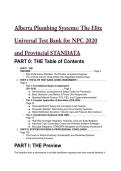
Alberta Plumbing Systems: The Elite
Universal Test Bank for NPC 2020
and Provincial STANDATA
PART 0: THE Table of Contents
1. PART I: THE
PREVIEW......................................................................................................... Page 2
○ Elite Performance Mandate: The Plumber as Systems Engineer
○ The "Critical Axioms" Cheat Sheet: Non-Negotiable Industry Rules
2. PART II: THE ELITE TEST BANK (CORE ASSESSMENT).................................................
Page 5
○ Tier 1: Foundational Syntax & Application
(Q1–Q15).............................................. Page 5
■ Administrative Jurisprudence & Safety Codes Act Framework
■ Basic Hydraulic Load Metrics & Fixture Unit Assignments
■ Standard Material Science: PVC, PEX, and Copper Implementation
○ Tier 2: Complex Application & Simulation (Q16–Q35)............................................
Page 35
■ Horizontal Branch Sizing and Cumulative Load Analysis
■ Pneumatic Stability: Wet Venting and Circuit Venting Geometry
■ Water Distribution Dynamics: Velocity Caps and Pressure Drop Calculus
○ Tier 3: Grandmaster Synthesis (Q36–Q60).............................................................
Page 75
■ High-Rise Drainage Integration: Hydraulic Jump and Suds Mitigation
■ Industrial Cross-Connection Control and Premises Isolation Strategies
■ Municipal Integration: STANDATA Navigation and Pumping Infrastructure
3. PART III: SYSTEM SYNTHESIS & PROFESSIONAL CONCLUSION..........................
Page 135
○ The Future of Alberta Plumbing: Sustainability and Reclaimed Systems
○ Final Instructional Summary
PART I: THE Preview
The transition from a journeyman to an elite practitioner requires more than manual dexterity; it
,demands a radical internalization of the National Plumbing Code (NPC) 2020 and its
Alberta-specific amendments. Mastering this test bank prepares the elite scholar to navigate the
complex regulatory and physical landscapes of high-performance building systems. By treating
each question as a real-world simulation, the student bypasses the trap of rote memorization
and develops a professional intuition rooted in the physics of fluid dynamics and the protection
of public health.
The "Critical Axioms" Cheat Sheet
● The Regulatory Baseline: As of April 1, 2023, the NPC 2020 is the governing technical
standard for Alberta, supplemented by STANDATA bulletins that address provincial
nuances like rowhousing (20-PCB-014) and reclaimed water (20-PCB-009).
● The Velocity Hard Deck: To mitigate pipe scouring and acoustic vibration, water velocity
must never exceed 3.0\text{ m/s} for HDPE, 2.4\text{ m/s} for PEX, and 1.5\text{ m/s} for
cold water copper (1.2\text{ m/s} for hot water copper).
● The Pneumatic Standard: Every building drain must be stabilized by at least one vent no
smaller than NPS 3, ensuring the entire drainage network maintains atmospheric
pressure during peak discharge.
● The Cross-Connection Firewall: Hazard levels (Minor, Moderate, Severe) dictate the
technology of protection. Severe hazards involving toxic substances mandate an Air Gap
or a Reduced Pressure (RP) principle assembly for premises isolation.
● The Fiduciary Cleanout: Maintenance access is a statutory requirement. Spacing for
1-way rodding on pipes up to 4 inches is capped at 15 meters to ensure mechanical
clearing is always possible.
PART II: THE ELITE TEST BANK
Q1: A developer is commissioning a high-rise residential project in Calgary. Under the Alberta
Safety Codes Act, which document serves as the primary technical regulation for the design and
installation of the plumbing systems as of the current 2024–2025 cycle? A) The Alberta Building
Code 2023, Part 9 B) The National Plumbing Code of Canada 2020 C) The International
Plumbing Code (IPC) 2021 Edition D) The CSA B125.3 standard for plumbing fittings
● The Answer: B (The National Plumbing Code of Canada 2020)
● Distractor Analysis:
○ A is incorrect: While the Alberta Building Code 2023 governs structural and
accessibility requirements (including plumbing facilities), the technical installation
and design of the pipes are strictly governed by the adopted NPC.
○ C is incorrect: The IPC is a model code used primarily in the United States;
Canadian jurisdictions utilize the National Model Codes developed by the National
Research Council.
○ D is incorrect: CSA B125.3 is a material and component standard referenced within
the code, not the administrative code itself.
The Mentor's Analysis: Administrative clarity is the foundation of professional practice. In
Alberta, the Safety Codes Act enables a "timely code adoption" process, which officially
integrated the NPC 2020 on April 1, 2023. By following the National model without heavy
provincial modification, Alberta ensures that practitioners can work across Canadian
jurisdictions with a unified technical language. Professional/Academic Intuition: The NPC
, 2020 is the absolute technical baseline for all plumbing infrastructure in Alberta.
Q2: A master plumber is sizing the drainage for a commercial kitchen in Edmonton. A domestic
dishwasher is to be installed and connected directly to a food waste grinder. According to NPC
2020 Table 2.4.9.3, what is the specific hydraulic load in fixture units (FUs) that must be added
to the branch sizing for this dishwasher? A) 1.5 FUs B) 2.0 FUs C) 0 FUs D) 3.0 FUs
● The Answer: C (0 FUs)
● Distractor Analysis:
○ A is incorrect: 1.5 FUs is the hydraulic load for a standalone domestic dishwasher
that drains independently into the sanitary system.
○ B is incorrect: 2.0 FUs is the standard load for a domestic clothes washer, which
has a higher discharge volume than a dishwasher.
○ D is incorrect: 3.0 FUs is the mandated load for a commercial dishwasher, which
operates with significantly higher flow rates.
The Mentor's Analysis: The code logic prevents redundant load accounting. When an
appliance like a dishwasher discharges into an existing fixture's trap (like a sink or grinder), its
load is considered "captured" by that primary fixture. This prevents the over-sizing of
downstream piping based on simultaneous use assumptions that are physically impossible in a
single-compartment setup. Professional/Academic Intuition: Ancillary appliances
connected to primary fixture drains carry a zero-sum hydraulic load.
Q3: During a site inspection of a public community center, a Safety Codes Officer identifies a
floor drain in a multi-stall washroom. The drain is intended primarily for overflow protection and
does not receive regular discharge. How is this fixture classified for hydraulic load purposes
under current Alberta standards? A) Non-emergency floor drain (2 FUs) B) Sanitary sewer inlet
(3 FUs) C) Emergency floor drain (0 FUs) D) Storm drainage inlet (1 FU)
● The Answer: C (Emergency floor drain (0 FUs))
● Distractor Analysis:
○ A is incorrect: Non-emergency floor drains are those intended for regular use, such
as in a commercial laundry or processing area, and carry a 2-FU or 3-FU load
depending on size.
○ B is incorrect: This is not a recognized classification for a standard interior floor
drain in the NPC.
○ D is incorrect: Sanitary floor drains must never connect to a storm system unless
they receive only clear-water waste, which is not the case for a washroom.
The Mentor's Analysis: Terminology dictates hydraulic capacity. By classifying a washroom
floor drain as an "emergency" drain, the code acknowledges it will not contribute to the
steady-state load of the stack. This distinction prevents the inflation of stack sizes in large public
buildings where hundreds of floor drains might otherwise add thousands of unnecessary fixture
units. Professional/Academic Intuition: Emergency floor drains are hydraulic
placeholders that require a trap and vent but contribute zero FUs.
Q4: A plumbing contractor is using the simplified sizing method in NPC 2020 Table 2.6.3.4 for a
new residential water distribution system. If the system is piped using PEX tubing and must
maintain a velocity of 2.4 m/s, what is the maximum hydraulic load in Water Supply Fixture Units
(WSFUs) permitted for a 3/4-inch NPS pipe? A) 8 WSFUs B) 16 WSFUs C) 21 WSFUs D) 31
WSFUs
● The Answer: B (16 WSFUs)
● Distractor Analysis:
○ A is incorrect: 8 WSFUs is the capacity of a 3/4-inch copper pipe restricted to the
lower velocity of 1.5\text{ m/s}.
Universal Test Bank for NPC 2020
and Provincial STANDATA
PART 0: THE Table of Contents
1. PART I: THE
PREVIEW......................................................................................................... Page 2
○ Elite Performance Mandate: The Plumber as Systems Engineer
○ The "Critical Axioms" Cheat Sheet: Non-Negotiable Industry Rules
2. PART II: THE ELITE TEST BANK (CORE ASSESSMENT).................................................
Page 5
○ Tier 1: Foundational Syntax & Application
(Q1–Q15).............................................. Page 5
■ Administrative Jurisprudence & Safety Codes Act Framework
■ Basic Hydraulic Load Metrics & Fixture Unit Assignments
■ Standard Material Science: PVC, PEX, and Copper Implementation
○ Tier 2: Complex Application & Simulation (Q16–Q35)............................................
Page 35
■ Horizontal Branch Sizing and Cumulative Load Analysis
■ Pneumatic Stability: Wet Venting and Circuit Venting Geometry
■ Water Distribution Dynamics: Velocity Caps and Pressure Drop Calculus
○ Tier 3: Grandmaster Synthesis (Q36–Q60).............................................................
Page 75
■ High-Rise Drainage Integration: Hydraulic Jump and Suds Mitigation
■ Industrial Cross-Connection Control and Premises Isolation Strategies
■ Municipal Integration: STANDATA Navigation and Pumping Infrastructure
3. PART III: SYSTEM SYNTHESIS & PROFESSIONAL CONCLUSION..........................
Page 135
○ The Future of Alberta Plumbing: Sustainability and Reclaimed Systems
○ Final Instructional Summary
PART I: THE Preview
The transition from a journeyman to an elite practitioner requires more than manual dexterity; it
,demands a radical internalization of the National Plumbing Code (NPC) 2020 and its
Alberta-specific amendments. Mastering this test bank prepares the elite scholar to navigate the
complex regulatory and physical landscapes of high-performance building systems. By treating
each question as a real-world simulation, the student bypasses the trap of rote memorization
and develops a professional intuition rooted in the physics of fluid dynamics and the protection
of public health.
The "Critical Axioms" Cheat Sheet
● The Regulatory Baseline: As of April 1, 2023, the NPC 2020 is the governing technical
standard for Alberta, supplemented by STANDATA bulletins that address provincial
nuances like rowhousing (20-PCB-014) and reclaimed water (20-PCB-009).
● The Velocity Hard Deck: To mitigate pipe scouring and acoustic vibration, water velocity
must never exceed 3.0\text{ m/s} for HDPE, 2.4\text{ m/s} for PEX, and 1.5\text{ m/s} for
cold water copper (1.2\text{ m/s} for hot water copper).
● The Pneumatic Standard: Every building drain must be stabilized by at least one vent no
smaller than NPS 3, ensuring the entire drainage network maintains atmospheric
pressure during peak discharge.
● The Cross-Connection Firewall: Hazard levels (Minor, Moderate, Severe) dictate the
technology of protection. Severe hazards involving toxic substances mandate an Air Gap
or a Reduced Pressure (RP) principle assembly for premises isolation.
● The Fiduciary Cleanout: Maintenance access is a statutory requirement. Spacing for
1-way rodding on pipes up to 4 inches is capped at 15 meters to ensure mechanical
clearing is always possible.
PART II: THE ELITE TEST BANK
Q1: A developer is commissioning a high-rise residential project in Calgary. Under the Alberta
Safety Codes Act, which document serves as the primary technical regulation for the design and
installation of the plumbing systems as of the current 2024–2025 cycle? A) The Alberta Building
Code 2023, Part 9 B) The National Plumbing Code of Canada 2020 C) The International
Plumbing Code (IPC) 2021 Edition D) The CSA B125.3 standard for plumbing fittings
● The Answer: B (The National Plumbing Code of Canada 2020)
● Distractor Analysis:
○ A is incorrect: While the Alberta Building Code 2023 governs structural and
accessibility requirements (including plumbing facilities), the technical installation
and design of the pipes are strictly governed by the adopted NPC.
○ C is incorrect: The IPC is a model code used primarily in the United States;
Canadian jurisdictions utilize the National Model Codes developed by the National
Research Council.
○ D is incorrect: CSA B125.3 is a material and component standard referenced within
the code, not the administrative code itself.
The Mentor's Analysis: Administrative clarity is the foundation of professional practice. In
Alberta, the Safety Codes Act enables a "timely code adoption" process, which officially
integrated the NPC 2020 on April 1, 2023. By following the National model without heavy
provincial modification, Alberta ensures that practitioners can work across Canadian
jurisdictions with a unified technical language. Professional/Academic Intuition: The NPC
, 2020 is the absolute technical baseline for all plumbing infrastructure in Alberta.
Q2: A master plumber is sizing the drainage for a commercial kitchen in Edmonton. A domestic
dishwasher is to be installed and connected directly to a food waste grinder. According to NPC
2020 Table 2.4.9.3, what is the specific hydraulic load in fixture units (FUs) that must be added
to the branch sizing for this dishwasher? A) 1.5 FUs B) 2.0 FUs C) 0 FUs D) 3.0 FUs
● The Answer: C (0 FUs)
● Distractor Analysis:
○ A is incorrect: 1.5 FUs is the hydraulic load for a standalone domestic dishwasher
that drains independently into the sanitary system.
○ B is incorrect: 2.0 FUs is the standard load for a domestic clothes washer, which
has a higher discharge volume than a dishwasher.
○ D is incorrect: 3.0 FUs is the mandated load for a commercial dishwasher, which
operates with significantly higher flow rates.
The Mentor's Analysis: The code logic prevents redundant load accounting. When an
appliance like a dishwasher discharges into an existing fixture's trap (like a sink or grinder), its
load is considered "captured" by that primary fixture. This prevents the over-sizing of
downstream piping based on simultaneous use assumptions that are physically impossible in a
single-compartment setup. Professional/Academic Intuition: Ancillary appliances
connected to primary fixture drains carry a zero-sum hydraulic load.
Q3: During a site inspection of a public community center, a Safety Codes Officer identifies a
floor drain in a multi-stall washroom. The drain is intended primarily for overflow protection and
does not receive regular discharge. How is this fixture classified for hydraulic load purposes
under current Alberta standards? A) Non-emergency floor drain (2 FUs) B) Sanitary sewer inlet
(3 FUs) C) Emergency floor drain (0 FUs) D) Storm drainage inlet (1 FU)
● The Answer: C (Emergency floor drain (0 FUs))
● Distractor Analysis:
○ A is incorrect: Non-emergency floor drains are those intended for regular use, such
as in a commercial laundry or processing area, and carry a 2-FU or 3-FU load
depending on size.
○ B is incorrect: This is not a recognized classification for a standard interior floor
drain in the NPC.
○ D is incorrect: Sanitary floor drains must never connect to a storm system unless
they receive only clear-water waste, which is not the case for a washroom.
The Mentor's Analysis: Terminology dictates hydraulic capacity. By classifying a washroom
floor drain as an "emergency" drain, the code acknowledges it will not contribute to the
steady-state load of the stack. This distinction prevents the inflation of stack sizes in large public
buildings where hundreds of floor drains might otherwise add thousands of unnecessary fixture
units. Professional/Academic Intuition: Emergency floor drains are hydraulic
placeholders that require a trap and vent but contribute zero FUs.
Q4: A plumbing contractor is using the simplified sizing method in NPC 2020 Table 2.6.3.4 for a
new residential water distribution system. If the system is piped using PEX tubing and must
maintain a velocity of 2.4 m/s, what is the maximum hydraulic load in Water Supply Fixture Units
(WSFUs) permitted for a 3/4-inch NPS pipe? A) 8 WSFUs B) 16 WSFUs C) 21 WSFUs D) 31
WSFUs
● The Answer: B (16 WSFUs)
● Distractor Analysis:
○ A is incorrect: 8 WSFUs is the capacity of a 3/4-inch copper pipe restricted to the
lower velocity of 1.5\text{ m/s}.


