

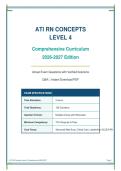
ATI RN CONCEPTS
LEVEL 4
Comprehensive Curriculum
2026-2027 Edition
Actual Exam Questions with Verified Solutions
Q&A; | Instant Download PDF
EXAM SPECIFICATIONS
Time Allocation: 3 Hours
Total Questions: 150 Questions
Question Format: Multiple Choice with Rationales
Minimum Competency: 70% Required to Pass
Core Focus: Advanced Med-Surg, Critical Care, Leadership, NCLEX-RN
ATI RN Concepts Level 4 Comprehensive 2026-2027 Page 1
, Exam Overview & Content Outline
EXAM PURPOSE
ATI RN Concepts Level 4 Comprehensive covers advanced medical-surgical nursing, critical care,
leadership, and NCLEX-RN preparation. Based on ATI Nursing Education curriculum, NCLEX-RN
Test Plan 2026, and AACN Essentials for professional nursing practice.
CONTENT DISTRIBUTION
• Advanced Medical-Surgical (30%) — Cardiovascular, respiratory, neurological, endocrine, GI,
renal complex conditions
• Critical Care & Emergency (25%) — Shock, ARDS, MI, stroke, trauma, codes, ventilators,
hemodynamics
• Pharmacology & Parenteral Therapies (20%) — High-alert meds, IV therapy, blood products,
calculations, adverse effects
• Leadership & Management (15%) — Delegation, prioritization, ethics, legal, quality improvement,
supervision
• Maternal-Child & Mental Health (10%) — High-risk OB, pediatrics, psychiatric emergencies, crisis
intervention
QUESTION FORMAT & SCORING
Each item presents four options. Correct answers are highlighted in green with checkmark (✓).
Every question includes detailed rationale with nursing standards. ATI requires 70% proficiency Level
2 to pass.
STUDY STRATEGY
Master ABCs and prioritization. Know advanced pathophysiology and interventions. Understand
critical care monitoring and hemodynamics. Review high-alert medications and IV therapy. Study
delegation and scope of practice. Practice dosage calculations. Review NCLEX-RN test-taking
strategies.
CURRICULUM ALIGNMENT
Questions reflect 2026-2027 standards: ATI Nursing Education, NCLEX-RN Test Plan, AACN
Essentials, ANA Scope and Standards, Joint Commission NPSGs, and QSEN competencies.
ATI RN Concepts Level 4 Comprehensive 2026-2027 Page 2
, SECTION I: Advanced Medical-Surgical
1. Myocardial infarction EKG changes:
A. U waves
✓ B. ST elevation, T wave inversion, Q waves
C. Prolonged PR
D. Delta waves
Rationale: MI EKG evolution: Hyperacute T waves → ST elevation (injury) → Q waves (necrosis) → T wave
inversion (ischemia). STEMI: ST elevation >1mm in 2+ contiguous leads. NSTEMI: ST depression or T
inversion. Anterior: V1-V4. Inferior: II, III, aVF. Lateral: I, aVL, V5-V6. Troponin confirms.
2. Acute respiratory distress syndrome (ARDS) criteria:
A. PaO2/FiO2 >500
✓ B. PaO2/FiO2 ≤300, bilateral infiltrates, not cardiac
C. Unilateral infiltrate
D. Normal chest X-ray
Rationale: ARDS Berlin criteria: Acute onset <1 week, bilateral opacities, PaO2/FiO2 ≤300 with PEEP ≥5,
not fully explained by cardiac failure. Mild 200-300, Moderate 100-200, Severe ≤100. Causes: sepsis,
pneumonia, trauma, aspiration. Treatment: low tidal volume 6mL/kg, PEEP, prone positioning.
3. DKA vs HHS distinguishing feature:
A. Both have ketones
✓ B. DKA: ketones present, HHS: minimal ketones, higher glucose
C. No difference
D. HHS has lower glucose
Rationale: DKA: Type 1, glucose >250, ketones, pH <7.3, anion gap >12. HHS: Type 2, glucose >600,
minimal ketones, pH >7.3, severe dehydration, altered mental status. Both: IV fluids, insulin. DKA: insulin
immediately. HHS: fluids first, then insulin. Monitor potassium - both risk hypokalemia with treatment.
4. Increased intracranial pressure early sign:
A. Decerebrate posturing
✓ B. Change in LOC, headache, vomiting
C. Fixed pupils
D. Cushing's triad
Rationale: Early ICP: ↓ LOC (first sign), headache, vomiting, blurred vision. Late: Cushing's triad (↑BP, ↓HR,
irregular respirations), pupillary changes, posturing. Normal ICP 5-15 mmHg. Interventions: HOB 30°, avoid
flexion/rotation, normothermia, normocapnia, mannitol, hypertonic saline. Monitor CPP = MAP - ICP.
5. Acute kidney injury stages (KDIGO):
A. No stages
✓ B. Stage 1: Cr 1.5-1.9x baseline, Stage 2: 2-2.9x, Stage 3: 3x or >4.0
C. Based on BUN only
ATI RN Concepts Level 4 Comprehensive 2026-2027 Page 3
LEVEL 4
Comprehensive Curriculum
2026-2027 Edition
Actual Exam Questions with Verified Solutions
Q&A; | Instant Download PDF
EXAM SPECIFICATIONS
Time Allocation: 3 Hours
Total Questions: 150 Questions
Question Format: Multiple Choice with Rationales
Minimum Competency: 70% Required to Pass
Core Focus: Advanced Med-Surg, Critical Care, Leadership, NCLEX-RN
ATI RN Concepts Level 4 Comprehensive 2026-2027 Page 1
, Exam Overview & Content Outline
EXAM PURPOSE
ATI RN Concepts Level 4 Comprehensive covers advanced medical-surgical nursing, critical care,
leadership, and NCLEX-RN preparation. Based on ATI Nursing Education curriculum, NCLEX-RN
Test Plan 2026, and AACN Essentials for professional nursing practice.
CONTENT DISTRIBUTION
• Advanced Medical-Surgical (30%) — Cardiovascular, respiratory, neurological, endocrine, GI,
renal complex conditions
• Critical Care & Emergency (25%) — Shock, ARDS, MI, stroke, trauma, codes, ventilators,
hemodynamics
• Pharmacology & Parenteral Therapies (20%) — High-alert meds, IV therapy, blood products,
calculations, adverse effects
• Leadership & Management (15%) — Delegation, prioritization, ethics, legal, quality improvement,
supervision
• Maternal-Child & Mental Health (10%) — High-risk OB, pediatrics, psychiatric emergencies, crisis
intervention
QUESTION FORMAT & SCORING
Each item presents four options. Correct answers are highlighted in green with checkmark (✓).
Every question includes detailed rationale with nursing standards. ATI requires 70% proficiency Level
2 to pass.
STUDY STRATEGY
Master ABCs and prioritization. Know advanced pathophysiology and interventions. Understand
critical care monitoring and hemodynamics. Review high-alert medications and IV therapy. Study
delegation and scope of practice. Practice dosage calculations. Review NCLEX-RN test-taking
strategies.
CURRICULUM ALIGNMENT
Questions reflect 2026-2027 standards: ATI Nursing Education, NCLEX-RN Test Plan, AACN
Essentials, ANA Scope and Standards, Joint Commission NPSGs, and QSEN competencies.
ATI RN Concepts Level 4 Comprehensive 2026-2027 Page 2
, SECTION I: Advanced Medical-Surgical
1. Myocardial infarction EKG changes:
A. U waves
✓ B. ST elevation, T wave inversion, Q waves
C. Prolonged PR
D. Delta waves
Rationale: MI EKG evolution: Hyperacute T waves → ST elevation (injury) → Q waves (necrosis) → T wave
inversion (ischemia). STEMI: ST elevation >1mm in 2+ contiguous leads. NSTEMI: ST depression or T
inversion. Anterior: V1-V4. Inferior: II, III, aVF. Lateral: I, aVL, V5-V6. Troponin confirms.
2. Acute respiratory distress syndrome (ARDS) criteria:
A. PaO2/FiO2 >500
✓ B. PaO2/FiO2 ≤300, bilateral infiltrates, not cardiac
C. Unilateral infiltrate
D. Normal chest X-ray
Rationale: ARDS Berlin criteria: Acute onset <1 week, bilateral opacities, PaO2/FiO2 ≤300 with PEEP ≥5,
not fully explained by cardiac failure. Mild 200-300, Moderate 100-200, Severe ≤100. Causes: sepsis,
pneumonia, trauma, aspiration. Treatment: low tidal volume 6mL/kg, PEEP, prone positioning.
3. DKA vs HHS distinguishing feature:
A. Both have ketones
✓ B. DKA: ketones present, HHS: minimal ketones, higher glucose
C. No difference
D. HHS has lower glucose
Rationale: DKA: Type 1, glucose >250, ketones, pH <7.3, anion gap >12. HHS: Type 2, glucose >600,
minimal ketones, pH >7.3, severe dehydration, altered mental status. Both: IV fluids, insulin. DKA: insulin
immediately. HHS: fluids first, then insulin. Monitor potassium - both risk hypokalemia with treatment.
4. Increased intracranial pressure early sign:
A. Decerebrate posturing
✓ B. Change in LOC, headache, vomiting
C. Fixed pupils
D. Cushing's triad
Rationale: Early ICP: ↓ LOC (first sign), headache, vomiting, blurred vision. Late: Cushing's triad (↑BP, ↓HR,
irregular respirations), pupillary changes, posturing. Normal ICP 5-15 mmHg. Interventions: HOB 30°, avoid
flexion/rotation, normothermia, normocapnia, mannitol, hypertonic saline. Monitor CPP = MAP - ICP.
5. Acute kidney injury stages (KDIGO):
A. No stages
✓ B. Stage 1: Cr 1.5-1.9x baseline, Stage 2: 2-2.9x, Stage 3: 3x or >4.0
C. Based on BUN only
ATI RN Concepts Level 4 Comprehensive 2026-2027 Page 3


