

The Elite Universal Test Bank:
Pennsylvania Board-Certified
Master Plumber Evaluation
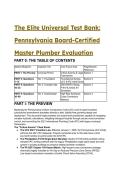
PART 0: THE TABLE OF CONTENTS
Section Blueprint Cognitive Tier Core Focus Area Page/Section
Reference
PART I: The Preview Universal Primer Critical Axioms & Legal Section 1
Frameworks
PART II: Questions Tier 1: Foundation Foundational Syntax, Section 2
1–15 UCC & IPC Hard Decks
PART II: Questions Tier 2: Complex App DWV/WSFU Sizing, Section 3
16–35 P-919 & Article XV
Simulation
PART II: Questions Tier 3: Grandmaster High-Rise Synthesis, Section 4
36–60 Cross-Connection
Matrices
PART I: THE PREVIEW
Mastering the Pennsylvania Uniform Construction Code (UCC) and its hyper-localized
jurisdictional amendments translates directly to elite, liability-free plumbing design and
deployment. This document forges students into board-level practitioners capable of navigating
complex hydraulic calculations, mitigating biological hazards through precise cross-connection
control, and reconciling the 2021 International Plumbing Code (IPC) with legacy municipal
frameworks.
The "Critical Axioms" Cheat Sheet:
● The UCC 2021 Transition Law: Effective January 1, 2026, the Pennsylvania UCC strictly
enforces the 2021 IPC statewide. Projects contracted prior to this date have a strict
six-month window to permit under the 2018 IPC.
● The Philadelphia P-919 Single-Stack Mandate: Section P-919 strictly prohibits mixing
standard IPC venting methods with the legacy Philadelphia single-stack waste and vent
system in existing buildings to preserve wetted perimeter ventilation.
● The PA DEP Chapter 109 Hazard Matrix: High-hazard cross-connections (sewage,
chemicals) legally mandate an Air Gap or Reduced Pressure Zone Device (RPZD).
Low-hazard connections mandate a Double Check Valve Assembly (DCVA).
, ● The Allegheny Article XV Lead & Trap Directives: The Allegheny County Health
Department outright prohibits partial lead water service line replacements, and explicitly
alters IPC fixture counts for gender-neutral single-user toilet rooms.
PART II: THE ELITE TEST BANK
Tier 1: Foundational Syntax & Application
Q1: A plumbing contractor in Pennsylvania executes a design contract on December 15, 2025.
The permit is officially applied for on March 1, 2026. Based on the principles of the Pennsylvania
Uniform Construction Code (UCC) adoption cycle, which action/conclusion is the MOST
ACCURATE? A) The project must comply with the 2021 IPC because the permit application
occurred after January 1, 2026. B) The project may proceed under the 2018 IPC because the
permit was applied for within six months of the January 1, 2026 effective date. C) The project
must comply with the 2018 IPC but must update all accessibility requirements to the 2021 IPC.
D) The project is subject to the 2024 IPC as mandated by the Review and Advisory Council
(RAC).
● The Answer: B (The project may proceed under the 2018 IPC because the permit was
applied for within six months of the January 1, 2026 effective date.)
● Distractor Analysis:
○ A is incorrect: While the 2021 IPC took effect January 1, 2026, the UCC grants a
six-month grace period for contracts executed prior to the effective date.
○ C is incorrect: The Commonwealth Court permanently enjoined the 2021
accessibility updates, rendering the 2018 accessibility standards permanent
regardless of this grace period.
○ D is incorrect: Pennsylvania bypassed the 2024 IPC and officially adopted the 2021
IPC.
The Mentor's Analysis: Administrative code determines legal enforcement timelines. When
facing a code transition, the immediate priority is verifying the date the design contract was
signed against the permit application date. By utilizing the six-month statutory grace period, you
bypass the common trap of unnecessarily redesigning a fully drafted project to a newer code
cycle. Professional/Academic Intuition: The date of contract execution shields the project if
permitted within the six-month statutory window.
Q2: A commercial building in Philadelphia connects its building sewer to a combined public
sewer. Based on the principles of the Philadelphia Plumbing Code Section P-1002.6, which
action/conclusion is the REQUIRED installation? A) A backwater valve installed at the point of
connection to prevent municipal storm surge. B) An air admittance valve installed at the highest
point of the sanitary stack. C) A building (house) trap located at the curb line with a properly
sized fresh air inlet. D) The complete elimination of all building traps, per standard IPC
requirements.
● The Answer: C (A building (house) trap located at the curb line with a properly sized
fresh air inlet.)
● Distractor Analysis:
○ A is incorrect: Backwater valves protect fixtures below the manhole cover elevation,
not the general connection to a combined sewer.
○ B is incorrect: Air admittance valves do not protect the building from public
combined sewer gases entering the main drain.
, ○ D is incorrect: While the base IPC prohibits building traps as redundant,
Philadelphia explicitly retains and mandates them to protect against combined
sewer failure in dense urban environments.
The Mentor's Analysis: Municipal infrastructure limitations dictate localized code amendments.
When facing Philadelphia's combined sewers, the immediate priority is isolating the building
from municipal sewer gas and surge. By utilizing a curb line building trap, you bypass the trap of
strictly applying the national IPC and violating a mandatory local health directive.
Professional/Academic Intuition: National code yields to local amendments; in Philadelphia,
the building trap is the primary defensive boundary.
Q3: Under the PA DEP Chapter 109 Cross-Connection Control program, a water purveyor
assesses a commercial boiler system containing chemical anti-corrosion additives. Based on
the principles of cross-connection control, which action/conclusion is the MOST ACCURATE
protection method? A) Installation of a Residential Dual Check Valve (RDCV). B) Installation of a
Double Check Valve Assembly (DCVA). C) Installation of an Atmospheric Vacuum Breaker
(AVB). D) Installation of a Reduced Pressure Zone Device (RPZD) or Air Gap.
● The Answer: D (Installation of a Reduced Pressure Zone Device (RPZD) or Air Gap.)
● Distractor Analysis:
○ A is incorrect: An RDCV is for non-testable, low-hazard residential applications only.
○ B is incorrect: A DCVA is utilized strictly for low-hazard (pollutant/aesthetic)
cross-connections. Chemical additives escalate the risk to a high health hazard.
○ C is incorrect: An AVB cannot be subjected to continuous pressure and does not
protect against backpressure generated by a boiler.
The Mentor's Analysis: Fluid toxicity defines the mechanical barrier required. When facing a
chemically treated system, the immediate priority is classifying the hazard as severe
(contaminant). By utilizing an RPZD, you bypass the common trap of specifying a DCVA, which
will legally fail a DEP hazard inspection. Professional/Academic Intuition: Chemical additives
always trigger high-hazard, RPZD/Air Gap protection.
Q4: A journeyman is sizing a standard horizontal drainage branch serving a public restroom.
The branch serves two public water closets (flushing greater than 1.6 gpf). Based on the
principles of IPC Table 709.1, which action/conclusion is the MOST ACCURATE Drainage
Fixture Unit (DFU) load for this branch? A) 8 DFU B) 12 DFU C) 6 DFU D) 10 DFU
● The Answer: B (12 DFU)
● Distractor Analysis:
○ A is incorrect: 8 DFU represents the load of two private water closets (flushing
greater than 1.6 gpf), which are 4 DFU each.
○ C is incorrect: 6 DFU is the load of a single public water closet (flushing greater
than 1.6 gpf).
○ D is incorrect: This is an arbitrary calculation usually reached by confusing WSFU
tables with DFU tables.
The Mentor's Analysis: Fixture unit loads fluctuate drastically based on public versus private
occupancy. When calculating public sanitary loads, the immediate priority is referencing the
specific flush volume and usage frequency. By utilizing the 6 DFU value per public water closet,
you bypass the common trap of undersizing the branch line using private residential metrics.
Professional/Academic Intuition: Public usage demands double the mathematical load
expectancy on the DWV system.
Q5: An inspector in Allegheny County discovers a contractor performing a partial replacement of
a lead water service line. Based on the principles of Allegheny County Health Department
Article XV, which action/conclusion is the MOST ACCURATE immediate action? A) Approve the
, work, provided a dielectric union is used to connect the lead to the new copper. B) Halt the
work; Article XV mandates that all lead water service lines must be replaced entirely with
approved materials. C) Require the contractor to install an RPZD backflow preventer
immediately downstream of the lead pipe. D) Issue a variance, provided the homeowner signs a
lead-exposure liability waiver.
● The Answer: B (Halt the work; Article XV mandates that all lead water service lines must
be replaced entirely with approved materials.)
● Distractor Analysis:
○ A is incorrect: Dielectric unions prevent galvanic corrosion but do not resolve the
illegality of partial lead replacements in this jurisdiction.
○ C is incorrect: Backflow preventers do not mitigate heavy metal leaching from
supply lines into the building's potable water.
○ D is incorrect: Local health codes cannot be bypassed via civil liability waivers.
The Mentor's Analysis: Heavy metal toxicity requires total system eradication, not mitigation.
When facing lead service lines in Allegheny County, the immediate priority is absolute removal.
By enforcing total line replacement, you bypass the trap of leaving a hazardous
biological/chemical condition intact within the municipal grid. Professional/Academic Intuition:
Partial lead replacement is a catastrophic legal and biological failure; the entire line must be
pulled.
Q6: A designer is utilizing the 2021 IPC to size the water distribution piping for a commercial
building. The building requires a peak demand calculation. Based on the principles of Table
604.3, what is the assigned Water Supply Fixture Unit (WSFU) value for a public water closet
utilizing a flushometer valve? A) 5.0 WSFU B) 10.0 WSFU C) 6.0 WSFU D) 8.0 WSFU
● The Answer: B (10.0 WSFU)
● Distractor Analysis:
○ A is incorrect: 5.0 WSFU is the value for a public flush tank water closet, not a
flushometer.
○ C is incorrect: 6.0 is the DFU (drainage) value for a public water closet, not the
water supply unit.
○ D is incorrect: 8.0 WSFU is a common miscalculation confusing the fixture with an
older private flushometer standard.
The Mentor's Analysis: Flushometer valves require massive, instantaneous hydraulic flow.
When calculating peak supply demand, the immediate priority is distinguishing between gravity
tanks and pressurized valves. By utilizing the 10.0 WSFU metric, you bypass the trap of
undersizing the water main, which would cause critical pressure drops during concurrent
flushing. Professional/Academic Intuition: Flushometers demand high volume instantly; their
WSFU is disproportionately high.
Q7: Under the Philadelphia Plumbing Code Section P-919.1, a contractor is renovating a
historic building equipped with an original single-stack waste and vent system. The contractor
proposes adding a new bathroom group using an independent, conventional vent stack
alongside the existing single-stack. Based on the principles of P-919, which action/conclusion is
the MOST ACCURATE? A) The design is permissible if the new vent stack is sized one size
larger. B) The design is prohibited; systems utilizing P-919 shall not incorporate any other
methods of design contained in other sections. C) The design is permissible provided an air
admittance valve is installed on the new fixtures. D) The design is required because modern
low-flow fixtures cannot operate on a legacy single stack.
● The Answer: B (The design is prohibited; systems utilizing P-919 shall not incorporate
any other methods of design contained in other sections.)
Pennsylvania Board-Certified
Master Plumber Evaluation
PART 0: THE TABLE OF CONTENTS
Section Blueprint Cognitive Tier Core Focus Area Page/Section
Reference
PART I: The Preview Universal Primer Critical Axioms & Legal Section 1
Frameworks
PART II: Questions Tier 1: Foundation Foundational Syntax, Section 2
1–15 UCC & IPC Hard Decks
PART II: Questions Tier 2: Complex App DWV/WSFU Sizing, Section 3
16–35 P-919 & Article XV
Simulation
PART II: Questions Tier 3: Grandmaster High-Rise Synthesis, Section 4
36–60 Cross-Connection
Matrices
PART I: THE PREVIEW
Mastering the Pennsylvania Uniform Construction Code (UCC) and its hyper-localized
jurisdictional amendments translates directly to elite, liability-free plumbing design and
deployment. This document forges students into board-level practitioners capable of navigating
complex hydraulic calculations, mitigating biological hazards through precise cross-connection
control, and reconciling the 2021 International Plumbing Code (IPC) with legacy municipal
frameworks.
The "Critical Axioms" Cheat Sheet:
● The UCC 2021 Transition Law: Effective January 1, 2026, the Pennsylvania UCC strictly
enforces the 2021 IPC statewide. Projects contracted prior to this date have a strict
six-month window to permit under the 2018 IPC.
● The Philadelphia P-919 Single-Stack Mandate: Section P-919 strictly prohibits mixing
standard IPC venting methods with the legacy Philadelphia single-stack waste and vent
system in existing buildings to preserve wetted perimeter ventilation.
● The PA DEP Chapter 109 Hazard Matrix: High-hazard cross-connections (sewage,
chemicals) legally mandate an Air Gap or Reduced Pressure Zone Device (RPZD).
Low-hazard connections mandate a Double Check Valve Assembly (DCVA).
, ● The Allegheny Article XV Lead & Trap Directives: The Allegheny County Health
Department outright prohibits partial lead water service line replacements, and explicitly
alters IPC fixture counts for gender-neutral single-user toilet rooms.
PART II: THE ELITE TEST BANK
Tier 1: Foundational Syntax & Application
Q1: A plumbing contractor in Pennsylvania executes a design contract on December 15, 2025.
The permit is officially applied for on March 1, 2026. Based on the principles of the Pennsylvania
Uniform Construction Code (UCC) adoption cycle, which action/conclusion is the MOST
ACCURATE? A) The project must comply with the 2021 IPC because the permit application
occurred after January 1, 2026. B) The project may proceed under the 2018 IPC because the
permit was applied for within six months of the January 1, 2026 effective date. C) The project
must comply with the 2018 IPC but must update all accessibility requirements to the 2021 IPC.
D) The project is subject to the 2024 IPC as mandated by the Review and Advisory Council
(RAC).
● The Answer: B (The project may proceed under the 2018 IPC because the permit was
applied for within six months of the January 1, 2026 effective date.)
● Distractor Analysis:
○ A is incorrect: While the 2021 IPC took effect January 1, 2026, the UCC grants a
six-month grace period for contracts executed prior to the effective date.
○ C is incorrect: The Commonwealth Court permanently enjoined the 2021
accessibility updates, rendering the 2018 accessibility standards permanent
regardless of this grace period.
○ D is incorrect: Pennsylvania bypassed the 2024 IPC and officially adopted the 2021
IPC.
The Mentor's Analysis: Administrative code determines legal enforcement timelines. When
facing a code transition, the immediate priority is verifying the date the design contract was
signed against the permit application date. By utilizing the six-month statutory grace period, you
bypass the common trap of unnecessarily redesigning a fully drafted project to a newer code
cycle. Professional/Academic Intuition: The date of contract execution shields the project if
permitted within the six-month statutory window.
Q2: A commercial building in Philadelphia connects its building sewer to a combined public
sewer. Based on the principles of the Philadelphia Plumbing Code Section P-1002.6, which
action/conclusion is the REQUIRED installation? A) A backwater valve installed at the point of
connection to prevent municipal storm surge. B) An air admittance valve installed at the highest
point of the sanitary stack. C) A building (house) trap located at the curb line with a properly
sized fresh air inlet. D) The complete elimination of all building traps, per standard IPC
requirements.
● The Answer: C (A building (house) trap located at the curb line with a properly sized
fresh air inlet.)
● Distractor Analysis:
○ A is incorrect: Backwater valves protect fixtures below the manhole cover elevation,
not the general connection to a combined sewer.
○ B is incorrect: Air admittance valves do not protect the building from public
combined sewer gases entering the main drain.
, ○ D is incorrect: While the base IPC prohibits building traps as redundant,
Philadelphia explicitly retains and mandates them to protect against combined
sewer failure in dense urban environments.
The Mentor's Analysis: Municipal infrastructure limitations dictate localized code amendments.
When facing Philadelphia's combined sewers, the immediate priority is isolating the building
from municipal sewer gas and surge. By utilizing a curb line building trap, you bypass the trap of
strictly applying the national IPC and violating a mandatory local health directive.
Professional/Academic Intuition: National code yields to local amendments; in Philadelphia,
the building trap is the primary defensive boundary.
Q3: Under the PA DEP Chapter 109 Cross-Connection Control program, a water purveyor
assesses a commercial boiler system containing chemical anti-corrosion additives. Based on
the principles of cross-connection control, which action/conclusion is the MOST ACCURATE
protection method? A) Installation of a Residential Dual Check Valve (RDCV). B) Installation of a
Double Check Valve Assembly (DCVA). C) Installation of an Atmospheric Vacuum Breaker
(AVB). D) Installation of a Reduced Pressure Zone Device (RPZD) or Air Gap.
● The Answer: D (Installation of a Reduced Pressure Zone Device (RPZD) or Air Gap.)
● Distractor Analysis:
○ A is incorrect: An RDCV is for non-testable, low-hazard residential applications only.
○ B is incorrect: A DCVA is utilized strictly for low-hazard (pollutant/aesthetic)
cross-connections. Chemical additives escalate the risk to a high health hazard.
○ C is incorrect: An AVB cannot be subjected to continuous pressure and does not
protect against backpressure generated by a boiler.
The Mentor's Analysis: Fluid toxicity defines the mechanical barrier required. When facing a
chemically treated system, the immediate priority is classifying the hazard as severe
(contaminant). By utilizing an RPZD, you bypass the common trap of specifying a DCVA, which
will legally fail a DEP hazard inspection. Professional/Academic Intuition: Chemical additives
always trigger high-hazard, RPZD/Air Gap protection.
Q4: A journeyman is sizing a standard horizontal drainage branch serving a public restroom.
The branch serves two public water closets (flushing greater than 1.6 gpf). Based on the
principles of IPC Table 709.1, which action/conclusion is the MOST ACCURATE Drainage
Fixture Unit (DFU) load for this branch? A) 8 DFU B) 12 DFU C) 6 DFU D) 10 DFU
● The Answer: B (12 DFU)
● Distractor Analysis:
○ A is incorrect: 8 DFU represents the load of two private water closets (flushing
greater than 1.6 gpf), which are 4 DFU each.
○ C is incorrect: 6 DFU is the load of a single public water closet (flushing greater
than 1.6 gpf).
○ D is incorrect: This is an arbitrary calculation usually reached by confusing WSFU
tables with DFU tables.
The Mentor's Analysis: Fixture unit loads fluctuate drastically based on public versus private
occupancy. When calculating public sanitary loads, the immediate priority is referencing the
specific flush volume and usage frequency. By utilizing the 6 DFU value per public water closet,
you bypass the common trap of undersizing the branch line using private residential metrics.
Professional/Academic Intuition: Public usage demands double the mathematical load
expectancy on the DWV system.
Q5: An inspector in Allegheny County discovers a contractor performing a partial replacement of
a lead water service line. Based on the principles of Allegheny County Health Department
Article XV, which action/conclusion is the MOST ACCURATE immediate action? A) Approve the
, work, provided a dielectric union is used to connect the lead to the new copper. B) Halt the
work; Article XV mandates that all lead water service lines must be replaced entirely with
approved materials. C) Require the contractor to install an RPZD backflow preventer
immediately downstream of the lead pipe. D) Issue a variance, provided the homeowner signs a
lead-exposure liability waiver.
● The Answer: B (Halt the work; Article XV mandates that all lead water service lines must
be replaced entirely with approved materials.)
● Distractor Analysis:
○ A is incorrect: Dielectric unions prevent galvanic corrosion but do not resolve the
illegality of partial lead replacements in this jurisdiction.
○ C is incorrect: Backflow preventers do not mitigate heavy metal leaching from
supply lines into the building's potable water.
○ D is incorrect: Local health codes cannot be bypassed via civil liability waivers.
The Mentor's Analysis: Heavy metal toxicity requires total system eradication, not mitigation.
When facing lead service lines in Allegheny County, the immediate priority is absolute removal.
By enforcing total line replacement, you bypass the trap of leaving a hazardous
biological/chemical condition intact within the municipal grid. Professional/Academic Intuition:
Partial lead replacement is a catastrophic legal and biological failure; the entire line must be
pulled.
Q6: A designer is utilizing the 2021 IPC to size the water distribution piping for a commercial
building. The building requires a peak demand calculation. Based on the principles of Table
604.3, what is the assigned Water Supply Fixture Unit (WSFU) value for a public water closet
utilizing a flushometer valve? A) 5.0 WSFU B) 10.0 WSFU C) 6.0 WSFU D) 8.0 WSFU
● The Answer: B (10.0 WSFU)
● Distractor Analysis:
○ A is incorrect: 5.0 WSFU is the value for a public flush tank water closet, not a
flushometer.
○ C is incorrect: 6.0 is the DFU (drainage) value for a public water closet, not the
water supply unit.
○ D is incorrect: 8.0 WSFU is a common miscalculation confusing the fixture with an
older private flushometer standard.
The Mentor's Analysis: Flushometer valves require massive, instantaneous hydraulic flow.
When calculating peak supply demand, the immediate priority is distinguishing between gravity
tanks and pressurized valves. By utilizing the 10.0 WSFU metric, you bypass the trap of
undersizing the water main, which would cause critical pressure drops during concurrent
flushing. Professional/Academic Intuition: Flushometers demand high volume instantly; their
WSFU is disproportionately high.
Q7: Under the Philadelphia Plumbing Code Section P-919.1, a contractor is renovating a
historic building equipped with an original single-stack waste and vent system. The contractor
proposes adding a new bathroom group using an independent, conventional vent stack
alongside the existing single-stack. Based on the principles of P-919, which action/conclusion is
the MOST ACCURATE? A) The design is permissible if the new vent stack is sized one size
larger. B) The design is prohibited; systems utilizing P-919 shall not incorporate any other
methods of design contained in other sections. C) The design is permissible provided an air
admittance valve is installed on the new fixtures. D) The design is required because modern
low-flow fixtures cannot operate on a legacy single stack.
● The Answer: B (The design is prohibited; systems utilizing P-919 shall not incorporate
any other methods of design contained in other sections.)


