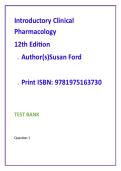
Pharmacology and the Nursing
Process
10th Edition
• Author(s)Linda Lane Lilley;
Shelly Rainforth Collins; Julie
S. Snyder
,TEST BANK
Question 1: Multiple-Choice Question (MCQ)
1. Item Type
Multiple-Choice Question (MCQ)
2. Clinical Scenario
An 82-year-old female patient with a history of chronic heart
failure and stage 3 chronic kidney disease (CKD) is admitted
with complaints of progressive anorexia, nausea, blurred vision,
and seeing "yellow-green halos" around objects. The patient
has been taking digoxin 0.25 mg orally daily at home for the
past two years.
3. Question Stem
The nurse reviews the patient’s laboratory results and notes a
serum digoxin level of 2.6 ng/mL (optimal therapeutic range:
0.5–0.9 ng/mL) and a potassium level of 3.2 mEq/L. Which
physiological factor and subsequent nursing intervention
represent the highest priority for this patient's safe
pharmacological care?
4. Answer Options
, • A. The patient’s renal clearance is reduced due to age and
CKD, prolonging the drug's half-life; the nurse should
immediately administer the scheduled morning dose of
digoxin and request a potassium-wasting diuretic.
• B. Hypokalemia increases the risk of digoxin toxicity by
allowing increased myocardial digoxin binding; the nurse
must hold the scheduled digoxin, notify the healthcare
provider, and prepare to correct the potassium deficit.
• C. The patient is experiencing therapeutic effects of digoxin
coupled with normal age-related visual changes; the nurse
should document the findings and reassess the patient in 4
hours.
• D. Hyperkalemia has directly potentiated the positive
inotropic effects of digoxin; the nurse should prepare to
administer sodium polystyrene sulfonate orally.
5. Correct Answer
B
6. Comprehensive Rationale
Digoxin is a cardiac glycoside with a narrow therapeutic index. It
inhibits the $Na^+/K^+$ ATPase pump, increasing intracellular
calcium to exert a positive inotropic effect and a negative
chronotropic/dromotropic effect.
, Digoxin is primarily eliminated unchanged by the kidneys via
glomerular filtration and active tubular secretion. In an older
adult with stage 3 CKD, renal clearance is significantly
compromised, prolonging the drug's half-life and causing
progressive accumulation.
Furthermore, potassium and digoxin compete for the same
binding sites on the $Na^+/K^+$ ATPase pump. When
hypokalemia ($< 3.5 \text{ mEq/L}$) is present, there are fewer
potassium ions to occupy these sites, allowing more digoxin to
bind, which dramatically increases the risk of toxicity even at
lower serum drug concentrations.
The patient presents with classic signs of digitalis toxicity
(gastrointestinal distress and visual disturbances like
xanthopsia/halos). The priority intervention is to stop the
medication, alert the provider, check cardiac monitoring due to
the risk of life-threatening dysrhythmias (such as PVCs or AV
blocks), and correct the potassium deficiency under close
surveillance.
7. Distractor Analysis
• Option A is incorrect: Administering more digoxin to a
toxic patient with impaired renal function is a catastrophic
medication error. While the statement regarding reduced
renal clearance is accurate, the intervention is unsafe, and
Process
10th Edition
• Author(s)Linda Lane Lilley;
Shelly Rainforth Collins; Julie
S. Snyder
,TEST BANK
Question 1: Multiple-Choice Question (MCQ)
1. Item Type
Multiple-Choice Question (MCQ)
2. Clinical Scenario
An 82-year-old female patient with a history of chronic heart
failure and stage 3 chronic kidney disease (CKD) is admitted
with complaints of progressive anorexia, nausea, blurred vision,
and seeing "yellow-green halos" around objects. The patient
has been taking digoxin 0.25 mg orally daily at home for the
past two years.
3. Question Stem
The nurse reviews the patient’s laboratory results and notes a
serum digoxin level of 2.6 ng/mL (optimal therapeutic range:
0.5–0.9 ng/mL) and a potassium level of 3.2 mEq/L. Which
physiological factor and subsequent nursing intervention
represent the highest priority for this patient's safe
pharmacological care?
4. Answer Options
, • A. The patient’s renal clearance is reduced due to age and
CKD, prolonging the drug's half-life; the nurse should
immediately administer the scheduled morning dose of
digoxin and request a potassium-wasting diuretic.
• B. Hypokalemia increases the risk of digoxin toxicity by
allowing increased myocardial digoxin binding; the nurse
must hold the scheduled digoxin, notify the healthcare
provider, and prepare to correct the potassium deficit.
• C. The patient is experiencing therapeutic effects of digoxin
coupled with normal age-related visual changes; the nurse
should document the findings and reassess the patient in 4
hours.
• D. Hyperkalemia has directly potentiated the positive
inotropic effects of digoxin; the nurse should prepare to
administer sodium polystyrene sulfonate orally.
5. Correct Answer
B
6. Comprehensive Rationale
Digoxin is a cardiac glycoside with a narrow therapeutic index. It
inhibits the $Na^+/K^+$ ATPase pump, increasing intracellular
calcium to exert a positive inotropic effect and a negative
chronotropic/dromotropic effect.
, Digoxin is primarily eliminated unchanged by the kidneys via
glomerular filtration and active tubular secretion. In an older
adult with stage 3 CKD, renal clearance is significantly
compromised, prolonging the drug's half-life and causing
progressive accumulation.
Furthermore, potassium and digoxin compete for the same
binding sites on the $Na^+/K^+$ ATPase pump. When
hypokalemia ($< 3.5 \text{ mEq/L}$) is present, there are fewer
potassium ions to occupy these sites, allowing more digoxin to
bind, which dramatically increases the risk of toxicity even at
lower serum drug concentrations.
The patient presents with classic signs of digitalis toxicity
(gastrointestinal distress and visual disturbances like
xanthopsia/halos). The priority intervention is to stop the
medication, alert the provider, check cardiac monitoring due to
the risk of life-threatening dysrhythmias (such as PVCs or AV
blocks), and correct the potassium deficiency under close
surveillance.
7. Distractor Analysis
• Option A is incorrect: Administering more digoxin to a
toxic patient with impaired renal function is a catastrophic
medication error. While the statement regarding reduced
renal clearance is accurate, the intervention is unsafe, and