

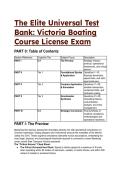
The Elite Universal Test
Bank: Victoria Boating
Course License Exam
PART 0: Table of Contents
Section Reference Cognitive Tier Subject Focus Description
PART I N/A The Preview Strategic mission
protocol, operational
frameworks, and critical
axioms.
PART II Tier 1 Foundational Syntax Questions 1–10:
& Application Absolute thresholds,
speed limits, and strict
legal minimums.
PART II Tier 2 Complex Application Questions 11–20:
& Simulation Variable intersection,
contextual limits, and
hardware scaling.
PART II Tier 3 Grandmaster Questions 21–30:
Synthesis Cascading failures,
multi-infraction
analysis, and crisis
management.
PART III N/A Strategic Conclusion Final synthesis of
maritime compliance
methodologies and
operational readiness.
PART I: The Preview
Mastering this rigorous assessment translates directly into elite operational competence on
Victorian waterways, forging skippers who instinctively execute the mandates of the Marine
Safety Act 2010. These cognitive simulations dismantle novice assumptions, embedding the
exact legal, physical, and toxicological thresholds required to command a vessel flawlessly
under current Safe Transport Victoria standards.
The "Critical Axioms" Cheat Sheet:
● The 5-Knot Universal Hard Deck: Speed is strictly capped at a maximum of 5 knots
when operating within 50 meters of swimmers, vessels, or inland shores, and within 200
meters of coastal or enclosed shores.
, ● The PWC Age & Endorsement Law: Personal Watercraft operation requires a specific
legislative endorsement that is legally unattainable under the age of 16. A Restricted
Marine Licence (ages 12–15) strictly prohibits PWC operation and any form of towing.
● The Heightened Risk Mandate: Boating alone, crossing coastal bars, or operating as the
sole adult with a child under 12 triggers automatic "heightened risk." This classification
legally requires mandatory lifejacket wear for all occupants on powered vessels up to 12
meters in length.
● The Zero-Tolerance BAC Doctrine: Operators strictly under 21 years of age are subject
to an absolute 0.00% Blood Alcohol Concentration limit. Operators 21 and over must
remain under the 0.05% threshold.
● The Enclosed Waters Flare Bypass: Pyrotechnic distress flares on enclosed waters
(such as Port Phillip Bay) can be legally replaced only by a GPS-enabled EPIRB, a
Personal Locator Beacon (PLB), or a 25-watt VHF marine radio.
PART II: THE ELITE TEST BANK
Tier 1: Foundational Syntax & Application
Q1: A 19-year-old operator holding a standard marine licence is navigating a 5-meter powered
vessel on inland waters. Based on the Marine Safety Act 2010, what is the MAXIMUM legal
Blood Alcohol Concentration (BAC) permitted for this operator? A) 0.05% B) 0.02% C) 0.00% D)
0.08%
● The Answer: C (0.00%)
● Distractor Analysis:
○ A is incorrect: The 0.05% metric applies strictly to individuals who are 21 years of
age and older. Applying this adult threshold to a 19-year-old operator represents a
critical regulatory violation that fundamentally compromises maritime safety
parameters.
○ B is incorrect: While a 0.02% limit represents a valid threshold in alternative
international jurisdictions (such as Georgia, USA) , it possesses absolutely no legal
standing under Victoria's stringent, age-gated toxicological frameworks.
○ D is incorrect: The 0.08% metric is a legacy automotive standard from foreign
jurisdictions and fails to align with current Victorian maritime regulations, which
demand significantly lower impairment thresholds.
The Mentor's Analysis: Chronological age dictates toxicological thresholds on Victorian
waterways. When evaluating operator legality, the immediate priority is verifying the operator's
age against the definitive 21-year pivot point. By utilizing the Zero-Tolerance BAC Doctrine, the
maritime auditor bypasses the common trap of applying standard adult automotive limits to
young marine operators. Professional/Academic Intuition: If the operator has not yet reached
their 21st birthday, the only mathematically acceptable Blood Alcohol Concentration is absolute
zero.
Q2: An operator is navigating a 6-meter powered vessel on enclosed waters. They observe a
single swimmer in the water ahead. According to Safe Transport Victoria, at what precise
distance MUST the operator reduce their vessel's speed to 5 knots or less? A) 30 meters B) 50
meters C) 100 meters D) 200 meters
● The Answer: B (50 meters)
● Distractor Analysis:
, ○ A is incorrect: 30 meters is a statutory distance utilized in New South Wales , not
Victoria. Applying interstate metrics causes localized compliance failure.
○ C is incorrect: 100 meters is the mandated 5-knot distance from a vessel or buoy
displaying a 'diver below' (Flag A) signal , not the baseline buffer for a standard
swimmer without a flag.
○ D is incorrect: 200 meters dictates the 5-knot boundary from the water's edge on
coastal and enclosed waters , not the required proximity radius to an isolated
human in the water.
The Mentor's Analysis: Human flesh lacks structural hull integrity. When encountering bathers,
the immediate priority is kinetic energy reduction before entering their immediate vicinity. By
utilizing the 50-Meter Human Proximity Rule, the master bypasses the common trap of
maintaining high cruising speeds too close to highly vulnerable waterway users.
Professional/Academic Intuition: 50 meters is the absolute minimum legal buffer zone
between a spinning propeller and a human life.
Q3: A 15-year-old holds a valid Restricted Marine Licence. They intend to operate a registered
Personal Watercraft (PWC) during daylight hours at a controlled speed of 8 knots. Based on
Victoria's licensing framework, is this specific operational profile legal? A) Yes, because the
speed is under 10 knots and operation occurs strictly during daylight hours. B) Yes, provided
they are accompanied onboard by a fully licensed adult over 18 years of age. C) No, because a
Restricted Marine Licence holder cannot legally possess a PWC endorsement. D) No, because
all PWC operation structurally requires a speed of at least 10 knots to maintain steering control.
● The Answer: C (No, because a Restricted Marine Licence holder cannot legally possess
a PWC endorsement.)
● Distractor Analysis:
○ A is incorrect: While restricted licence holders must indeed operate under 10 knots
in daylight, they are categorically banned from any PWC operation regardless of
how slow they travel.
○ B is incorrect: Direct supervision allows an entirely unlicensed person to operate a
vessel , but the prompt asks if the 15-year-old can operate based on their
Restricted Marine Licence privileges. Furthermore, PWC operation natively requires
an explicit endorsement that a 15-year-old cannot legally hold.
○ D is incorrect: This is a mechanical myth; while thrust is required for steering,
PWCs can and must operate legally at speeds below 5 knots in restricted zones.
The Mentor's Analysis: Hardware capability must align with administrative privilege. When
assessing PWC operation, the immediate priority is verifying the operator has reached 16 years
of age to legally hold the required endorsement. By utilizing the Age 16 PWC Threshold,
regulators bypass the common trap of assuming a Restricted Marine Licence covers all vessels
merely operating at low speeds. Professional/Academic Intuition: Jetskis require adult-level
endorsements; restricted minors are strictly limited to operating conventional displacement or
planing hulls.
Q4: Based on the 2023 updates to the Marine Safety Regulations, which child is legally
REQUIRED to wear an approved lifejacket at all times when in an open area of a vessel that is
underway? A) A 13-year-old on a 6-meter powered vessel. B) An 11-year-old on a 15-meter
powered vessel. C) A 12-year-old on a recreational tender. D) A 14-year-old on an off-the-beach
sailing yacht.
● The Answer: B (An 11-year-old on a 15-meter powered vessel.)
● Distractor Analysis:
○ A is incorrect: The mandatory age threshold in Victoria is strictly under 12 years. A
Bank: Victoria Boating
Course License Exam
PART 0: Table of Contents
Section Reference Cognitive Tier Subject Focus Description
PART I N/A The Preview Strategic mission
protocol, operational
frameworks, and critical
axioms.
PART II Tier 1 Foundational Syntax Questions 1–10:
& Application Absolute thresholds,
speed limits, and strict
legal minimums.
PART II Tier 2 Complex Application Questions 11–20:
& Simulation Variable intersection,
contextual limits, and
hardware scaling.
PART II Tier 3 Grandmaster Questions 21–30:
Synthesis Cascading failures,
multi-infraction
analysis, and crisis
management.
PART III N/A Strategic Conclusion Final synthesis of
maritime compliance
methodologies and
operational readiness.
PART I: The Preview
Mastering this rigorous assessment translates directly into elite operational competence on
Victorian waterways, forging skippers who instinctively execute the mandates of the Marine
Safety Act 2010. These cognitive simulations dismantle novice assumptions, embedding the
exact legal, physical, and toxicological thresholds required to command a vessel flawlessly
under current Safe Transport Victoria standards.
The "Critical Axioms" Cheat Sheet:
● The 5-Knot Universal Hard Deck: Speed is strictly capped at a maximum of 5 knots
when operating within 50 meters of swimmers, vessels, or inland shores, and within 200
meters of coastal or enclosed shores.
, ● The PWC Age & Endorsement Law: Personal Watercraft operation requires a specific
legislative endorsement that is legally unattainable under the age of 16. A Restricted
Marine Licence (ages 12–15) strictly prohibits PWC operation and any form of towing.
● The Heightened Risk Mandate: Boating alone, crossing coastal bars, or operating as the
sole adult with a child under 12 triggers automatic "heightened risk." This classification
legally requires mandatory lifejacket wear for all occupants on powered vessels up to 12
meters in length.
● The Zero-Tolerance BAC Doctrine: Operators strictly under 21 years of age are subject
to an absolute 0.00% Blood Alcohol Concentration limit. Operators 21 and over must
remain under the 0.05% threshold.
● The Enclosed Waters Flare Bypass: Pyrotechnic distress flares on enclosed waters
(such as Port Phillip Bay) can be legally replaced only by a GPS-enabled EPIRB, a
Personal Locator Beacon (PLB), or a 25-watt VHF marine radio.
PART II: THE ELITE TEST BANK
Tier 1: Foundational Syntax & Application
Q1: A 19-year-old operator holding a standard marine licence is navigating a 5-meter powered
vessel on inland waters. Based on the Marine Safety Act 2010, what is the MAXIMUM legal
Blood Alcohol Concentration (BAC) permitted for this operator? A) 0.05% B) 0.02% C) 0.00% D)
0.08%
● The Answer: C (0.00%)
● Distractor Analysis:
○ A is incorrect: The 0.05% metric applies strictly to individuals who are 21 years of
age and older. Applying this adult threshold to a 19-year-old operator represents a
critical regulatory violation that fundamentally compromises maritime safety
parameters.
○ B is incorrect: While a 0.02% limit represents a valid threshold in alternative
international jurisdictions (such as Georgia, USA) , it possesses absolutely no legal
standing under Victoria's stringent, age-gated toxicological frameworks.
○ D is incorrect: The 0.08% metric is a legacy automotive standard from foreign
jurisdictions and fails to align with current Victorian maritime regulations, which
demand significantly lower impairment thresholds.
The Mentor's Analysis: Chronological age dictates toxicological thresholds on Victorian
waterways. When evaluating operator legality, the immediate priority is verifying the operator's
age against the definitive 21-year pivot point. By utilizing the Zero-Tolerance BAC Doctrine, the
maritime auditor bypasses the common trap of applying standard adult automotive limits to
young marine operators. Professional/Academic Intuition: If the operator has not yet reached
their 21st birthday, the only mathematically acceptable Blood Alcohol Concentration is absolute
zero.
Q2: An operator is navigating a 6-meter powered vessel on enclosed waters. They observe a
single swimmer in the water ahead. According to Safe Transport Victoria, at what precise
distance MUST the operator reduce their vessel's speed to 5 knots or less? A) 30 meters B) 50
meters C) 100 meters D) 200 meters
● The Answer: B (50 meters)
● Distractor Analysis:
, ○ A is incorrect: 30 meters is a statutory distance utilized in New South Wales , not
Victoria. Applying interstate metrics causes localized compliance failure.
○ C is incorrect: 100 meters is the mandated 5-knot distance from a vessel or buoy
displaying a 'diver below' (Flag A) signal , not the baseline buffer for a standard
swimmer without a flag.
○ D is incorrect: 200 meters dictates the 5-knot boundary from the water's edge on
coastal and enclosed waters , not the required proximity radius to an isolated
human in the water.
The Mentor's Analysis: Human flesh lacks structural hull integrity. When encountering bathers,
the immediate priority is kinetic energy reduction before entering their immediate vicinity. By
utilizing the 50-Meter Human Proximity Rule, the master bypasses the common trap of
maintaining high cruising speeds too close to highly vulnerable waterway users.
Professional/Academic Intuition: 50 meters is the absolute minimum legal buffer zone
between a spinning propeller and a human life.
Q3: A 15-year-old holds a valid Restricted Marine Licence. They intend to operate a registered
Personal Watercraft (PWC) during daylight hours at a controlled speed of 8 knots. Based on
Victoria's licensing framework, is this specific operational profile legal? A) Yes, because the
speed is under 10 knots and operation occurs strictly during daylight hours. B) Yes, provided
they are accompanied onboard by a fully licensed adult over 18 years of age. C) No, because a
Restricted Marine Licence holder cannot legally possess a PWC endorsement. D) No, because
all PWC operation structurally requires a speed of at least 10 knots to maintain steering control.
● The Answer: C (No, because a Restricted Marine Licence holder cannot legally possess
a PWC endorsement.)
● Distractor Analysis:
○ A is incorrect: While restricted licence holders must indeed operate under 10 knots
in daylight, they are categorically banned from any PWC operation regardless of
how slow they travel.
○ B is incorrect: Direct supervision allows an entirely unlicensed person to operate a
vessel , but the prompt asks if the 15-year-old can operate based on their
Restricted Marine Licence privileges. Furthermore, PWC operation natively requires
an explicit endorsement that a 15-year-old cannot legally hold.
○ D is incorrect: This is a mechanical myth; while thrust is required for steering,
PWCs can and must operate legally at speeds below 5 knots in restricted zones.
The Mentor's Analysis: Hardware capability must align with administrative privilege. When
assessing PWC operation, the immediate priority is verifying the operator has reached 16 years
of age to legally hold the required endorsement. By utilizing the Age 16 PWC Threshold,
regulators bypass the common trap of assuming a Restricted Marine Licence covers all vessels
merely operating at low speeds. Professional/Academic Intuition: Jetskis require adult-level
endorsements; restricted minors are strictly limited to operating conventional displacement or
planing hulls.
Q4: Based on the 2023 updates to the Marine Safety Regulations, which child is legally
REQUIRED to wear an approved lifejacket at all times when in an open area of a vessel that is
underway? A) A 13-year-old on a 6-meter powered vessel. B) An 11-year-old on a 15-meter
powered vessel. C) A 12-year-old on a recreational tender. D) A 14-year-old on an off-the-beach
sailing yacht.
● The Answer: B (An 11-year-old on a 15-meter powered vessel.)
● Distractor Analysis:
○ A is incorrect: The mandatory age threshold in Victoria is strictly under 12 years. A


