

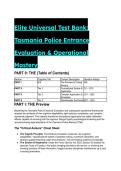
Elite Universal Test Bank:
Tasmania Police Entrance
Evaluation & Operational
Mastery
PART 0: THE (Table of Contents)
Section Cognitive Tier Content Description Question Range
PART I N/A The Preview & Critical N/A
Axioms
PART II Tier 1 Foundational Syntax & Q1 – Q10
Application
PART II Tier 2 Complex Application & Q11 – Q20
Simulation
PART II Tier 3 Grandmaster Synthesis Q21 – Q30
PART I: THE Preview
Mastering the Tasmania Police Entrance Evaluation and subsequent operational frameworks
requires the synthesis of raw cognitive adaptability, rigid statutory compliance, and complex
situational judgment. This material transforms foundational applicants into highly calibrated
officers capable of surviving both the rigorous Talogy/Cognify psychological screening and the
uncompromising legal standards of the Tasmania Police Manual (TPM).
The "Critical Axioms" Cheat Sheet
● The Cognify Principle: The entrance evaluation measures raw cognitive
adaptability—specifically the speed of problem-solving, numerical calculation, and
abstract spatial reasoning under time pressure—not pre-existing academic knowledge.
● The Section 42 Imperative: Under the Police Service Act 2003, Section 42 dictates the
absolute Code of Conduct. Any action bringing discredit to the service, or involving the
knowing provision of false information, triggers severe disciplinary mechanisms up to and
including termination.
, ● The Abacus Threshold: Internal complaints are strictly bifurcated. Level 1 matters are
minor performance issues with a 14-day resolution benchmark. Level 2 matters involve
potential Code of Conduct breaches and carry a 70-day investigation benchmark.
● The BWC Buffering Law: Body Worn Cameras (BWC) must remain in continuous
buffering mode. Activation triggers a 30-second back-capture that is strictly visual; audio
is never captured during the buffering period.
● The Youth Justice Mandate: Under the Youth Justice Act 1997, interactions with minors
prioritize diversion. A police officer cannot formally interview a youth (under 18) without
the explicit presence of a parent, guardian, or legally defined responsible adult.
● The Prior History Exclusion Rule: Background integrity is absolute. A conviction
resulting in imprisonment triggers an indefinite exclusion, while a drink driving conviction
exceeding 0.10% triggers a mandatory 5-year exclusion period.
PART II: THE ELITE TEST BANK
Tier 1 - Foundational Syntax & Application
The evolution of modern police recruitment in Tasmania has shifted definitively away from rote
memorization and legacy knowledge testing. The contemporary paradigm, anchored by the
Talogy Cognify assessment suite, prioritizes fluid intelligence, cognitive agility, and the rapid
assimilation of novel data. This shift recognizes that the operational environment of a police
officer is inherently chaotic and unstructured. An applicant's ability to navigate the Shortcuts or
Gridlock mini-games serves as a direct proxy for their capacity to process a high-stakes tactical
scenario where variables shift by the second.
Simultaneously, the Tasmania Police Manual (TPM) and the Police Service Act 2003 establish
the rigid boundaries within which this cognitive agility must operate. The tension between rapid,
creative problem-solving and absolute, uncompromising statutory compliance forms the crucible
of Tier 1 mastery.
Cognify Assessment Primary Objective Example Module Predictive Operational
Domain Value
Abstract Reasoning Pattern recognition Resemble (Shapes) Rapid threat
without pre-existing assessment in chaotic
knowledge visual environments.
Numerical Reasoning Extracting data from Numbubbles Calculating speed,
worded problems to distance, and critical
apply formulas incident geometry.
Verbal Reasoning Reading Proof It Drafting legally binding,
comprehension and unassailable incident
logical linguistic reports.
deduction
Q1: A prospective applicant is preparing for the psychological testing phase of the Tasmania
Police Entrance Evaluation. During this phase, the applicant must complete the Cognify
assessment, specifically the Shortcuts mini-game. Based on the evaluation's parameters, what
is the MOST ACCURATE primary metric being assessed by this specific module? A) The
applicant's existing knowledge of traffic laws, geographic mapping, and spatial orientation. B)
The applicant's numerical reasoning capability when dividing complex fractions under extreme
time limits. C) The applicant's ability to problem-solve by learning quickly and minimizing penalty
, points through strategic pathway optimization. D) The applicant's verbal reasoning skills in
decoding situational judgment prompts.
● The Answer: C (The applicant's ability to problem-solve by learning quickly and
minimizing penalty points through strategic pathway optimization.)
● Distractor Analysis:
○ A is incorrect: Cognify strictly tests raw cognitive ability and fluid intelligence,
explicitly ignoring learned geographic or legal knowledge.
○ B is incorrect: While numerical reasoning is tested elsewhere in the exam, the
Shortcuts game relies entirely on visual-spatial problem-solving, not complex
arithmetic or fractions.
○ D is incorrect: Verbal reasoning requires reading comprehension passages and
linguistic deduction, whereas Shortcuts is a purely visual, text-free maze simulation.
The Mentor's Analysis: The Cognify paradigm shifts recruitment from historical academic
performance to fluid cognitive adaptability. When facing the Shortcuts module, the immediate
priority is demonstrating efficient, penalty-averse decision-making under stress. By utilizing rapid
spatial reasoning, the candidate bypasses the common trap of making haphazard movements
that accumulate disqualifying penalty points. Professional/Academic Intuition: Predictability in
policing relies on adaptability; the assessment measures how fast a candidate assimilates new
operational rules, not what they already know.
Q2: A candidate is reviewing their driving history prior to submitting an Expression of Interest
(EoI) for Tasmania Police. The candidate has a previous drink driving conviction with a recorded
Blood Alcohol Concentration (BAC) of 0.12%. According to the Tasmania Police Applicant Prior
History Offence Guidelines, which conclusion regarding the applicant's eligibility is the MOST
ACCURATE? A) The applicant is indefinitely excluded from joining the Tasmania Police due to a
severe traffic violation. B) The applicant must wait 5 years from the date of the offence before
they are eligible to apply. C) The applicant may apply immediately, but their application will be
subject to a case-by-case review by Recruiting Services. D) The applicant is eligible to apply
after a 10-year exclusion period has elapsed.
● The Answer: B (The applicant must wait 5 years from the date of the offence before they
are eligible to apply.)
● Distractor Analysis:
○ A is incorrect: Indefinite exclusion is legally reserved for convictions resulting in a
term of imprisonment (including suspended sentences), not universally for
high-range drink driving.
○ C is incorrect: While minor traffic offenses (like standard speeding tickets) receive
case-by-case assessments, a BAC of 0.10% or more triggers an automatic,
non-negotiable statutory exclusion timeframe.
○ D is incorrect: The specific statutory exclusion period for a BAC of 0.10% or more is
precisely 5 years, making the 10-year metric a plausible but factually incorrect
legacy distractor.
The Mentor's Analysis: Integrity and public safety are foundational prerequisites for law
enforcement employment, and past behavior is the baseline predictor. When facing background
checks, the immediate priority is establishing the precise temporal distance from disqualifying
conduct. By utilizing the strict 5-year exclusion framework, the agency bypasses the trap of
absorbing candidates with recent, severe risk-taking behaviors. Professional/Academic
Intuition: The timeline of redemption is legislated, not negotiated; a BAC over 0.10% stops the
clock for exactly five years.
Q3: Under Section 42 of the Police Service Act 2003, Tasmania Police officers are bound by a
Tasmania Police Entrance
Evaluation & Operational
Mastery
PART 0: THE (Table of Contents)
Section Cognitive Tier Content Description Question Range
PART I N/A The Preview & Critical N/A
Axioms
PART II Tier 1 Foundational Syntax & Q1 – Q10
Application
PART II Tier 2 Complex Application & Q11 – Q20
Simulation
PART II Tier 3 Grandmaster Synthesis Q21 – Q30
PART I: THE Preview
Mastering the Tasmania Police Entrance Evaluation and subsequent operational frameworks
requires the synthesis of raw cognitive adaptability, rigid statutory compliance, and complex
situational judgment. This material transforms foundational applicants into highly calibrated
officers capable of surviving both the rigorous Talogy/Cognify psychological screening and the
uncompromising legal standards of the Tasmania Police Manual (TPM).
The "Critical Axioms" Cheat Sheet
● The Cognify Principle: The entrance evaluation measures raw cognitive
adaptability—specifically the speed of problem-solving, numerical calculation, and
abstract spatial reasoning under time pressure—not pre-existing academic knowledge.
● The Section 42 Imperative: Under the Police Service Act 2003, Section 42 dictates the
absolute Code of Conduct. Any action bringing discredit to the service, or involving the
knowing provision of false information, triggers severe disciplinary mechanisms up to and
including termination.
, ● The Abacus Threshold: Internal complaints are strictly bifurcated. Level 1 matters are
minor performance issues with a 14-day resolution benchmark. Level 2 matters involve
potential Code of Conduct breaches and carry a 70-day investigation benchmark.
● The BWC Buffering Law: Body Worn Cameras (BWC) must remain in continuous
buffering mode. Activation triggers a 30-second back-capture that is strictly visual; audio
is never captured during the buffering period.
● The Youth Justice Mandate: Under the Youth Justice Act 1997, interactions with minors
prioritize diversion. A police officer cannot formally interview a youth (under 18) without
the explicit presence of a parent, guardian, or legally defined responsible adult.
● The Prior History Exclusion Rule: Background integrity is absolute. A conviction
resulting in imprisonment triggers an indefinite exclusion, while a drink driving conviction
exceeding 0.10% triggers a mandatory 5-year exclusion period.
PART II: THE ELITE TEST BANK
Tier 1 - Foundational Syntax & Application
The evolution of modern police recruitment in Tasmania has shifted definitively away from rote
memorization and legacy knowledge testing. The contemporary paradigm, anchored by the
Talogy Cognify assessment suite, prioritizes fluid intelligence, cognitive agility, and the rapid
assimilation of novel data. This shift recognizes that the operational environment of a police
officer is inherently chaotic and unstructured. An applicant's ability to navigate the Shortcuts or
Gridlock mini-games serves as a direct proxy for their capacity to process a high-stakes tactical
scenario where variables shift by the second.
Simultaneously, the Tasmania Police Manual (TPM) and the Police Service Act 2003 establish
the rigid boundaries within which this cognitive agility must operate. The tension between rapid,
creative problem-solving and absolute, uncompromising statutory compliance forms the crucible
of Tier 1 mastery.
Cognify Assessment Primary Objective Example Module Predictive Operational
Domain Value
Abstract Reasoning Pattern recognition Resemble (Shapes) Rapid threat
without pre-existing assessment in chaotic
knowledge visual environments.
Numerical Reasoning Extracting data from Numbubbles Calculating speed,
worded problems to distance, and critical
apply formulas incident geometry.
Verbal Reasoning Reading Proof It Drafting legally binding,
comprehension and unassailable incident
logical linguistic reports.
deduction
Q1: A prospective applicant is preparing for the psychological testing phase of the Tasmania
Police Entrance Evaluation. During this phase, the applicant must complete the Cognify
assessment, specifically the Shortcuts mini-game. Based on the evaluation's parameters, what
is the MOST ACCURATE primary metric being assessed by this specific module? A) The
applicant's existing knowledge of traffic laws, geographic mapping, and spatial orientation. B)
The applicant's numerical reasoning capability when dividing complex fractions under extreme
time limits. C) The applicant's ability to problem-solve by learning quickly and minimizing penalty
, points through strategic pathway optimization. D) The applicant's verbal reasoning skills in
decoding situational judgment prompts.
● The Answer: C (The applicant's ability to problem-solve by learning quickly and
minimizing penalty points through strategic pathway optimization.)
● Distractor Analysis:
○ A is incorrect: Cognify strictly tests raw cognitive ability and fluid intelligence,
explicitly ignoring learned geographic or legal knowledge.
○ B is incorrect: While numerical reasoning is tested elsewhere in the exam, the
Shortcuts game relies entirely on visual-spatial problem-solving, not complex
arithmetic or fractions.
○ D is incorrect: Verbal reasoning requires reading comprehension passages and
linguistic deduction, whereas Shortcuts is a purely visual, text-free maze simulation.
The Mentor's Analysis: The Cognify paradigm shifts recruitment from historical academic
performance to fluid cognitive adaptability. When facing the Shortcuts module, the immediate
priority is demonstrating efficient, penalty-averse decision-making under stress. By utilizing rapid
spatial reasoning, the candidate bypasses the common trap of making haphazard movements
that accumulate disqualifying penalty points. Professional/Academic Intuition: Predictability in
policing relies on adaptability; the assessment measures how fast a candidate assimilates new
operational rules, not what they already know.
Q2: A candidate is reviewing their driving history prior to submitting an Expression of Interest
(EoI) for Tasmania Police. The candidate has a previous drink driving conviction with a recorded
Blood Alcohol Concentration (BAC) of 0.12%. According to the Tasmania Police Applicant Prior
History Offence Guidelines, which conclusion regarding the applicant's eligibility is the MOST
ACCURATE? A) The applicant is indefinitely excluded from joining the Tasmania Police due to a
severe traffic violation. B) The applicant must wait 5 years from the date of the offence before
they are eligible to apply. C) The applicant may apply immediately, but their application will be
subject to a case-by-case review by Recruiting Services. D) The applicant is eligible to apply
after a 10-year exclusion period has elapsed.
● The Answer: B (The applicant must wait 5 years from the date of the offence before they
are eligible to apply.)
● Distractor Analysis:
○ A is incorrect: Indefinite exclusion is legally reserved for convictions resulting in a
term of imprisonment (including suspended sentences), not universally for
high-range drink driving.
○ C is incorrect: While minor traffic offenses (like standard speeding tickets) receive
case-by-case assessments, a BAC of 0.10% or more triggers an automatic,
non-negotiable statutory exclusion timeframe.
○ D is incorrect: The specific statutory exclusion period for a BAC of 0.10% or more is
precisely 5 years, making the 10-year metric a plausible but factually incorrect
legacy distractor.
The Mentor's Analysis: Integrity and public safety are foundational prerequisites for law
enforcement employment, and past behavior is the baseline predictor. When facing background
checks, the immediate priority is establishing the precise temporal distance from disqualifying
conduct. By utilizing the strict 5-year exclusion framework, the agency bypasses the trap of
absorbing candidates with recent, severe risk-taking behaviors. Professional/Academic
Intuition: The timeline of redemption is legislated, not negotiated; a BAC over 0.10% stops the
clock for exactly five years.
Q3: Under Section 42 of the Police Service Act 2003, Tasmania Police officers are bound by a


