

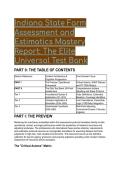
Indiana State Farm
Assessment and
Estimatics Mastery
Report: The Elite
Universal Test Bank
PART 0: THE TABLE OF CONTENTS
Section Reference Content Architecture & Core Domain Focus
Cognitive Progression
PART I The Preview: Operational Critical Axioms, INAIP Statues,
Framework and FP-7955 Metrics
PART II The Elite Test Bank: 60-Point Comprehensive Indiana
Assessment Adjusting and Sales Protocol
Tier 1 Foundational Syntax & Code Definitions, Estimatics
Application (Q1–Q15) Baseline, Coverage Identifiers
Tier 2 Complex Application & Limit Calculations, Deductible
Simulation (Q16–Q35) Logic, FCB Rider Integration
Tier 3 Grandmaster Synthesis Multi-Peril Adjusting,
(Q36–Q60) Commercial Excess, Fiduciary
Litigation
PART I: THE PREVIEW
Mastering the mechanics embedded within this assessment protocol translates directly to elite
operational, clinical, and legal performance within the jurisdiction of Indiana's insurance and
adjusting landscape. The professional who internalizes these precise statutory requirements
and estimatics protocols secures an impregnable foundation for executing flawless technical
judgments in high-risk, multi-variable environments. This document serves as the definitive
calibrator for top-tier agency producers and property adjusters operating under modern Indiana
Department of Insurance (IDOI) mandates.
The "Critical Axioms" Matrix
,Core Framework Operational Rule & Real-World Evidence Base
Application
The FP-7955 Deductible When applying deductibles
Doctrine under Policy FP-7955, the final
settlement is unequivocally the
greater of the calculated
amounts after comparing the
total covered loss minus the
deductible versus the
application of specific policy
sub-limits.
The Coverage C Triad Under FP-7955, Coverage C
strictly encapsulates three
protections: Additional Living
Expense, Fair Rental Value,
and Property Removed. It does
not natively include debris
removal.
The INAIP 36-Month Rule The Indiana Auto Insurance
Plan (INAIP) provides liability
coverage of last resort for
high-risk drivers for a duration
of three years, requiring state
minimum split limits of
25/50/10.
The FCB Mechanism The Flexible Care Benefit
(FCB) rider modifies whole and
universal life policies by
accelerating benefits and
waiving monthly deductions
while the insured receives
qualified long-term care.
Estimatics Area Supremacy Area calculations demand
geometric precision; trapezoids
require [(base1+base2) / 2] *
height, triangles require 1/2
base * height, and circular
turrets utilize pi * r^2.
PART II: THE ELITE TEST BANK
Tier 1: Foundational Syntax & Application
Q1: A high-risk driver in Indiana is rejected by three standard market insurers due to a severe
motor vehicle record and subsequently secures liability coverage through the Indiana Auto
Insurance Plan (INAIP). Based on INAIP statutory guidelines, what is the MAXIMUM mandated
period this specific placement coverage is provided? A) 12 consecutive months B) 18 months,
mirroring specific secondary SR-22 infractions C) 3 years D) 5 years, mirroring maximum
, penalty durations
● The Answer: C (3 years)
● Distractor Analysis:
○ A is incorrect: Standard voluntary auto policies renew annually, but INAIP statutory
assignments guarantee participation limits for a longer rehabilitative period.
○ B is incorrect: The 180-day or 18-month metrics apply to initial SR-22 requirements
for specific uninsured infractions, not the duration of an INAIP placement.
○ D is incorrect: Five years applies exclusively to SR-22 durations for a third or
subsequent suspension, not the systemic INAIP plan duration.
The Mentor's Analysis: The INAIP acts as the market of last resort, structurally designed to
reintegrate high-risk drivers while protecting the public trust. The policy guarantees a 36-month
safe harbor for the insured to establish a verifiable, clean driving record before being forced to
re-enter the standard voluntary market. By strictly adhering to the 36-month assignment
lifecycle, the state ensures equitable distribution of high-risk pools among carriers.
Professional/Academic Intuition: INAIP placement legally binds the assigned carrier to
the risk for exactly three years.
Q2: When a field adjuster is calculating the area of a structural exterior feature with a distinctly
trapezoidal shape, which mathematical formula is the MOST ACCURATE for determining the
required siding material? A) 1/2 base * height B) [(base1+base2) / 2] * height C) Base * height
D) pi * r^2
● The Answer: B ([(base1+base2) / 2] * height)
● Distractor Analysis:
○ A is incorrect: This formula strictly isolates the area of a standard triangle, which
would severely undercalculate the material required for a trapezoid.
○ C is incorrect: This formula isolates the area of a square or rectangle, failing to
account for the angled geometry of the trapezoidal roofline.
○ D is incorrect: This formula isolates the area of a circle, applicable only to turrets or
silos.
The Mentor's Analysis: Precision in spatial adjusting requires flawless application of
foundational geometry to prevent systemic overpayment or material shortages. When facing
trapezoidal roof structures or complex wall elevations, the immediate priority is mathematically
averaging the parallel bases before multiplying by the altitude. By utilizing the averaging
theorem inherent in the correct formula, the adjuster bypasses the common trap of artificially
inflating the linear footage of the claim. Professional/Academic Intuition: Trapezoidal
estimatics strictly require the aggregation of parallel bases divided by two, multiplied by
height.
Q3: Under the standard FP-7955 homeowner policy framework, Coverage C encapsulates
exactly three distinct sub-coverages to protect the insured following a catastrophic
displacement. Which of the following is NOT included within the specific Coverage C triad? A)
Fair Rental Value B) Additional Living Expense C) Debris Removal D) Property Removed
● The Answer: C (Debris Removal)
● Distractor Analysis:
○ A is incorrect: Fair Rental Value is a core component of Coverage C, indemnifying
lost rental income for specific premises configurations.
○ B is incorrect: Additional Living Expense (ALE) is the primary, defining component
of Coverage C.
○ D is incorrect: Property Removed is explicitly codified under Coverage C to protect
assets during emergency relocation.
Assessment and
Estimatics Mastery
Report: The Elite
Universal Test Bank
PART 0: THE TABLE OF CONTENTS
Section Reference Content Architecture & Core Domain Focus
Cognitive Progression
PART I The Preview: Operational Critical Axioms, INAIP Statues,
Framework and FP-7955 Metrics
PART II The Elite Test Bank: 60-Point Comprehensive Indiana
Assessment Adjusting and Sales Protocol
Tier 1 Foundational Syntax & Code Definitions, Estimatics
Application (Q1–Q15) Baseline, Coverage Identifiers
Tier 2 Complex Application & Limit Calculations, Deductible
Simulation (Q16–Q35) Logic, FCB Rider Integration
Tier 3 Grandmaster Synthesis Multi-Peril Adjusting,
(Q36–Q60) Commercial Excess, Fiduciary
Litigation
PART I: THE PREVIEW
Mastering the mechanics embedded within this assessment protocol translates directly to elite
operational, clinical, and legal performance within the jurisdiction of Indiana's insurance and
adjusting landscape. The professional who internalizes these precise statutory requirements
and estimatics protocols secures an impregnable foundation for executing flawless technical
judgments in high-risk, multi-variable environments. This document serves as the definitive
calibrator for top-tier agency producers and property adjusters operating under modern Indiana
Department of Insurance (IDOI) mandates.
The "Critical Axioms" Matrix
,Core Framework Operational Rule & Real-World Evidence Base
Application
The FP-7955 Deductible When applying deductibles
Doctrine under Policy FP-7955, the final
settlement is unequivocally the
greater of the calculated
amounts after comparing the
total covered loss minus the
deductible versus the
application of specific policy
sub-limits.
The Coverage C Triad Under FP-7955, Coverage C
strictly encapsulates three
protections: Additional Living
Expense, Fair Rental Value,
and Property Removed. It does
not natively include debris
removal.
The INAIP 36-Month Rule The Indiana Auto Insurance
Plan (INAIP) provides liability
coverage of last resort for
high-risk drivers for a duration
of three years, requiring state
minimum split limits of
25/50/10.
The FCB Mechanism The Flexible Care Benefit
(FCB) rider modifies whole and
universal life policies by
accelerating benefits and
waiving monthly deductions
while the insured receives
qualified long-term care.
Estimatics Area Supremacy Area calculations demand
geometric precision; trapezoids
require [(base1+base2) / 2] *
height, triangles require 1/2
base * height, and circular
turrets utilize pi * r^2.
PART II: THE ELITE TEST BANK
Tier 1: Foundational Syntax & Application
Q1: A high-risk driver in Indiana is rejected by three standard market insurers due to a severe
motor vehicle record and subsequently secures liability coverage through the Indiana Auto
Insurance Plan (INAIP). Based on INAIP statutory guidelines, what is the MAXIMUM mandated
period this specific placement coverage is provided? A) 12 consecutive months B) 18 months,
mirroring specific secondary SR-22 infractions C) 3 years D) 5 years, mirroring maximum
, penalty durations
● The Answer: C (3 years)
● Distractor Analysis:
○ A is incorrect: Standard voluntary auto policies renew annually, but INAIP statutory
assignments guarantee participation limits for a longer rehabilitative period.
○ B is incorrect: The 180-day or 18-month metrics apply to initial SR-22 requirements
for specific uninsured infractions, not the duration of an INAIP placement.
○ D is incorrect: Five years applies exclusively to SR-22 durations for a third or
subsequent suspension, not the systemic INAIP plan duration.
The Mentor's Analysis: The INAIP acts as the market of last resort, structurally designed to
reintegrate high-risk drivers while protecting the public trust. The policy guarantees a 36-month
safe harbor for the insured to establish a verifiable, clean driving record before being forced to
re-enter the standard voluntary market. By strictly adhering to the 36-month assignment
lifecycle, the state ensures equitable distribution of high-risk pools among carriers.
Professional/Academic Intuition: INAIP placement legally binds the assigned carrier to
the risk for exactly three years.
Q2: When a field adjuster is calculating the area of a structural exterior feature with a distinctly
trapezoidal shape, which mathematical formula is the MOST ACCURATE for determining the
required siding material? A) 1/2 base * height B) [(base1+base2) / 2] * height C) Base * height
D) pi * r^2
● The Answer: B ([(base1+base2) / 2] * height)
● Distractor Analysis:
○ A is incorrect: This formula strictly isolates the area of a standard triangle, which
would severely undercalculate the material required for a trapezoid.
○ C is incorrect: This formula isolates the area of a square or rectangle, failing to
account for the angled geometry of the trapezoidal roofline.
○ D is incorrect: This formula isolates the area of a circle, applicable only to turrets or
silos.
The Mentor's Analysis: Precision in spatial adjusting requires flawless application of
foundational geometry to prevent systemic overpayment or material shortages. When facing
trapezoidal roof structures or complex wall elevations, the immediate priority is mathematically
averaging the parallel bases before multiplying by the altitude. By utilizing the averaging
theorem inherent in the correct formula, the adjuster bypasses the common trap of artificially
inflating the linear footage of the claim. Professional/Academic Intuition: Trapezoidal
estimatics strictly require the aggregation of parallel bases divided by two, multiplied by
height.
Q3: Under the standard FP-7955 homeowner policy framework, Coverage C encapsulates
exactly three distinct sub-coverages to protect the insured following a catastrophic
displacement. Which of the following is NOT included within the specific Coverage C triad? A)
Fair Rental Value B) Additional Living Expense C) Debris Removal D) Property Removed
● The Answer: C (Debris Removal)
● Distractor Analysis:
○ A is incorrect: Fair Rental Value is a core component of Coverage C, indemnifying
lost rental income for specific premises configurations.
○ B is incorrect: Additional Living Expense (ALE) is the primary, defining component
of Coverage C.
○ D is incorrect: Property Removed is explicitly codified under Coverage C to protect
assets during emergency relocation.


