

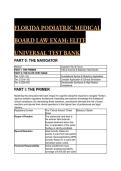
FLORIDA PODIATRIC MEDICAL
BOARD LAW EXAM: ELITE
UNIVERSAL TEST BANK
PART 0: THE NAVIGATOR
Section Cognitive Tier & Focus
PART I: THE PRIMER Critical Axioms & Statutory Hard Decks
PART II: THE ELITE TEST BANK
Tier 1 (Q1–15) Foundational Syntax & Statutory Application
Tier 2 (Q16–35) Complex Application & Clinical Simulation
Tier 3 (Q36–60) Grandmaster Synthesis & High-Stakes
Compliance
PART I: THE PRIMER
Mastering this exhaustive test bank forges the cognitive discipline required to navigate Florida’s
rigorous podiatric regulatory architecture, translating raw statutory knowledge into bulletproof
clinical compliance. By internalizing these scenarios, practitioners eliminate the risk of board
sanctions and elevate their clinical operations to the highest tiers of professional and legal
mastery.
Regulatory Domain The "Critical Axioms" Cheat Statutory Citation
Sheet
Scope of Practice The anatomical hard deck is
the anterior tibial tubercle.
Surgical treatment above this
line, or amputation of the entire
foot/leg, is strictly prohibited.
Record Retention Adult records: Retain for
exactly 5 years from last patient
contact. Deceased/retiring DPM
records: Retain for 2 years with
mandatory public notice.
Financial Responsibility Active practitioners must
maintain professional liability
coverage of $100,000 per claim
,Regulatory Domain The "Critical Axioms" Cheat Statutory Citation
Sheet
/ $300,000 aggregate, or an
equivalent escrow/letter of
credit.
CE Synthesis 40 hours biennially. Mandates:
2 hrs Medical Errors, 1 hr Risk
Management, 1 hr Laws/Rules,
2 hrs Controlled Substances
(DEA only), 1 hr Human
Trafficking (1st renewal).
Disciplinary & Fraud Unlicensed practice is a
3rd-degree felony. Any violation
involving fraud mandates a
strict statutory fine of $10,000
per count.
Delegation Doctrine Podiatric X-Ray Assistants and
Medical Assistants require
direct supervision. Custom
casting by an unlicensed entity
requires a DPM prescription.
PART II: THE ELITE TEST BANK
Tier 1: Foundational Syntax & Application
Q1: A Florida-licensed podiatric physician is evaluating a patient with severe diabetic
neuropathy progressing up the lower extremity. The DPM determines an amputation is required
to halt tissue necrosis. Based on the principles of F.S. 461.003, which action is the MOST
ACCURATE? A) The DPM may amputate the entire foot if the necrosis has compromised the
midtarsal joint. B) The DPM may perform surgical intervention up to the patella if life-saving
measures are required. C) The DPM may amputate the toes or parts of the foot, but amputation
of the entire foot or leg is strictly prohibited. D) The DPM must delegate any amputation
procedure to an orthopedic surgeon under recent specialty title legislation.
● The Answer: C (The DPM may amputate the toes or parts of the foot, but amputation of
the entire foot or leg is strictly prohibited.)
● Distractor Analysis:
○ A is incorrect: Regardless of necrosis severity, amputating the entire foot violates
the statutory scope of practice.
○ B is incorrect: The anatomical limit for surgical treatment is strictly the anterior tibial
tubercle; the patella is above this line.
○ D is incorrect: Senate Bill 172 restricts specialty titles (like "Orthopedic Surgeon"); it
does not force DPMs to delegate amputations that fall legally within their scope.
The Mentor's Analysis: The state legislature sets absolute physical boundaries on licensure.
When facing advancing necrosis, the immediate priority is recognizing your statutory anatomical
limits. By utilizing F.S. 461.003, you bypass the common trap of allowing clinical urgency to
override legal authority. Professional/Academic Intuition: Your license stops at the anterior
tibial tubercle and forbids total foot amputation; crossing this line is unlicensed practice
, of medicine.
Q2: A DPM is entering their first biennial license renewal cycle in Florida. Aside from the
mandatory 2 hours of prevention of medical errors and 1 hour of HIV/AIDS, what unique
Continuing Education (CE) requirement MUST be fulfilled during this initial period? A) 40 hours
of synchronous, live clinical seminars. B) Attendance at one full day of a Florida Board of
Podiatric Medicine meeting where disciplinary hearings are conducted. C) A 5-hour
jurisprudence exam administered by the Department of Health. D) 10 hours of pro bono clinical
service under the auspices of a nonprofit agency.
● The Answer: B (Attendance at one full day of a Florida Board of Podiatric Medicine
meeting where disciplinary hearings are conducted.)
● Distractor Analysis:
○ A is incorrect: 40 hours is the standard biennial requirement, but it is not unique to
the first biennium, nor must it all be synchronous.
○ C is incorrect: Florida does not require a secondary 5-hour jurisprudence exam for
renewal.
○ D is incorrect: Pro bono service (up to 10 hours) is an optional method to earn CE
credits, not a mandatory requirement.
The Mentor's Analysis: The Board demands new practitioners witness the consequences of
ethical failure firsthand. When entering your first renewal cycle, the immediate priority is
attending a disciplinary board meeting. By utilizing F.A.C. 64B18-17.005, you bypass the
common trap of assuming standard CE hours fulfill initial licensure obligations.
Professional/Academic Intuition: First-year compliance requires witnessing board
discipline; attend the meeting, or face the audit.
Q3: A DPM decides to close their private practice and relocate to another state. Based on the
principles of F.A.C. 64B18-15, which action regarding patient medical records is MOST
ACCURATE? A) The DPM must destroy all records immediately to comply with federal privacy
standards. B) The DPM must transfer all records directly to the Board of Podiatric Medicine. C)
The DPM must retain the records for at least 2 years and publish a notice in a local newspaper
advising patients how to obtain them. D) The DPM must retain adult records for 7 years before
initiating a transfer protocol.
● The Answer: C (The DPM must retain the records for at least 2 years and publish a
notice in a local newspaper advising patients how to obtain them.)
● Distractor Analysis:
○ A is incorrect: Immediate destruction constitutes patient abandonment and violates
state retention statutes.
○ B is incorrect: The Board does not warehouse private patient records.
○ D is incorrect: While general retention is 5 years, the specific mandate for a
terminating/relocating practice requires a minimum 2-year retention
post-termination with mandatory public notice.
The Mentor's Analysis: Practice closure does not sever your duty to patient data access.
When terminating a practice, the immediate priority is securing records and ensuring patient
notification. By utilizing F.A.C. 64B18-15.001, you bypass the common trap of abandoning
clinical data during a geographic transition. Professional/Academic Intuition: When you
leave, the data stays accessible; publish the notice and hold the files for 24 months.
Q4: A patient requests the administration of dimethyl sulfoxide (DMSO) for chronic foot pain.
The FDA has not approved DMSO for this specific disorder. Under F.S. 461.0134, what is the
DPM’s FIRST required action before administration? A) Refuse the treatment, as unapproved
FDA use is strictly prohibited by the Florida Department of Health. B) Obtain a signed, written
BOARD LAW EXAM: ELITE
UNIVERSAL TEST BANK
PART 0: THE NAVIGATOR
Section Cognitive Tier & Focus
PART I: THE PRIMER Critical Axioms & Statutory Hard Decks
PART II: THE ELITE TEST BANK
Tier 1 (Q1–15) Foundational Syntax & Statutory Application
Tier 2 (Q16–35) Complex Application & Clinical Simulation
Tier 3 (Q36–60) Grandmaster Synthesis & High-Stakes
Compliance
PART I: THE PRIMER
Mastering this exhaustive test bank forges the cognitive discipline required to navigate Florida’s
rigorous podiatric regulatory architecture, translating raw statutory knowledge into bulletproof
clinical compliance. By internalizing these scenarios, practitioners eliminate the risk of board
sanctions and elevate their clinical operations to the highest tiers of professional and legal
mastery.
Regulatory Domain The "Critical Axioms" Cheat Statutory Citation
Sheet
Scope of Practice The anatomical hard deck is
the anterior tibial tubercle.
Surgical treatment above this
line, or amputation of the entire
foot/leg, is strictly prohibited.
Record Retention Adult records: Retain for
exactly 5 years from last patient
contact. Deceased/retiring DPM
records: Retain for 2 years with
mandatory public notice.
Financial Responsibility Active practitioners must
maintain professional liability
coverage of $100,000 per claim
,Regulatory Domain The "Critical Axioms" Cheat Statutory Citation
Sheet
/ $300,000 aggregate, or an
equivalent escrow/letter of
credit.
CE Synthesis 40 hours biennially. Mandates:
2 hrs Medical Errors, 1 hr Risk
Management, 1 hr Laws/Rules,
2 hrs Controlled Substances
(DEA only), 1 hr Human
Trafficking (1st renewal).
Disciplinary & Fraud Unlicensed practice is a
3rd-degree felony. Any violation
involving fraud mandates a
strict statutory fine of $10,000
per count.
Delegation Doctrine Podiatric X-Ray Assistants and
Medical Assistants require
direct supervision. Custom
casting by an unlicensed entity
requires a DPM prescription.
PART II: THE ELITE TEST BANK
Tier 1: Foundational Syntax & Application
Q1: A Florida-licensed podiatric physician is evaluating a patient with severe diabetic
neuropathy progressing up the lower extremity. The DPM determines an amputation is required
to halt tissue necrosis. Based on the principles of F.S. 461.003, which action is the MOST
ACCURATE? A) The DPM may amputate the entire foot if the necrosis has compromised the
midtarsal joint. B) The DPM may perform surgical intervention up to the patella if life-saving
measures are required. C) The DPM may amputate the toes or parts of the foot, but amputation
of the entire foot or leg is strictly prohibited. D) The DPM must delegate any amputation
procedure to an orthopedic surgeon under recent specialty title legislation.
● The Answer: C (The DPM may amputate the toes or parts of the foot, but amputation of
the entire foot or leg is strictly prohibited.)
● Distractor Analysis:
○ A is incorrect: Regardless of necrosis severity, amputating the entire foot violates
the statutory scope of practice.
○ B is incorrect: The anatomical limit for surgical treatment is strictly the anterior tibial
tubercle; the patella is above this line.
○ D is incorrect: Senate Bill 172 restricts specialty titles (like "Orthopedic Surgeon"); it
does not force DPMs to delegate amputations that fall legally within their scope.
The Mentor's Analysis: The state legislature sets absolute physical boundaries on licensure.
When facing advancing necrosis, the immediate priority is recognizing your statutory anatomical
limits. By utilizing F.S. 461.003, you bypass the common trap of allowing clinical urgency to
override legal authority. Professional/Academic Intuition: Your license stops at the anterior
tibial tubercle and forbids total foot amputation; crossing this line is unlicensed practice
, of medicine.
Q2: A DPM is entering their first biennial license renewal cycle in Florida. Aside from the
mandatory 2 hours of prevention of medical errors and 1 hour of HIV/AIDS, what unique
Continuing Education (CE) requirement MUST be fulfilled during this initial period? A) 40 hours
of synchronous, live clinical seminars. B) Attendance at one full day of a Florida Board of
Podiatric Medicine meeting where disciplinary hearings are conducted. C) A 5-hour
jurisprudence exam administered by the Department of Health. D) 10 hours of pro bono clinical
service under the auspices of a nonprofit agency.
● The Answer: B (Attendance at one full day of a Florida Board of Podiatric Medicine
meeting where disciplinary hearings are conducted.)
● Distractor Analysis:
○ A is incorrect: 40 hours is the standard biennial requirement, but it is not unique to
the first biennium, nor must it all be synchronous.
○ C is incorrect: Florida does not require a secondary 5-hour jurisprudence exam for
renewal.
○ D is incorrect: Pro bono service (up to 10 hours) is an optional method to earn CE
credits, not a mandatory requirement.
The Mentor's Analysis: The Board demands new practitioners witness the consequences of
ethical failure firsthand. When entering your first renewal cycle, the immediate priority is
attending a disciplinary board meeting. By utilizing F.A.C. 64B18-17.005, you bypass the
common trap of assuming standard CE hours fulfill initial licensure obligations.
Professional/Academic Intuition: First-year compliance requires witnessing board
discipline; attend the meeting, or face the audit.
Q3: A DPM decides to close their private practice and relocate to another state. Based on the
principles of F.A.C. 64B18-15, which action regarding patient medical records is MOST
ACCURATE? A) The DPM must destroy all records immediately to comply with federal privacy
standards. B) The DPM must transfer all records directly to the Board of Podiatric Medicine. C)
The DPM must retain the records for at least 2 years and publish a notice in a local newspaper
advising patients how to obtain them. D) The DPM must retain adult records for 7 years before
initiating a transfer protocol.
● The Answer: C (The DPM must retain the records for at least 2 years and publish a
notice in a local newspaper advising patients how to obtain them.)
● Distractor Analysis:
○ A is incorrect: Immediate destruction constitutes patient abandonment and violates
state retention statutes.
○ B is incorrect: The Board does not warehouse private patient records.
○ D is incorrect: While general retention is 5 years, the specific mandate for a
terminating/relocating practice requires a minimum 2-year retention
post-termination with mandatory public notice.
The Mentor's Analysis: Practice closure does not sever your duty to patient data access.
When terminating a practice, the immediate priority is securing records and ensuring patient
notification. By utilizing F.A.C. 64B18-15.001, you bypass the common trap of abandoning
clinical data during a geographic transition. Professional/Academic Intuition: When you
leave, the data stays accessible; publish the notice and hold the files for 24 months.
Q4: A patient requests the administration of dimethyl sulfoxide (DMSO) for chronic foot pain.
The FDA has not approved DMSO for this specific disorder. Under F.S. 461.0134, what is the
DPM’s FIRST required action before administration? A) Refuse the treatment, as unapproved
FDA use is strictly prohibited by the Florida Department of Health. B) Obtain a signed, written


