

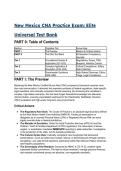
New Mexico CNA Practice Exam: Elite
Universal Test Bank
PART 0: Table of Contents
Section Cognitive Tier Focus Area
PART I The Preview Mission & Critical Axioms
PART II The Elite Test Bank 60-Question Competency
Gauntlet
Tier 1 Foundational Syntax & Regulations, Scope, TMU
Application (Q1–Q15) Blueprint, Infection Control
Tier 2 Complex Application & Cultural Competence, Safety,
Simulation (Q16–Q35) Data Collection
Tier 3 Grandmaster Synthesis High-Stakes Dilemmas, Ethics,
(Q36–Q60) Triage, Legal Compliance
PART I: The Preview
Mastering the New Mexico Certified Nurse Aide (CNA) competency framework requires more
than rote memorization; it demands the seamless synthesis of federal regulations, state-specific
legal mandates, and culturally competent clinical reasoning. By immersing the candidate in
complex, high-stakes scenarios, this test bank forges theoretical knowledge into elite-level
clinical intuition, ensuring unparalleled readiness for the Headmaster TestMaster Universe
(TMU) evaluation and high-acuity long-term care environments.
Critical Axioms
● The Regulatory Hard Deck: The Scope of Practice is an absolute legal boundary defined
by the New Mexico Health Care Authority (NMHCA). Facility job descriptions or
delegation by a Licensed Practical Nurse (LPN) or Registered Nurse (RN) can never
legally override state or federal prohibitions.
● The Mandate of Escalation: Under the Adult Protective Services (APS) Act and the
Children, Youth & Families Department (CYFD) regulations, the observation of abuse,
neglect, or exploitation mandates IMMEDIATE reporting to state authorities. Investigation
is the jurisdiction of the state, not the bedside practitioner.
● The Cultural Syntax Rule: Culturally competent care recognizes that behavioral
presentations—such as indirect eye contact, silence, or describing pain through narrative
storytelling—are valid clinical baselines, particularly within New Mexico's Native American
and Hispanic populations.
● The Sovereignty of the Resident: Governed by NMAC 8.370.14.33, resident rights
supersede facility convenience. The right to refuse treatment, manage personal finances,
and maintain unhindered privacy are absolute, non-negotiable standards.
,Headmaster TMU Knowledge Exam: Content Weighting
To mathematically conquer the exam, candidates must prioritize high-yield domains. The current
blueprint relies on the following distribution :
Domain / Subject Area Question Count Core Objective
Basic Nursing Skills 6 Execution of foundational
physical care ADLs.
Safety 6 Fall prevention, environmental
hazards, fire protocols.
Infection Control 6 Pathogen interruption, PPE
usage, isolation protocols.
Communication 6 Verbal, non-verbal, and cultural
communication competency.
Role & Responsibility 6 Scope of practice, legal
limitations, ethical mandates.
Resident Rights 6 NMAC 8.370.14.33 compliance
and patient autonomy.
Disease Process 5 Pathology, presentation, and
symptom monitoring.
Data Collection 4 Vital signs, intake/output
conversions, height/weight.
PART II: THE ELITE TEST BANK
Tier 1: Foundational Syntax & Application (Questions 1–15)
Q1: Under New Mexico Administrative Code (NMAC 8.370.25), an individual listed on the
Employee Abuse Registry for a substantiated finding wishes to petition the New Mexico Health
Care Authority for removal. Which condition MUST be met for this petition to be legally
considered? A) The finding was for physical abuse, and the individual has completed
state-mandated anger management training. B) The finding was for financial exploitation of an
amount less than $100. C) The finding was for neglect, and a minimum of one year has elapsed
since the placement on the registry. D) The finding was for verbal abuse, and the facility
administrator has provided a written waiver.
● The Answer: C (The finding was for neglect, and a minimum of one year has elapsed
since the placement on the registry.)
● Distractor Analysis:
○ A is incorrect: Petitions for removal are strictly prohibited for findings of physical or
verbal abuse.
○ B is incorrect: Financial exploitation permanently disqualifies a candidate from
removal petition eligibility regardless of the monetary value.
○ D is incorrect: Facility administrators possess no legal authority to waive state
registry findings.
The Mentor's Analysis: Accountability in long-term care relies on permanent safeguards
against malicious intent. When navigating the Employee Abuse Registry, the immediate priority
is understanding that intentional harm is unforgivable under the law. By utilizing NMAC
, 8.370.25, the practitioner bypasses the common trap of assuming all registry placements are
temporary. Professional/Academic Intuition: Neglect may allow for rehabilitation after one
year; intentional abuse and exploitation are permanent.
Q2: A practitioner is caring for a Native American resident in a New Mexico facility. During the
intake assessment, the resident consistently avoids direct eye contact and maintains long
periods of silence before answering questions. Based on culturally competent care standards,
which conclusion is the MOST ACCURATE? A) The resident is demonstrating cognitive decline
and requires a dementia screening. B) The resident is exhibiting passive-aggressive resistance
to the admission process. C) The resident is utilizing silence to gather thoughts and avoiding
eye contact as a traditional sign of respect. D) The resident is experiencing acute auditory
hallucinations and is distracted.
● The Answer: C (The resident is utilizing silence to gather thoughts and avoiding eye
contact as a traditional sign of respect.)
● Distractor Analysis:
○ A is incorrect: Misinterpreting cultural norms as cognitive deficits leads to
inappropriate and harmful clinical pathways.
○ B is incorrect: Assuming resistance ignores the established cultural reality of Native
American communication styles.
○ D is incorrect: There is zero objective clinical data in the scenario suggesting
psychosis.
The Mentor's Analysis: Effective care requires interpreting behavior through the patient's
cultural lens, not the practitioner's dominant societal norm. When evaluating communication
styles, the immediate priority is establishing a culturally safe baseline. By utilizing cultural
awareness, the practitioner bypasses the common trap of pathologizing respect and
thoughtfulness. Professional/Academic Intuition: In many Native American traditions,
silence is processing, and lowered eyes signify profound respect.
Q3: Based on the New Mexico "Duty to Report Child Abuse and Child Neglect" law (32A-4-3), if
a CNA working in pediatric home health has a reasonable suspicion of abuse, what is the
IMMEDIATE legal requirement? A) Conduct a preliminary interview with the parents to verify the
suspicion before taking action. B) Wait 24 hours to observe if the abusive behavior repeats to
ensure the report is accurate. C) Report the matter immediately to the CYFD Statewide Central
Intake hotline or law enforcement. D) Document the suspicion in the clinical notes and rely on
the supervising RN to file the report.
● The Answer: C (Report the matter immediately to the CYFD Statewide Central Intake
hotline or law enforcement.)
● Distractor Analysis:
○ A is incorrect: Confronting suspected abusers places the child in immediate,
escalated danger and compromises state investigations.
○ B is incorrect: Waiting violates the explicit statutory mandate for immediate
reporting.
○ D is incorrect: Mandatory reporting is an individual legal burden; relying on a
supervisor to report is a misdemeanor offense.
The Mentor's Analysis: The law demands action over hierarchy. When encountering pediatric
abuse, the immediate priority is alerting state protective apparatuses to secure the victim. By
utilizing direct reporting protocols, the practitioner bypasses the common trap of assuming the
chain of command relieves them of legal liability. Professional/Academic Intuition: Suspicion
mandates immediate reporting; absolute proof is not the practitioner's burden.
Q4: A Hispanic resident's family expresses concern that the resident is suffering from susto
Universal Test Bank
PART 0: Table of Contents
Section Cognitive Tier Focus Area
PART I The Preview Mission & Critical Axioms
PART II The Elite Test Bank 60-Question Competency
Gauntlet
Tier 1 Foundational Syntax & Regulations, Scope, TMU
Application (Q1–Q15) Blueprint, Infection Control
Tier 2 Complex Application & Cultural Competence, Safety,
Simulation (Q16–Q35) Data Collection
Tier 3 Grandmaster Synthesis High-Stakes Dilemmas, Ethics,
(Q36–Q60) Triage, Legal Compliance
PART I: The Preview
Mastering the New Mexico Certified Nurse Aide (CNA) competency framework requires more
than rote memorization; it demands the seamless synthesis of federal regulations, state-specific
legal mandates, and culturally competent clinical reasoning. By immersing the candidate in
complex, high-stakes scenarios, this test bank forges theoretical knowledge into elite-level
clinical intuition, ensuring unparalleled readiness for the Headmaster TestMaster Universe
(TMU) evaluation and high-acuity long-term care environments.
Critical Axioms
● The Regulatory Hard Deck: The Scope of Practice is an absolute legal boundary defined
by the New Mexico Health Care Authority (NMHCA). Facility job descriptions or
delegation by a Licensed Practical Nurse (LPN) or Registered Nurse (RN) can never
legally override state or federal prohibitions.
● The Mandate of Escalation: Under the Adult Protective Services (APS) Act and the
Children, Youth & Families Department (CYFD) regulations, the observation of abuse,
neglect, or exploitation mandates IMMEDIATE reporting to state authorities. Investigation
is the jurisdiction of the state, not the bedside practitioner.
● The Cultural Syntax Rule: Culturally competent care recognizes that behavioral
presentations—such as indirect eye contact, silence, or describing pain through narrative
storytelling—are valid clinical baselines, particularly within New Mexico's Native American
and Hispanic populations.
● The Sovereignty of the Resident: Governed by NMAC 8.370.14.33, resident rights
supersede facility convenience. The right to refuse treatment, manage personal finances,
and maintain unhindered privacy are absolute, non-negotiable standards.
,Headmaster TMU Knowledge Exam: Content Weighting
To mathematically conquer the exam, candidates must prioritize high-yield domains. The current
blueprint relies on the following distribution :
Domain / Subject Area Question Count Core Objective
Basic Nursing Skills 6 Execution of foundational
physical care ADLs.
Safety 6 Fall prevention, environmental
hazards, fire protocols.
Infection Control 6 Pathogen interruption, PPE
usage, isolation protocols.
Communication 6 Verbal, non-verbal, and cultural
communication competency.
Role & Responsibility 6 Scope of practice, legal
limitations, ethical mandates.
Resident Rights 6 NMAC 8.370.14.33 compliance
and patient autonomy.
Disease Process 5 Pathology, presentation, and
symptom monitoring.
Data Collection 4 Vital signs, intake/output
conversions, height/weight.
PART II: THE ELITE TEST BANK
Tier 1: Foundational Syntax & Application (Questions 1–15)
Q1: Under New Mexico Administrative Code (NMAC 8.370.25), an individual listed on the
Employee Abuse Registry for a substantiated finding wishes to petition the New Mexico Health
Care Authority for removal. Which condition MUST be met for this petition to be legally
considered? A) The finding was for physical abuse, and the individual has completed
state-mandated anger management training. B) The finding was for financial exploitation of an
amount less than $100. C) The finding was for neglect, and a minimum of one year has elapsed
since the placement on the registry. D) The finding was for verbal abuse, and the facility
administrator has provided a written waiver.
● The Answer: C (The finding was for neglect, and a minimum of one year has elapsed
since the placement on the registry.)
● Distractor Analysis:
○ A is incorrect: Petitions for removal are strictly prohibited for findings of physical or
verbal abuse.
○ B is incorrect: Financial exploitation permanently disqualifies a candidate from
removal petition eligibility regardless of the monetary value.
○ D is incorrect: Facility administrators possess no legal authority to waive state
registry findings.
The Mentor's Analysis: Accountability in long-term care relies on permanent safeguards
against malicious intent. When navigating the Employee Abuse Registry, the immediate priority
is understanding that intentional harm is unforgivable under the law. By utilizing NMAC
, 8.370.25, the practitioner bypasses the common trap of assuming all registry placements are
temporary. Professional/Academic Intuition: Neglect may allow for rehabilitation after one
year; intentional abuse and exploitation are permanent.
Q2: A practitioner is caring for a Native American resident in a New Mexico facility. During the
intake assessment, the resident consistently avoids direct eye contact and maintains long
periods of silence before answering questions. Based on culturally competent care standards,
which conclusion is the MOST ACCURATE? A) The resident is demonstrating cognitive decline
and requires a dementia screening. B) The resident is exhibiting passive-aggressive resistance
to the admission process. C) The resident is utilizing silence to gather thoughts and avoiding
eye contact as a traditional sign of respect. D) The resident is experiencing acute auditory
hallucinations and is distracted.
● The Answer: C (The resident is utilizing silence to gather thoughts and avoiding eye
contact as a traditional sign of respect.)
● Distractor Analysis:
○ A is incorrect: Misinterpreting cultural norms as cognitive deficits leads to
inappropriate and harmful clinical pathways.
○ B is incorrect: Assuming resistance ignores the established cultural reality of Native
American communication styles.
○ D is incorrect: There is zero objective clinical data in the scenario suggesting
psychosis.
The Mentor's Analysis: Effective care requires interpreting behavior through the patient's
cultural lens, not the practitioner's dominant societal norm. When evaluating communication
styles, the immediate priority is establishing a culturally safe baseline. By utilizing cultural
awareness, the practitioner bypasses the common trap of pathologizing respect and
thoughtfulness. Professional/Academic Intuition: In many Native American traditions,
silence is processing, and lowered eyes signify profound respect.
Q3: Based on the New Mexico "Duty to Report Child Abuse and Child Neglect" law (32A-4-3), if
a CNA working in pediatric home health has a reasonable suspicion of abuse, what is the
IMMEDIATE legal requirement? A) Conduct a preliminary interview with the parents to verify the
suspicion before taking action. B) Wait 24 hours to observe if the abusive behavior repeats to
ensure the report is accurate. C) Report the matter immediately to the CYFD Statewide Central
Intake hotline or law enforcement. D) Document the suspicion in the clinical notes and rely on
the supervising RN to file the report.
● The Answer: C (Report the matter immediately to the CYFD Statewide Central Intake
hotline or law enforcement.)
● Distractor Analysis:
○ A is incorrect: Confronting suspected abusers places the child in immediate,
escalated danger and compromises state investigations.
○ B is incorrect: Waiting violates the explicit statutory mandate for immediate
reporting.
○ D is incorrect: Mandatory reporting is an individual legal burden; relying on a
supervisor to report is a misdemeanor offense.
The Mentor's Analysis: The law demands action over hierarchy. When encountering pediatric
abuse, the immediate priority is alerting state protective apparatuses to secure the victim. By
utilizing direct reporting protocols, the practitioner bypasses the common trap of assuming the
chain of command relieves them of legal liability. Professional/Academic Intuition: Suspicion
mandates immediate reporting; absolute proof is not the practitioner's burden.
Q4: A Hispanic resident's family expresses concern that the resident is suffering from susto


